

Over the years, I have learned that when a company says, “Our process is inefficient,” the real problem is rarely just one process.
Usually, the issue is much bigger.
A delay in purchasing can affect manufacturing. A manufacturing problem can affect inventory. Inventory problems can affect customers. Poor communication between departments can create additional work, while outdated technology can make an already complicated process even harder to manage.
This is why I believe Business Process Redesign Consulting should begin by looking at the business as a connected system rather than trying to fix individual problems one at a time.

The First Question I Ask: Why Does the Process Work This Way?
One of the biggest mistakes I see companies make is assuming that the current process is the best process simply because it has been in place for years.
Processes evolve.
Someone adds an approval because of an old problem. Another department creates a spreadsheet because information is not available in the existing system. A new employee is given a manual workaround because the official procedure is too slow.
Individually, these decisions may make sense.
Eventually, however, the organization can end up with a process containing unnecessary approvals, duplicated work, manual handoffs, and disconnected information.
My first objective in a redesign project is therefore to understand why the process works the way it does today.
I Look at People, Process, and Technology Together
I have found that it is difficult to redesign a business process successfully by looking only at the workflow.
People matter.
Technology matters.
Organizational structure matters.
And, most importantly, the process needs to support the company's strategic objectives.
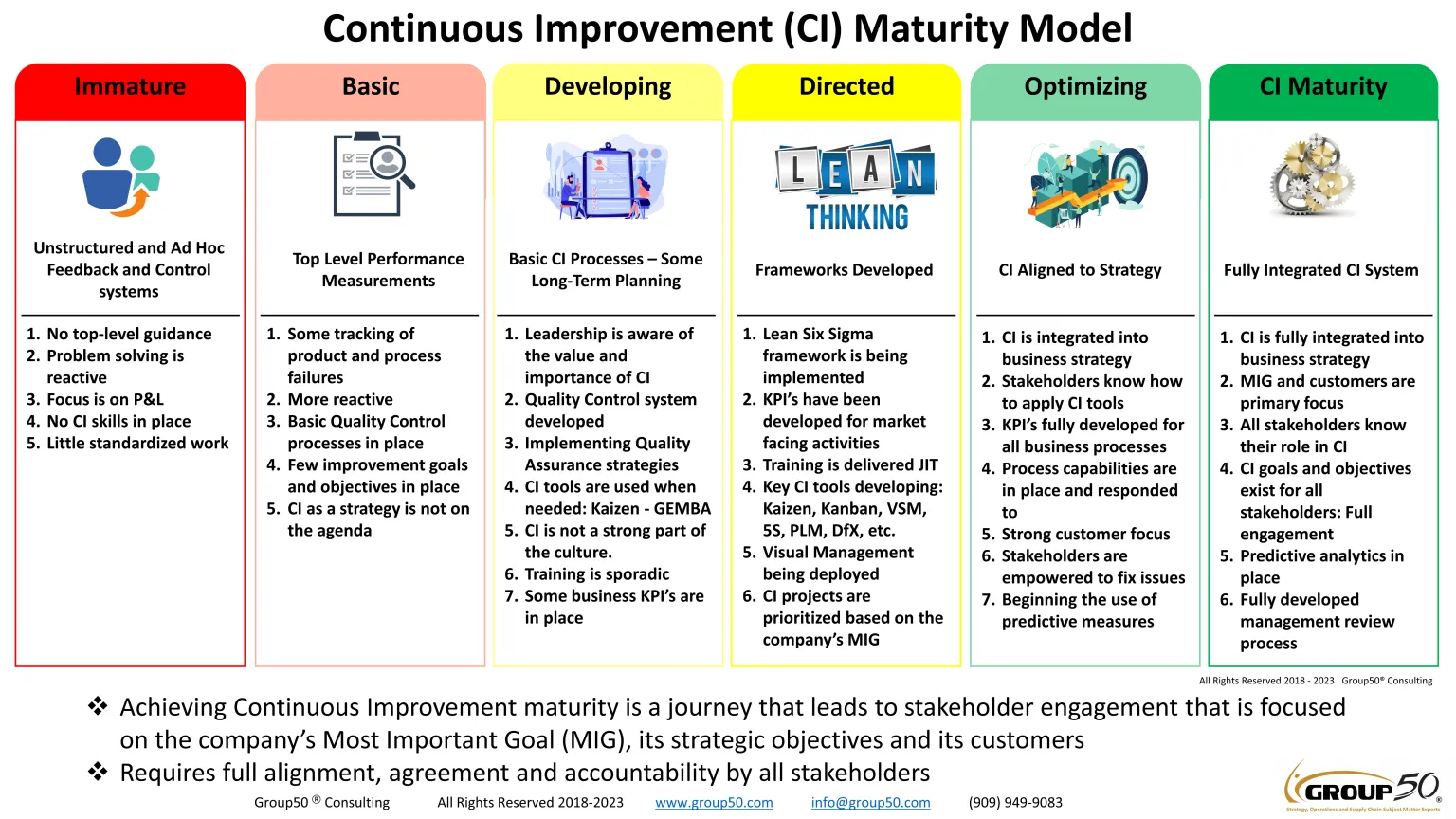
Group50's approach to business optimization focuses on the intersection of people, processes, information technology, and automation. Its consultants use assessments, cross-functional workshops, implementation roadmaps, value stream mapping, continuous improvement, and business process reengineering to identify and address strategic, operational, and organizational gaps.
That integrated perspective is important because a process can look efficient on paper while still creating problems for the people responsible for executing it.
One Department's Improvement Can Become Another Department's Problem
I have seen this happen repeatedly.
A department improves its own performance metric, but the overall business does not improve.
Why?
Because the process crosses departmental boundaries.
For example, purchasing may optimize order quantities to reduce its workload. Manufacturing may want smaller and more frequent deliveries. Finance may want tighter controls. Sales may need faster customer fulfillment.
Every department can have a legitimate objective, but optimizing each department independently does not necessarily optimize the entire value stream.
That is why I prefer to map the complete process.
Value Stream Mapping Changes the Conversation
When people describe a process in a meeting, everyone often has a different version of what actually happens.
A value stream map makes the process visible.
It helps the team see where work begins, where information moves, where materials move, where decisions are made, and where work waits.
More importantly, it creates a common language.
Instead of saying, “Purchasing always causes the delay,” the team can ask:
Where exactly does the delay occur, and what causes it?
That shift from blame to analysis can completely change the improvement conversation.
Group50 incorporates Value Stream Mapping among the tools it uses to understand and optimize business processes and supply chains.
I Do Not Believe in Redesigning Processes Just to Make Them Look Better
A redesigned process should accomplish something meaningful.
It might reduce cycle time.
It might improve customer service.
It might reduce operating costs.
It might improve decision-making.
It might eliminate unnecessary work.
Or it might allow the organization to scale without adding the same level of complexity.
The process should ultimately connect to measurable business performance.
This is why I believe process redesign needs to remain connected to strategy and financial performance. Group50's approach explicitly considers the strategic relevance and financial performance of processes alongside operational and organizational performance.
Technology Is an Enabler, Not the Starting Point
Another lesson I have learned is that companies sometimes try to solve process problems by buying technology.
That can be a mistake.
If a process is unnecessarily complicated, automating it does not necessarily make it better.
It may simply allow the organization to perform a bad process faster.
I prefer to understand and redesign the workflow first.
Once the future-state process is clear, technology can be evaluated as an enabler.
This approach is particularly important when companies are considering ERP systems, automation, digital transformation, or other technology investments.
The People Performing the Work Know More Than the Process Map
One of the most valuable sources of information during process redesign is the employee who performs the process every day.
Executives may understand the desired outcome.
Managers may understand the performance metrics.
But employees often know exactly where the process breaks down.
They know which approval takes too long.
They know which report has to be recreated manually.
They know which system does not communicate with another system.
They know which step exists only because “that's the way we have always done it.”
That knowledge should be part of the redesign process.
Cross-functional workshops can bring these perspectives together and help create practical implementation roadmaps.
Redesign Is Only Half the Job
I have never considered a process redesign complete when the future-state diagram is finished.
That is where the real work begins.
People need to understand the new process.
Responsibilities need to be clear.
Performance measures need to be established.
Technology may need to change.
Managers need to reinforce the new behaviors.
And leadership needs to monitor whether the redesigned process is actually producing the expected results.
Group50 describes its consultants as working with clients through the process reengineering and optimization process, with additional support available through training, project management, and workshops.
When I Would Recommend Business Process Redesign
I would consider redesign when a company is experiencing:
Persistent process delays
Excessive manual work
Duplicate activities
Too many approvals
Poor communication between departments
High levels of rework
Increasing operating costs
Customer-service problems
Growth that existing processes cannot support
Major organizational or technology changes
I would especially recommend looking at the process when employees are spending more time working around the system than working within it.
That is usually a warning sign.
My Biggest Takeaway
The biggest lesson I have learned is simple:
Do not redesign a process just because it is old. Redesign it because it is preventing the business from achieving something important.
The objective should never be a prettier process map.
The objective should be better business performance.
That means understanding the current state, involving the people who actually perform the work, identifying waste and bottlenecks, evaluating technology, designing a practical future state, and then implementing the changes.
For manufacturing and distribution organizations, this broader approach can connect business process redesign with supply chain optimization, continuous improvement, organizational development, technology, and strategic execution. Group50's consulting model is built around this type of integrated business optimization.
Ultimately, successful Business Process Redesign Consulting is not about changing processes for the sake of change.
It is about creating an organization that can make decisions faster, serve customers better, operate more efficiently, and execute its strategy more effectively.
























Sign in to leave a comment.