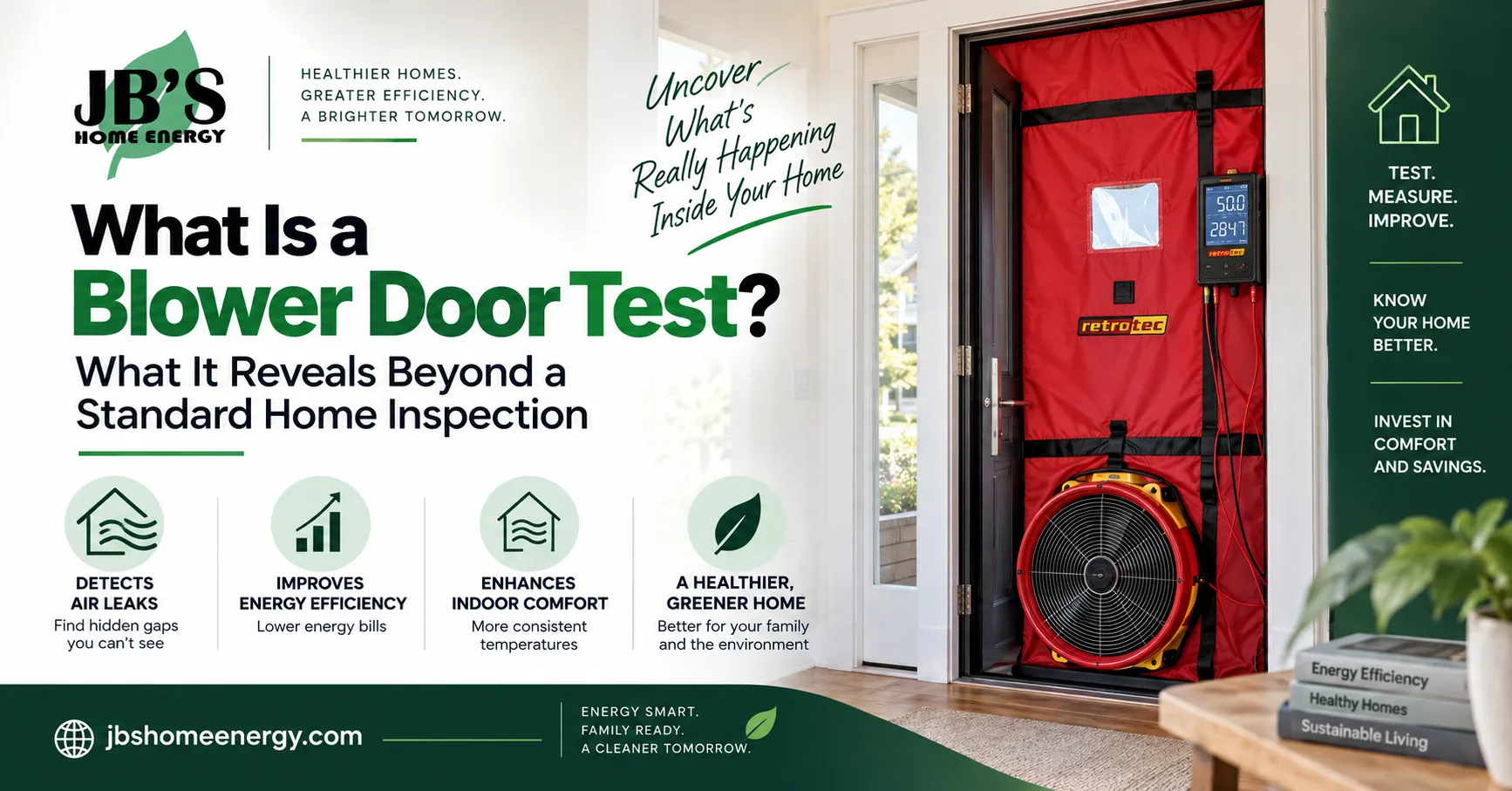

A home can look properly finished and still have air leakage that affects comfort, energy performance, and code compliance. That is where the difference between a standard inspection and blower door testing becomes important.
A standard inspection primarily examines visible and accessible conditions. A blower door test measures how tightly the building envelope contains air and helps reveal leakage paths that may not be obvious during a visual inspection.
A Home Inspection Looks at Conditions. A Blower Door Test Measures Performance.
The two approaches answer different questions.
| Standard Home Inspection | Blower Door Test |
| What can be observed or accessed? | What amount of air is leaking through the building envelope? |
| Are visible components in acceptable condition? | How airtight is the home under controlled pressure? |
| Are there obvious defects? | Where are significant leakage pathways? |
| Does a component appear properly installed? | Does the completed envelope perform as intended? |
That does not make one test a replacement for the other. They provide different types of information.
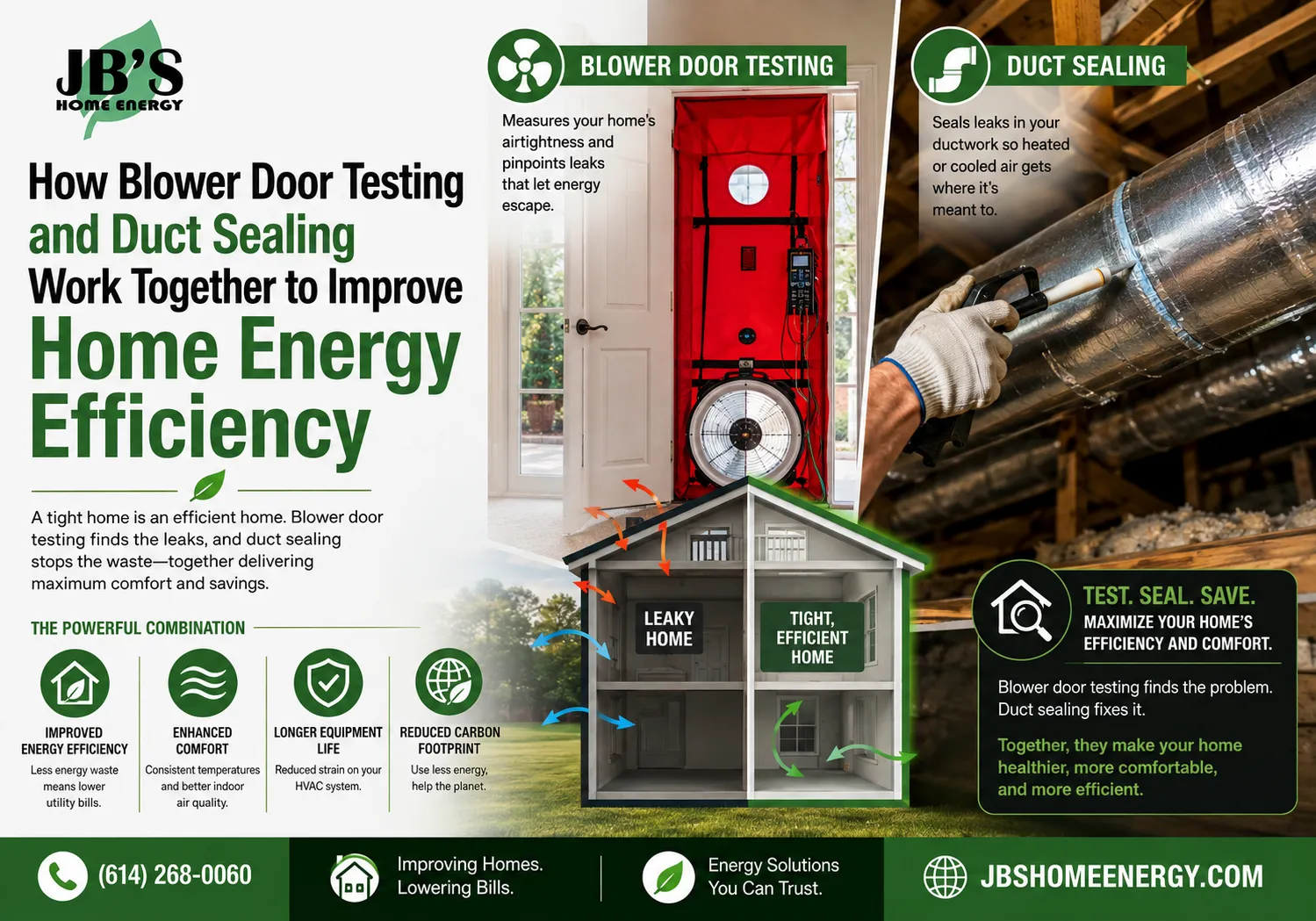
A blower door testing Michigan uses a calibrated fan installed in an exterior doorway to create a controlled pressure difference. The airflow needed to maintain that pressure provides a standardized measure of enclosure leakage, commonly reported as CFM50 and, when combined with building volume, ACH50.
What the Test Can Reveal Behind the Finished Surfaces
Air can move through surprisingly small openings around the building envelope. A visual inspection may not show how much uncontrolled air is moving through those areas.
During blower door testing, pressure makes leakage easier to detect. Depending on the investigation, technicians can use smoke or other diagnostic methods to help identify locations around areas such as windows, doors, electrical penetrations, baseboards, and other envelope connections.
For a builder, this creates a practical advantage. Instead of simply knowing that a home has an air-sealing issue, testing can provide measurable evidence of the home's overall airtightness and help direct attention toward areas that need correction.
Why the Blower Door Number Matters to Builders
A visible gap is not the same thing as a quantified building-performance problem.
The blower door result provides a standardized measurement that can be compared with applicable project requirements. PNNL's Building America Solution Center identifies enclosure leakage testing as both a diagnostic and code-compliance tool, with many energy programs and codes using standardized leakage measurements.
This makes blower door testing projects particularly relevant when builders need to verify that air-sealing work meets applicable requirements rather than relying solely on visual checks.
The same principle applies when contractors are working in other markets. Blower door testing projects in Massachusetts may require attention to applicable residential energy-code requirements, while blower door testing Massachusetts can support broader building-performance and energy-efficiency goals.
What Happens During the Test?
The process is more controlled than simply looking for drafts.
A typical enclosure leakage test involves installing a calibrated fan in an exterior doorway, measuring baseline conditions, and creating a pressure difference between the home and outdoors. The amount of airflow required to maintain the test pressure is recorded as the leakage measurement.
| Test Finding | What It Can Mean |
| Higher measured leakage | More uncontrolled air movement through the envelope |
| Localized airflow during testing | A potential leakage pathway requiring investigation |
| Improved result after sealing | Evidence that corrective work reduced measured leakage |
| Unexpected leakage location | An opportunity to inspect construction details that may have been missed |
The test therefore provides something a visual inspection generally cannot: a performance measurement under controlled conditions.
When Should a Builder Schedule Blower Door Testing?
Timing matters.
For new construction, testing after major air-sealing work can help identify problems while corrective work is still practical. Testing again after repairs can help verify whether the work improved the measured result.
This approach is valuable because a problem discovered late in construction can be more expensive and disruptive to correct.
JB's Home Energy provides blower door testing Ohio as part of its energy-performance and code-compliance services for Michigan builders and contractors. Its Michigan service page specifically identifies blower door testing and air sealing as services used for new-construction energy efficiency and compliance.
Why Testing Is More Useful Than Guessing
If a home has drafts, uneven comfort, or an unexpected energy-performance result, it can be tempting to blame insulation or HVAC equipment first.
A blower door test can establish whether the building envelope itself is contributing to the problem.
That makes testing useful not only for identifying leakage, but also for verifying corrective work. PNNL notes that enclosure leakage testing can be used to identify areas requiring air-tightening and to verify the correction of leakage problems.
For builders and contractors, that distinction matters. A standard inspection can identify observable construction conditions. Blower door testing provides measurable evidence of envelope airtightness.
If your Michigan project needs airtightness verification, energy-code testing, or help identifying air-leakage problems, JB's Home Energy can help determine which testing services fit the project. Request an estimate to discuss your requirements.
FAQ
Is a blower door test noisy?
The calibrated fan produces noticeable airflow noise during testing, but the test itself is generally brief.
Does a blower door test check the HVAC system?
No. A blower door test evaluates the building envelope's airtightness. Duct leakage requires separate testing and should not be confused with envelope leakage.
Can a blower door test be done on an occupied home?
Yes, provided the home can be prepared according to the applicable testing procedure and safety requirements.




















Sign in to leave a comment.