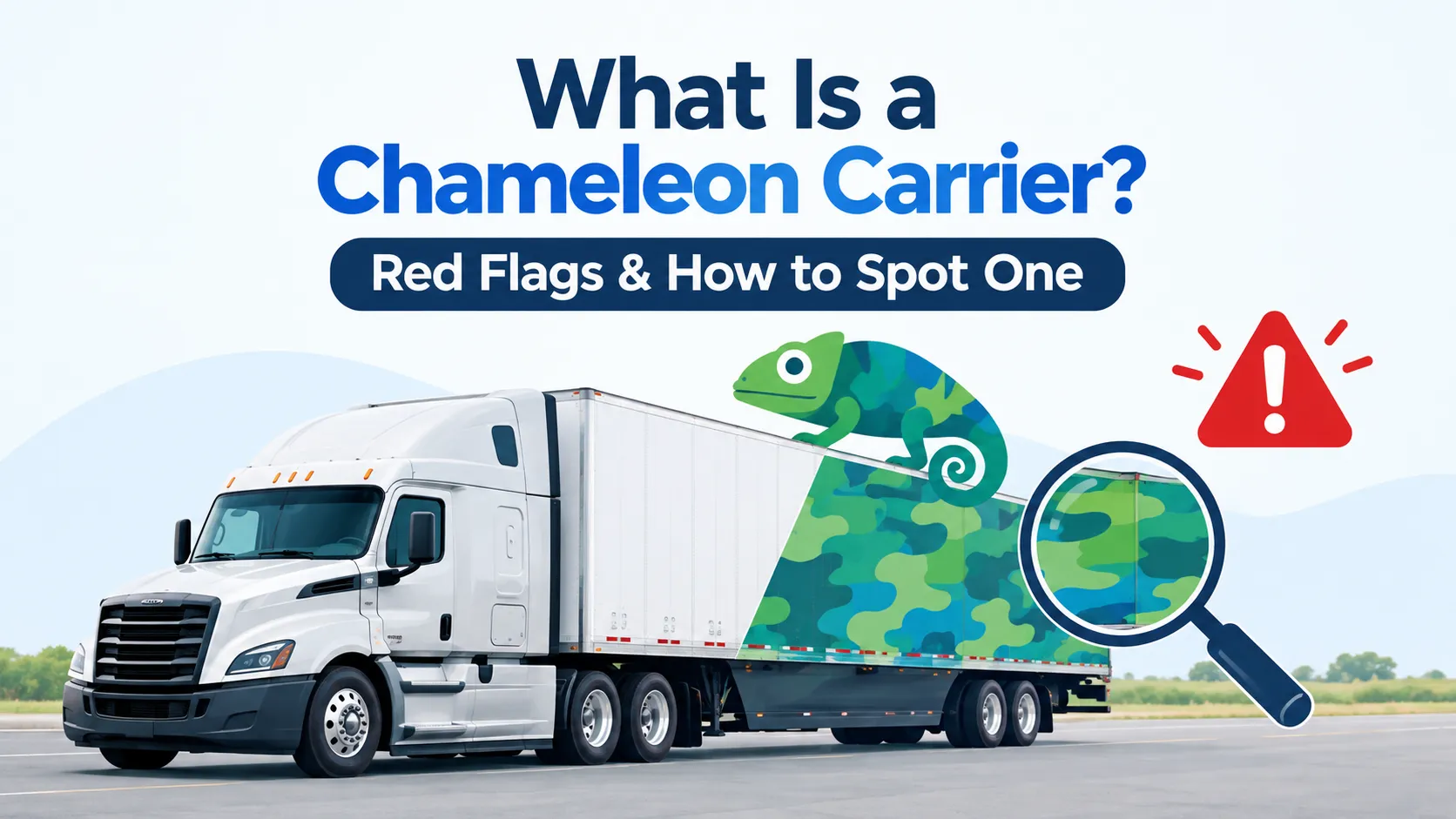

If you've spent any real time around freight brokerage, trucking compliance, or carrier vetting, you've probably heard the term "chameleon carrier" come up in a somewhat hushed, cautionary tone. It's one of those industry problems that doesn't get discussed enough outside of safety circles, even though it directly affects brokers, shippers, and honest carriers who compete against companies gaming the system.

This article explains exactly what a chameleon carrier is, why the practice exists, and how to spot the warning signs before you end up doing business with one. Since this entire issue revolves around companies hiding behind new registrations, understanding how to run a proper DOT Number Lookup is essential groundwork before we get into the red flags themselves.
Tools like Carrier90 were built partly to help with exactly this kind of research, since spotting a chameleon carrier usually requires cross-referencing several pieces of information rather than relying on a single search. An MC Number Lookup is often the second identifier you'll need, since chameleon carriers frequently shuffle both DOT and MC numbers when they re-register under a new identity.
We'll also look closely at how CSA Score history plays into this pattern, since the entire point of a chameleon carrier is usually to escape a poor safety record. For a deeper, dedicated breakdown beyond what we cover here, our full guide on Chameleon Carriers goes into additional case patterns and enforcement history.
By the end of this piece, you'll have a practical checklist for identifying these companies before you sign a contract, hire a driver, or hand off a load. Let's start with the basic definition, because understanding the mechanics makes the red flags much easier to recognize later.
Defining a Chameleon Carrier
A chameleon carrier is a trucking company that ceases operations under one legal identity, typically after accumulating a poor safety record, unpaid fines, or regulatory violations, and then re-registers as a "new" company to continue operating with a clean slate. On paper, the new entity looks completely unrelated to the old one, but in practice it often involves the same owners, the same trucks, the same drivers, or some combination of all three.
The term comes from the obvious comparison to an actual chameleon changing its appearance to blend into a new environment. In this case, the "new environment" is a fresh USDOT number, free of the violations, crashes, and CSA percentile history that made the previous entity a liability.
This practice isn't just a minor loophole. It directly undermines the entire purpose of the Federal Motor Carrier Safety Administration's safety monitoring system, since the whole point of tracking violations over time is to identify carriers that pose an ongoing risk.
Why This Practice Exists in the First Place
The core incentive behind chameleon carrier behavior is straightforward: a bad safety record has real financial consequences. Carriers with high CSA percentiles in categories like Unsafe Driving or Vehicle Maintenance often struggle to get approved by brokers, face higher insurance premiums, and risk increased scrutiny from FMCSA, including audits and potential out-of-service orders.
Rather than doing the harder work of fixing underlying safety problems, some carrier operators find it easier to simply shut down and start over under a new name. Since registering a new motor carrier with FMCSA doesn't require an extensive vetting process upfront, a company can often complete this transition in a matter of weeks.
This creates a frustrating asymmetry in the industry. Carriers that invest in proper maintenance, training, and compliance are competing against companies that periodically wipe their record clean rather than addressing the actual causes of their poor performance.
Common Triggers That Lead to a Chameleon Registration
Understanding what typically pushes a carrier toward this behavior helps explain the patterns you'll want to watch for later. A carrier facing an imminent FMCSA safety audit, particularly one likely to result in a Conditional or Unsatisfactory rating, has a strong incentive to shut down before that rating becomes official.
Similarly, a carrier that has accumulated enough violations to push several BASIC categories above intervention thresholds may choose to re-register rather than deal with the increased inspection frequency and scrutiny that comes with those thresholds. Unpaid civil penalties or outstanding fines from FMCSA enforcement actions are another common trigger, since starting fresh under a new entity can sometimes let operators avoid these financial obligations entirely.
In some cases, the trigger is less about safety and more about avoiding a canceled insurance policy after too many claims. Whatever the specific reason, the underlying pattern is usually the same: something made the old identity a liability, so the operator manufactured a new one.
How FMCSA Attempts to Detect This Pattern
FMCSA has become increasingly sophisticated about identifying chameleon carriers, though the practice hasn't been eliminated entirely. One of the primary detection methods involves cross-referencing company officers and registered agents listed on new applications against those tied to previously revoked or shut-down carriers.
Physical addresses are another key data point, since chameleon carriers often reuse the same warehouse, terminal, or even residential address as their previous entity, simply because it's the actual location where their trucks are parked. FMCSA also looks at equipment identifiers, such as vehicle identification numbers, that might match trucks previously registered under a different DOT number.
Despite these efforts, detection isn't perfect, particularly when operators take deliberate steps to obscure the connection, such as using a relative's name on the new registration or leasing different equipment temporarily. This is exactly why independent verification through your own dot number lookup by name search remains valuable, even when you're relying on FMCSA's own enforcement systems in the background.
Red Flag #1: A Suspiciously Short Operating History With Claims of Experience
One of the clearest warning signs is a mismatch between a carrier's actual registration date and the experience they claim to have. If a company's DOT number was issued only a few months ago, but the person you're speaking with talks about "twenty years in the business," that gap deserves an explanation.
This doesn't automatically mean something is wrong, since legitimate reasons exist for restructuring a business or launching under a new entity. But it's exactly the kind of detail that should prompt a closer usdot number lookup and a comparison against any previously known company names associated with the same owners or address.
Newer legitimate carriers usually don't mind explaining their business history, including any previous entities they operated under. Evasiveness or vague answers about why a "new" company exists is often more telling than the short history itself.
Red Flag #2: An Almost Empty CSA Profile Paired With Fleet Size That Doesn't Match
A brand-new carrier showing "insufficient data" across most BASIC categories is completely normal and expected, since FMCSA requires a minimum number of inspections before generating reliable percentiles. What's less normal is a newly registered carrier claiming a large, established fleet size that doesn't match the very limited inspection history on file.
If a company says they operate fifty trucks but their CSA profile shows only a handful of inspections total since registration, that's a mismatch worth investigating further. Established fleets of that size typically accumulate inspections at a rate that would show up clearly in the data within their first several months of active operation.
This is one area where checking a carrier's profile against industry norms for similarly sized operations can be genuinely useful. Comparing patterns against Largest Fleets can help you understand what a realistic inspection volume looks like for a fleet of a given size, which makes anomalies easier to spot.
Red Flag #3: Overlapping Officers, Addresses, or Contact Information
This is one of the most direct signals available, and it's exactly what FMCSA's own detection systems focus on as well. If a quick search of the carrier's registered officers turns up a name connected to a previously revoked or shut-down company, that connection is worth taking seriously.
The same logic applies to physical addresses, phone numbers, and even email domains listed on the registration. Chameleon carriers frequently reuse this kind of contact information because changing an actual business location or phone line is more disruptive than filing new paperwork with FMCSA.
Running a carrier lookup that includes historical registration data, rather than just the current snapshot, makes these overlaps far easier to catch. A single shared detail might be coincidental, but multiple overlapping data points paired with a short operating history is a pattern that shouldn't be ignored.
Red Flag #4: A Previous Entity That Shut Down Right Before Serious Enforcement Action
If you can trace a connection between a new carrier and a previous entity, the next step is checking what happened to that previous company right before it went inactive. A carrier that voluntarily surrendered its operating authority shortly before a scheduled compliance review, or right after accumulating several BASICs above intervention thresholds, fits the classic chameleon pattern closely.
This timing detail matters because legitimate business closures happen for all sorts of unrelated reasons, including retirement, financial difficulty unrelated to safety, or a simple change in career direction. A closure that lines up suspiciously well with an impending audit or enforcement action is a much stronger signal than a closure alone.
FMCSA's SAFER system and inspection history records can help establish this timeline, showing when a previous entity's authority was revoked or surrendered relative to their last recorded violations. Piecing this timeline together takes a bit more effort than a single search, but it's often the clearest evidence of intentional evasion.
Red Flag #5: Insurance Gaps or Rapid Insurance Provider Changes
Checking fmcsa licensing and insurance status can reveal another useful pattern, since chameleon carriers sometimes struggle to maintain consistent insurance coverage across their various identities. Insurance companies that have paid out significant claims on a carrier's previous policy are often reluctant to reinsure that same operation, even under a new business name, once they identify the connection.
This can result in a pattern of frequent insurance provider changes, gaps in coverage, or policies with unusually high premiums relative to the carrier's stated fleet size. Reviewing licensing and insurance fmcsa records over time, rather than just the current snapshot, can reveal these gaps clearly.
A single insurance change isn't inherently suspicious, since carriers switch providers for competitive pricing reasons all the time. But frequent changes combined with other red flags on this list add meaningfully to the overall picture.
Red Flag #6: Equipment That Traces Back to a Previous Carrier
Trucks and trailers have identifying information, including VIN numbers, that can sometimes be cross-referenced against previous registrations, inspection records, or even accident reports. If a "new" carrier's equipment shows up in inspection records tied to a different, previously revoked DOT number, that's about as direct a connection as you're likely to find.
This kind of verification typically requires digging into inspection reports rather than relying on a summary lookup, since equipment details aren't always prominently displayed in basic carrier profiles. It's a more time-consuming check, but it's also one of the hardest data points for a chameleon carrier to fully disguise, since replacing an entire fleet is expensive and often impractical.
For high-value freight or long-term contracts, this level of due diligence can be worth the extra time investment. It's far less necessary for smaller, one-off shipments where the financial exposure is limited.
Red Flag #7: Reluctance to Provide References or Operating History
Beyond the data itself, simple conversational red flags matter too. A legitimate carrier, even a newer one, usually has no problem providing references from previous shippers or brokers, along with a straightforward explanation of their business history.
A carrier that becomes noticeably evasive when asked about previous business names, why they're operating under a new entity, or who their past clients were is worth extra scrutiny. This doesn't prove wrongdoing on its own, but combined with data-based red flags, it tends to reinforce the same conclusion.
Trusting your instincts here matters just as much as trusting the data. If something about a conversation feels evasive or rehearsed, it's reasonable to slow down and dig further before committing to a business relationship.
How to Actually Investigate a Suspected Chameleon Carrier
If you've spotted one or two of these red flags, the next step is building out a fuller picture using available public data. Start with a straightforward lookup dot number search to confirm the carrier's current registration details, including their registration date, officer names, and listed address.
From there, search those same officer names and addresses independently to see if they connect to any previously revoked or inactive carriers. FMCSA's public licensing and insurance records, along with SAFER's operating history data, can help you trace whether a previous entity existed and what happened to it.
Comparing the timeline of that previous entity's shutdown against their last known violations or enforcement actions often reveals the clearest pattern. If the timing lines up closely with an impending audit, deteriorating CSA scores, or unpaid penalties, you're likely looking at a genuine chameleon carrier rather than an unrelated coincidence.
What to Do If You Confirm a Chameleon Carrier
If your research strongly suggests you're dealing with a chameleon carrier, the most straightforward response is simply declining to do business with them. This protects your own liability exposure, particularly if you're a broker or shipper who could face negligent-hiring claims later if something goes wrong.
Beyond your own decision, FMCSA does accept complaints and tips regarding suspected chameleon carrier activity, which contributes to their broader enforcement efforts. Reporting a suspected case doesn't guarantee immediate action, since investigations take time, but it does add to the pattern recognition FMCSA relies on for future enforcement.
It's worth being reasonably confident in your findings before making serious accusations, since coincidental overlaps do happen occasionally. Basing a decision on multiple independent red flags, rather than a single data point, keeps your judgment on solid ground.
Why This Matters Beyond Individual Business Decisions
Chameleon carriers don't just create risk for the specific broker or shipper who happens to work with them. They undermine the entire CSA scoring system's usefulness, since the percentile rankings only work as an accurate safety signal if carriers can't simply erase their history by rebranding.
Every chameleon carrier that successfully evades detection also puts pressure on honest carriers competing in the same market. A company that invests real money in maintenance, training, and compliance is at a competitive disadvantage against one that periodically resets its safety record instead of actually improving it.
This is part of why continued attention to this issue matters industry-wide, not just for individual due diligence. Better detection benefits everyone operating honestly within the system, including the carriers who never needed to hide anything in the first place.
Legitimate Reasons a Carrier Might Look Similar to a Chameleon Pattern
It's worth being fair here, since not every company with overlapping details is actually engaged in evasion. Legitimate business restructuring happens for all sorts of reasons, including mergers, ownership transitions, tax planning, or simply splitting a larger operation into smaller regional entities.
A family business passing operations from one generation to the next might technically register a new DOT number while operating from the same address with some of the same equipment. This isn't inherently deceptive, particularly if the new entity is transparent about the connection and hasn't been trying to escape a poor safety record.
The key distinguishing factor is usually intent and timing. A transparent business restructuring that happens independent of any safety or enforcement pressure looks very different from a sudden shutdown that conveniently precedes an audit or coincides with mounting violations.
How Brokers Can Build This Screening Into Standard Onboarding
Rather than treating chameleon carrier detection as a special investigation reserved for suspicious cases, many established brokerages build basic screening into their standard onboarding process for every new carrier. This typically starts with a straightforward mc number lookup and dot number lookup to confirm registration details, followed by a check of officer names and addresses against any historical FMCSA records.
Some brokerages also flag any carrier registered within the past twelve months for additional scrutiny by default, simply because newer registrations carry a higher baseline probability of being connected to a previous entity. This isn't about assuming bad faith, but rather applying a consistent standard that catches genuine problems without singling out individual companies unfairly.
Building this kind of check into a repeatable process, rather than relying on gut instinct alone, catches more cases over time and treats every carrier by the same standard. Tools like Carrier90 can help streamline the identifier-matching portion of this process, though the deeper historical cross-referencing still requires some manual review.
The Role of Insurance Companies in Catching These Patterns
Insurance providers have their own strong financial incentive to identify chameleon carriers, since insuring a company with a hidden history of major claims or violations is a direct financial risk. Many insurers maintain their own internal databases tracking claims history tied to specific individuals and addresses, independent of what's publicly available through FMCSA.
This means a chameleon carrier that successfully evades FMCSA's detection might still struggle to find affordable insurance, simply because the insurance industry's own risk models catch the connection. This is part of why insurance gaps or unusually high premiums, mentioned earlier as a red flag, tend to correlate so strongly with this pattern.
For brokers and shippers doing their own due diligence, this means insurance verification serves a dual purpose. It's not just confirming basic compliance, but potentially catching risk signals that the insurance industry has already identified independently.
What This Means for Drivers Considering a New Employer
Drivers aren't immune to the risks created by chameleon carriers either, and it's worth a brief note on this from the employment side. A driver who joins a carrier that turns out to be a chameleon operation may find themselves working for a company with worse safety practices than initially advertised, since the entire point of the rebrand was to hide that exact information.
Before accepting a position, drivers can run the same basic checks described throughout this article, including a dot number lookup and a review of the carrier's current CSA profile. A company that seems evasive about its history, or whose safety practices don't match what was promised during hiring, is worth approaching cautiously.
This kind of verification takes only a few minutes but can save a driver from unknowingly joining an operation with a track record they'd never have accepted knowingly.
Final Thoughts
A chameleon carrier is, at its core, an attempt to escape accountability by hiding behind a fresh registration rather than fixing the underlying safety problems that made the previous entity a liability. Recognizing this pattern requires looking beyond a single data point, since no individual red flag proves evasion on its own.
The strongest signals come from combinations: a short operating history paired with claimed experience, overlapping officers or addresses tied to a previously revoked carrier, insurance gaps, and timing that conveniently lines up with an impending audit or enforcement action. Building a habit of cross-referencing registration details, officer names, and historical CSA data turns this from guesswork into a reliable screening process.
The practical takeaway is straightforward: never take a carrier's stated history at face value, and always verify registration details, ownership connections, and safety records independently before entering into a business relationship. A few extra minutes of research using public FMCSA data can be the difference between working with an honest new carrier and unknowingly inheriting the risk of one that never actually fixed its problems in the first place.



























Sign in to leave a comment.