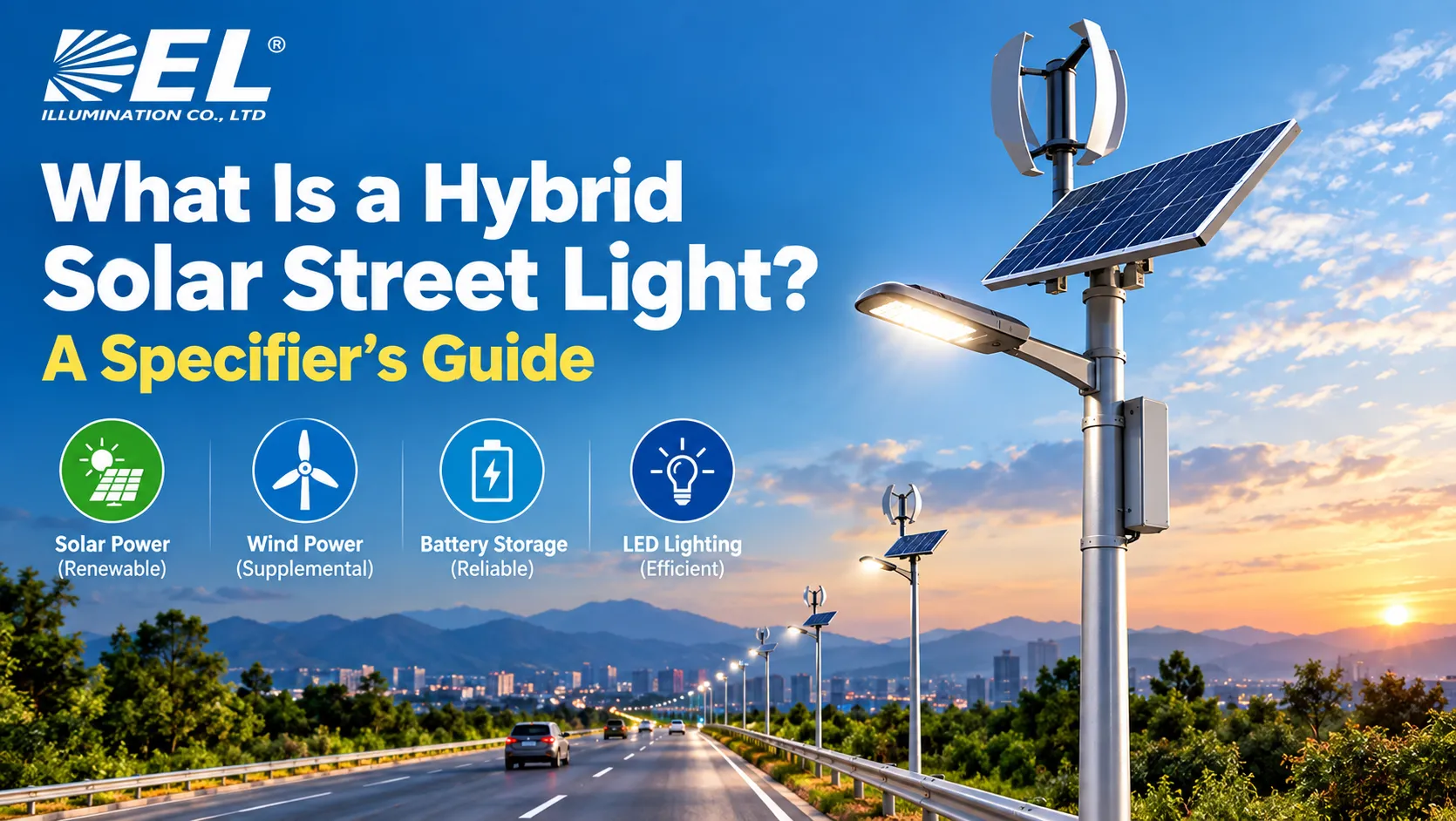

Solar street lighting has one well-known weakness: it depends on the weather. A conventional off-grid unit relies entirely on how much sun reached its panel yesterday, so a run of overcast days, a monsoon week, or a shaded pole can leave a road darker than its design intended. For low-stakes applications that risk is tolerable. On a highway, an industrial access road, or any corridor where continuous illumination is safety-critical, it is not. This is the gap a hybrid solar street light is built to close.
For EPC contractors, municipal engineers, and procurement officers, understanding what "hybrid" actually means, and where it is the right specification, prevents both over-engineering a simple rural road and under-specifying a critical one. This guide explains the two main hybrid configurations, how they work, and how to specify one correctly.
Two Meanings of "Hybrid"
The word hybrid is used for two distinct system architectures, and confusing them in a tender is a common and costly mistake.
The first is the solar-wind hybrid. This system pairs a solar panel with a small wind turbine so the fixture harvests energy from two independent sources. Solar performs best on clear days; wind often performs best precisely when solar cannot, on overcast, stormy, or windy nights. The two sources balance each other, producing steadier charging across changing weather. These systems remain fully off-grid, requiring no trenching or utility connection.
The second is the solar-AC hybrid, sometimes called a grid-hybrid. Here the fixture combines solar charging with a mains grid connection as backup. It runs primarily on stored solar energy, and when the battery drops below a set threshold, the controller automatically draws from the grid to maintain full output. Some configurations invert the priority, running on mains and switching to solar during grid outages, which turns the light into an emergency-resilient asset during power cuts.
Both share the same goal: eliminate the single point of failure that a solar-only system carries.
How a Hybrid System Works
Regardless of configuration, the core components are consistent. A monocrystalline solar panel captures daytime energy. A LiFePO4 battery stores it, chosen for long cycle life, temperature stability, and safety. A smart controller manages energy flow, and an LED head delivers the light. The hybrid element, whether a wind turbine or a grid connection, adds a second charging path.
In a solar-wind system, small vertical-axis turbines commonly begin generating at cut-in wind speeds of around 2.5 to 3.5 metres per second, roughly 9 to 13 km/h. Project turbines are typically rated between 200 and 1,000 W. When ambient light falls below a set threshold, detected by photosensor or timer, the controller switches on the LED using stored energy, drawing on whichever source charged the battery.
In a solar-AC system, the logic is a priority hierarchy. In solar-priority mode the system uses battery energy first and only calls on the grid when storage runs low, minimising electricity bills while guaranteeing the road never goes dark. This dual-source architecture is what allows a specifier to promise continuous compliance rather than weather-dependent performance.
Where Hybrid Is the Right Choice
Hybrid is not automatically better than solar-only. It costs more, so it should be specified where the application genuinely justifies it.
Solar-wind hybrids earn their place in regions with limited peak sun hours or reliable wind. Coastal roads with steady breezes, mountainous and high-altitude corridors, and high-latitude sites with long overcast winters all suit the dual-source approach, because wind fills the gap when solar output collapses. These are also the environments where a solar-only system would need an oversized panel and battery to achieve the same autonomy.
Solar-AC hybrids suit locations that have grid access but unreliable supply, common across many emerging-market cities and industrial zones. Here the hybrid delivers most of the energy-cost savings of solar while using the grid as an insurance policy, so a critical arterial or an industrial park never loses lighting during a cloudy spell.
For a genuinely remote road far from any grid and with poor wind resource, a well-sized solar-only system is often the more sensible and economical answer. Matching the architecture to the site is the essence of good specification.
What to Specify
A defensible hybrid specification sets minimums for every component and, critically, is matched to site data.
- LED package: typically 30 to 240 W depending on road class, at 160 to 180 lm/W efficacy so fewer poles cover the same road.
- Solar array: monocrystalline at 21 to 23% efficiency, sized alongside the second source.
- Battery: LiFePO4 rated for 2,000 to 3,000 cycles and 8 to 12 years, offering 3 to 5 days of backup autonomy.
- Wind turbine (solar-wind only): rated 200 to 1,000 W, with cut-in speed matched to the site's measured average wind speed.
- Grid interface (solar-AC only): an automatic transfer controller with a defined priority mode.
- Protection: IP66 and IK08 or higher, verified by accredited test reports.
The single most important discipline is resource matching. A solar-wind hybrid specified without site wind-speed data is guesswork, and a battery sized without local weather statistics will disappoint. Insist that the supplier sizes the system against real irradiance and wind figures for the exact location, not a generic datasheet.
Conclusion
A hybrid solar street light removes the weather dependency that limits solar-only lighting, either by adding a wind turbine as a second renewable source or by using the grid as automatic backup. It is the right specification for safety-critical roads, harsh or variable climates, and sites where continuous illumination cannot be left to chance, but it should be matched carefully to each project rather than applied by default. The key is honest sizing against real site data and minimum component standards that survive the full contract.
For engineering support, DIALux photometric design, and hybrid or off-grid solar street lighting solutions matched to your project's climate and grid conditions, visit solar-led-street-light.com to discuss requirements or request a customised quote.






















Sign in to leave a comment.