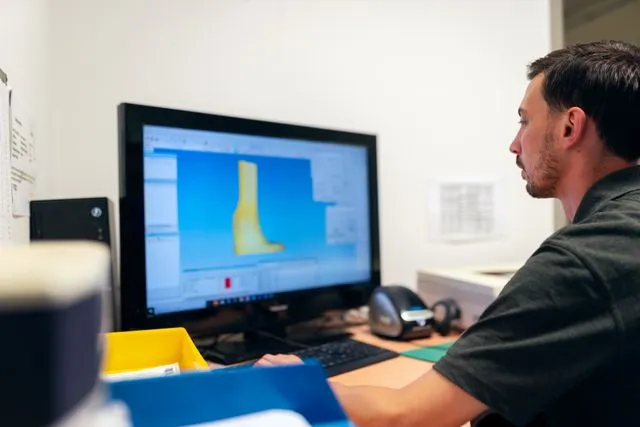

An AI HMS (Artificial Intelligence Hospital Management System) is hospital management software that uses artificial intelligence to automate routine tasks, analyze healthcare data, improve scheduling, support documentation, streamline billing, manage resources, and provide predictive insights. Unlike a traditional hospital management system that mainly stores and processes information, an AI-enabled HMS can identify patterns, prioritize tasks, and help hospital teams make faster, data-informed decisions.
As hospitals handle increasing patient volumes, complex administrative workflows, growing documentation requirements, and pressure to use resources efficiently, AI is becoming an important technology for modern hospital operations. However, AI should support healthcare professionals rather than replace their clinical judgment.
What Is an AI HMS?
An AI HMS is a hospital management platform that combines the core functions of a traditional Hospital Management System with artificial intelligence and data-driven automation.
A conventional HMS may manage areas such as:
- Patient registration
- Appointments
- Electronic health records
- Billing
- Pharmacy
- Laboratory
- Inpatient management
- Staff and resource management
- Reporting
An AI-enabled system adds intelligent capabilities to these workflows. It can analyze information, automate repetitive activities, identify unusual patterns, generate predictions, and provide recommendations to authorized users.
For example, instead of simply showing a hospital manager last month's patient volume, an AI-enabled platform may analyze historical and current data to identify demand patterns and provide forward-looking operational signals.
The goal is not to make every hospital decision automatically. The goal is to reduce unnecessary manual work and give healthcare teams better information when they need it.
MediTale describes its AI-powered HMS as an integrated platform where AI-assisted capabilities are embedded across scheduling, documentation, billing, inventory, diagnostics, and predictive operations rather than operating as a separate system.
How Does an AI-Powered Hospital Management System Work?
An AI HMS generally works through four connected layers:
1. Data Collection
The system collects information generated by hospital activities.
This may include:
- Patient registration data
- Appointment information
- Clinical documentation
- Laboratory results
- Imaging information
- Medication records
- Billing transactions
- Insurance information
- Inventory records
- Bed availability
- Staff schedules
The quality and consistency of this data are important because AI systems depend on the information available to them.
2. Data Processing
The system organizes and processes information so that it can be used by different hospital workflows.
For example, appointment data can be connected with doctor availability, room capacity, and patient preferences.
Similarly, clinical and billing information can be connected to help identify missing charges or potential claim issues.
3. AI Analysis
Artificial intelligence can analyze patterns within the available data.
Depending on the application, AI may:
- Recommend appointment slots
- Identify unusual activity
- Prioritize tasks
- Support documentation
- Forecast demand
- Flag potential billing problems
- Estimate inventory requirements
- Highlight operational trends
4. Action and Human Review
The final step is using the insight or recommendation within the appropriate workflow.
Some tasks can be automated, while others require human review.
For example, an AI system may flag a potential billing issue, but a qualified billing professional should review it before taking action.
Likewise, AI may assist with clinical documentation, but healthcare professionals remain responsible for reviewing and approving patient records.
This human-in-the-loop approach is especially important in healthcare. The World Health Organization emphasizes human autonomy, safety, transparency, accountability, and equity when AI is used in health.
What Features Does an AI HMS Include?
The exact features vary between platforms, but a comprehensive AI-enabled HMS can include several intelligent capabilities.
AI-Based Appointment Scheduling
Appointment management is one of the most visible areas of hospital operations.
Traditional scheduling can lead to:
- Conflicting appointments
- Unused slots
- Overcrowded clinics
- Long waiting times
- Missed appointments
AI-assisted scheduling can analyze doctor availability, room capacity, appointment types, patient preferences, and historical demand to support better scheduling decisions.
Automated reminders can also help patients remember upcoming appointments.
MediTale's AI-powered HMS includes AI-assisted scheduling designed to balance doctor availability, room capacity, and patient preferences while providing real-time visibility to front-office and call-center teams.
Intelligent Electronic Health Records
Electronic health records contain a large amount of information that healthcare professionals need to access quickly.
AI can support EHR workflows by helping with:
- Voice-to-text documentation
- Structured templates
- Coding assistance
- Patient history organization
- Information retrieval
- Clinical documentation workflows
The objective is to reduce repetitive documentation while maintaining appropriate clinical review.
For example, voice-based documentation can allow a clinician to capture consultation information more efficiently, after which the clinician can review and finalize the record.
AI-Assisted Billing and Claims
Billing is another area where intelligent automation can improve efficiency.
An AI HMS may help identify:
- Missing information
- Potential coding issues
- Unusual charges
- Claim inconsistencies
- Authorization-related problems
- Revenue-cycle exceptions
Instead of requiring staff to manually review every transaction in the same way, AI can help highlight cases that deserve additional attention.
MediTale's platform includes guided charge capture, AI-assisted claim scrubbing, payer-rule checks, and insurance/TPA workflow capabilities.
Predictive Inventory Management
Hospitals need to maintain sufficient medicines, supplies, and equipment without unnecessarily overstocking.
AI can analyze consumption patterns and inventory levels to support more informed purchasing and replenishment decisions.
For example, if the system identifies increasing demand for a particular medical supply, it can provide an early signal to inventory managers.
Predictive inventory management can potentially help hospitals reduce:
- Stockout risk
- Excess inventory
- Expiry-related waste
- Manual inventory monitoring
Predictive Hospital Operations
One of the major differences between traditional reporting and AI-enabled hospital management is the ability to move from historical reporting toward predictive insights.
A traditional report may show:
“The hospital treated 5,000 patients last month.”
An AI-enabled analytics system can potentially go further:
“Based on current and historical patterns, patient demand may increase during specific periods.”
This type of insight can help management plan:
- Beds
- Staff
- OPD capacity
- Diagnostic resources
- Inventory
- Operating rooms
The accuracy of these predictions depends on data quality, model design, implementation, and continuous monitoring.
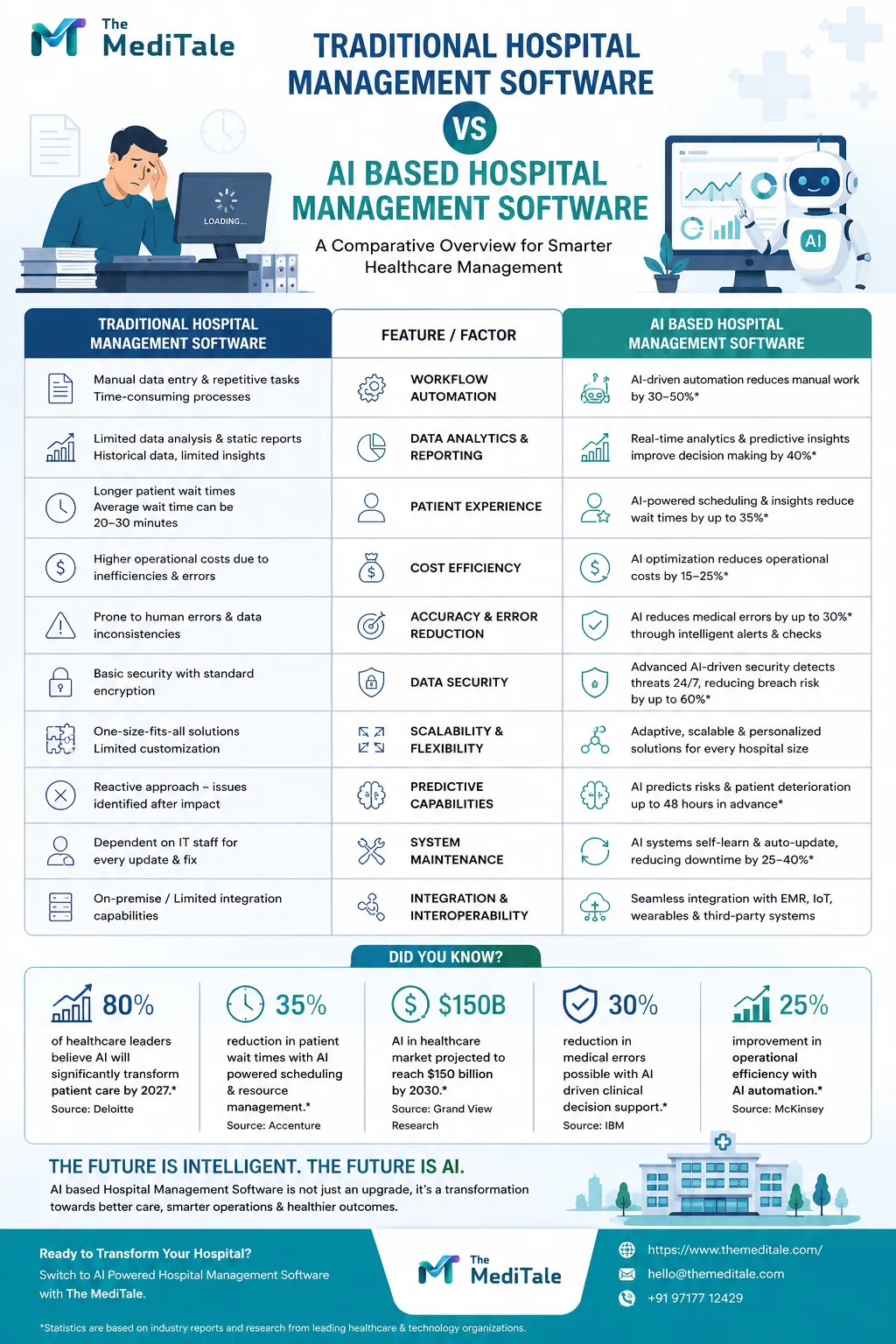
How Is AI HMS Different From Traditional Hospital Management Software?
The biggest difference is the role of intelligence and automation.
| Traditional HMS | AI HMS |
|---|---|
| Records and manages information | Records, analyzes, and interprets information |
| Mostly rule-based workflows | Can include AI-assisted workflows |
| Primarily historical reporting | Can provide predictive insights |
| More manual task handling | Greater automation potential |
| Static scheduling | AI-assisted scheduling optimization |
| Manual exception identification | Can flag potential exceptions |
| Standard dashboards | Intelligent alerts and analytics |
| Human-led data review | Human decision-making supported by AI |
This does not mean that traditional HMS platforms are obsolete. Many hospitals still require reliable core hospital management functions.
Instead, AI can be considered an additional intelligence layer that makes existing workflows more automated and data-driven.
What Problems Can AI HMS Solve in Hospitals?
Hospitals may consider AI-enabled management software when they face operational challenges such as:
Long patient waiting times
AI-assisted scheduling and patient-flow analytics can help identify patterns contributing to delays.
Excessive administrative work
Automation can reduce repetitive data entry, documentation, scheduling, and communication tasks.
Billing and claim errors
AI-assisted claim checks can help identify potential problems before they result in additional rework.
Poor resource utilization
Predictive analytics can support better planning of beds, staff, rooms, and other resources.
Inventory challenges
AI-based demand analysis can support better stock planning and replenishment.
Fragmented information
An integrated HMS can connect information across OPD, IPD, diagnostics, pharmacy, nursing, and finance.
MediTale's AI-powered HMS is designed around these connected workflows, with an emphasis on bringing operational information together instead of leaving departments dependent on disconnected tools.
Does AI HMS Replace Doctors and Hospital Staff?
No. AI HMS is designed to assist healthcare teams, not replace qualified professionals.
AI can perform or support repetitive tasks, analyze large amounts of information, and highlight potential issues. However, clinical decisions, patient communication, and important administrative decisions may still require human judgment.
For example, an AI system might identify an unusual pattern in patient information, but the appropriate healthcare professional must determine what that information means in the clinical context.
The WHO recommends that humans remain in control of healthcare systems and medical decisions and emphasizes accountability and transparency in the use of AI for health.
Is AI HMS Safe for Patient Data?
Patient data requires strong privacy and security controls.
An AI HMS may handle highly sensitive information such as:
- Patient identities
- Medical histories
- Diagnoses
- Laboratory results
- Prescriptions
- Insurance details
- Billing information
Therefore, hospitals should evaluate security architecture, access controls, auditability, encryption, backup processes, and data governance before implementing an AI system.
For organizations operating under HIPAA, the U.S. Department of Health and Human Services explains that the HIPAA Privacy Rule establishes national standards for protecting medical records and individually identifiable health information and places conditions on certain uses and disclosures.
MediTale states that its AI-powered HMS incorporates controls including encryption, role-based access, audit logs, security reviews, and backup and disaster recovery capabilities.
Hospitals should also establish clear governance around who can access AI features, how outputs are reviewed, and how sensitive information is handled.
What Should Hospitals Consider Before Implementing AI HMS?
Choosing an AI HMS should involve more than comparing feature lists.
Hospitals should evaluate the following areas.
1. Integration
The platform should work with the hospital's existing systems and workflows wherever required.
2. Data Quality
AI requires reliable information. Duplicate, outdated, or incomplete data can affect the usefulness of AI-generated insights.
3. Security
Hospitals should evaluate encryption, access control, audit trails, backup procedures, and privacy policies.
4. Human Oversight
Important AI-supported decisions should have appropriate human review.
5. Scalability
The system should be able to support additional departments, locations, users, and workflows as the hospital grows.
6. Staff Training
Employees need practical training on how AI-assisted workflows operate and when human review is required.
7. Governance
Hospitals should establish policies for responsible AI usage, monitoring, accountability, and risk management.
The NIST AI Risk Management Framework provides organizations with a voluntary framework for managing AI risks and promoting trustworthy and responsible AI development and use.
How Should a Hospital Implement AI HMS?
A phased implementation can be more practical than attempting to introduce every AI capability at once.
Phase 1: Identify the Problem
Start by identifying the hospital's biggest operational challenges.
For example:
- Appointment delays
- Documentation workload
- Billing errors
- Inventory problems
- Poor reporting
Phase 2: Select the Appropriate Workflow
Choose one or two areas where AI can provide measurable value.
Phase 3: Prepare the Data
Clean and organize the relevant data before deploying advanced analytics.
Phase 4: Train Staff
Healthcare and administrative teams should understand how the system works and how to validate AI-generated outputs.
Phase 5: Pilot the System
Test the workflow with a limited department or user group before expanding it.
Phase 6: Measure Results
Hospitals can monitor metrics such as:
- Waiting time
- Appointment utilization
- Documentation time
- Claim rework
- Inventory waste
- Staff workload
- Patient satisfaction
Phase 7: Expand Gradually
Once the initial workflow performs reliably, additional AI-enabled modules can be introduced.
MediTale follows a phased approach covering discovery and design, configuration and data readiness, training and pilot, followed by go-live and optimization.
What Are the Benefits of AI HMS?
The potential benefits of AI-enabled hospital management include:
- Reduced repetitive administrative work
- More efficient appointment scheduling
- Faster access to organized information
- Improved documentation workflows
- Better billing and claims management
- Smarter inventory planning
- Predictive operational insights
- Better resource utilization
- Improved coordination between departments
- More data-informed management decisions
However, results depend on implementation quality. AI should be treated as part of a broader digital transformation strategy rather than a standalone solution.
What Is the Future of AI in Hospital Management?
The future of hospital management is likely to involve increasing integration between AI, electronic health records, analytics, automation, and connected healthcare systems.
AI may increasingly help hospitals move from reactive management toward predictive operations.
Instead of waiting for:
- A department to become overcrowded
- A medicine to run out
- A claim to be rejected
- A doctor schedule to become overloaded
- A documentation backlog to grow
hospital teams can use intelligent systems to identify warning signals earlier.
At the same time, responsible implementation will remain important. Healthcare organizations need to balance innovation with privacy, security, transparency, clinical safety, and human oversight.
The WHO's guidance emphasizes that AI in healthcare should be developed and deployed with ethics, human rights, safety, accountability, transparency, and equity in mind.
Frequently Asked Questions
What is AI HMS?
AI HMS stands for Artificial Intelligence Hospital Management System. It is hospital management software that integrates AI into workflows such as scheduling, documentation, billing, inventory management, analytics, and hospital operations.
How does AI HMS work?
AI HMS collects and processes hospital data, analyzes patterns using AI technologies, generates insights or recommendations, and supports users within hospital workflows. Some routine activities can be automated, while important decisions remain under human supervision.
What is the difference between HMS and AI HMS?
A traditional HMS primarily manages and organizes hospital information and workflows. AI HMS adds intelligent automation, predictive analytics, recommendations, and pattern detection to selected hospital processes.
Can AI HMS reduce hospital administrative workload?
Yes. AI can support repetitive activities such as scheduling, documentation, record management, billing checks, reminders, and data analysis, potentially allowing staff to spend more time on tasks requiring human judgment.
Can AI HMS help with hospital billing?
Yes. AI-assisted billing features can identify potential claim inconsistencies, support charge capture, and flag issues for review. Human billing professionals should still validate important transactions.
Is AI HMS suitable for small hospitals?
AI HMS can be useful for hospitals of different sizes, but the appropriate features depend on patient volume, workflows, budget, data maturity, and operational needs. Smaller organizations may benefit from starting with specific high-impact workflows rather than deploying every feature simultaneously.
Does AI HMS replace doctors?
No. AI HMS is intended to support healthcare professionals by reducing administrative work and providing data-driven assistance. Qualified healthcare professionals remain responsible for clinical decisions.
What should hospitals check before buying AI HMS?
Hospitals should evaluate functionality, integrations, security, privacy, scalability, AI governance, data quality, staff training, implementation support, and the ability to maintain human oversight.
Conclusion
An AI HMS combines traditional hospital management capabilities with artificial intelligence, automation, and predictive analytics. It can help hospitals manage appointments, documentation, billing, inventory, patient workflows, and operational planning more efficiently.
The most important difference is that an AI-enabled system does more than store information. It can analyze information, identify patterns, automate repetitive processes, and provide useful signals to healthcare teams.
However, successful implementation requires more than advanced technology. Hospitals need reliable data, secure systems, trained employees, clear governance, appropriate integrations, and human oversight.
For hospitals looking to modernize their operations, the practical approach is to start with measurable problems, implement AI where it can provide meaningful value, evaluate results, and gradually expand.
A platform such as MediTale's AI-powered HMS brings AI-assisted scheduling, documentation, billing, inventory, diagnostics, and predictive operations into a connected hospital management environment, allowing organizations to adopt intelligent capabilities progressively according to their workflow and readiness.



























Sign in to leave a comment.