What Is Digital Asset Management? A Practical Guide for Indian Families

In most offices the phrase means a library of brand images. At home it means something far more important: knowing what you own and how to reach it.
If you search for “what is digital asset management”, the first results will probably describe software for marketing teams: a central library for logos, product photos, videos and brand guidelines, so the right file reaches the right person. That meaning is real, and it’s how the industry uses the term.
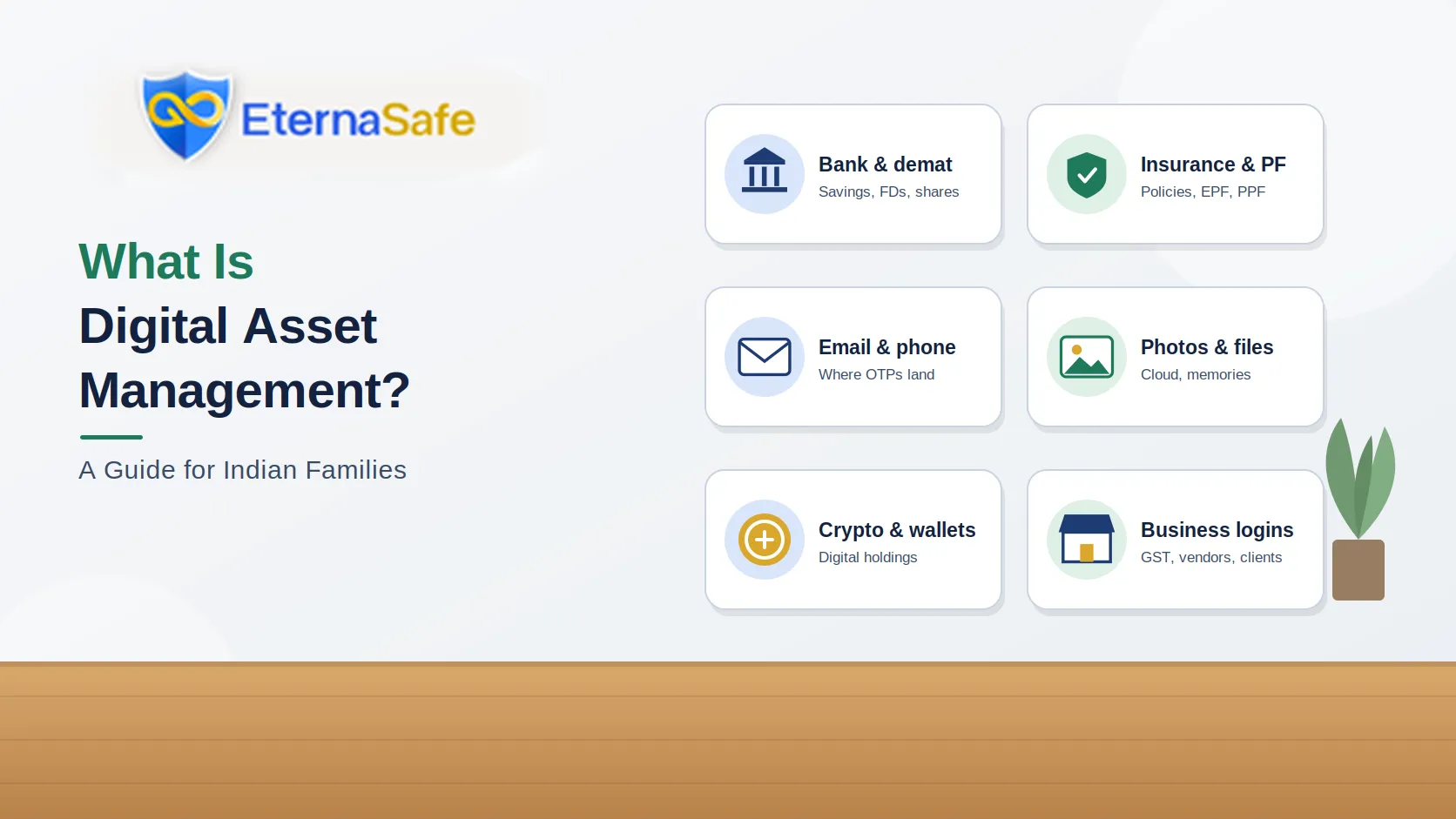
But there’s a second meaning that almost nobody writes about, and for ordinary households it matters more. Your family has digital assets too. They’re just less glamorous than a campaign video. They’re bank and demat accounts, insurance portals, provident fund logins, cloud photos, email, subscriptions and, for a growing number of people, crypto wallets. Managing them well is a different job from managing a brand library, but the core idea is the same: know what you have, keep it organised and make sure the right people can reach it.
The short answer
Digital asset management is the practice of organising, storing, protecting and controlling access to the digital things that have value to you or your business. In a company, that usually means creative files. In a household, it means the financial and personal records that now live behind logins.
The difference shows up in the stakes. When a company loses track of an image, a designer re-exports it. When a family loses track of an account, money can sit untouched for years. As of January 2026, ₹60,518 crore in unclaimed deposits was sitting in the Reserve Bank of India’s Depositor Education and Awareness Fund (DD News). Plenty of that belongs to people who simply never knew an account existed.
What counts as a digital asset at home
It helps to widen the definition, because most people undercount.
The obvious ones are financial: net banking, UPI apps, fixed deposits, mutual funds, demat accounts, PPF and EPF. Then come insurance policies, many of which now exist only as a PDF and a portal login. After that, the practical backbone, which is the email address and mobile number that receive every one-time password. A good deal of your digital asset management really comes down to protecting those two things.
Then there’s the personal layer: photographs, videos, documents scanned into cloud storage, and years of messages. And for some households there’s a business layer, with GST and bank logins, supplier contacts, client lists and software licences that exist nowhere except one person’s memory.
None of this feels like an asset until the day someone else needs it.
Why a digital asset management strategy matters
Most families don’t have a digital asset management strategy. They have habits, and habits work fine until the person who holds all the knowledge isn’t available.
A strategy doesn’t have to be elaborate. It answers four plain questions. What exists? Where does it live? Who is allowed to deal with it, and when? And how will the people who need to act on it find the record?
Without those answers, the pattern repeats. A family learns there’s “some app” for investments but no one knows which. A policy number is scribbled on an old envelope. A phone opens only with a fingerprint, and the email that could reset everything sends its code to that same phone. Nobody was careless. They just never had a system.
Building a simple strategy in an evening
The most useful digital asset management strategy is the one you actually finish, so keep it small.
Start with a list. Sit down with your phone, your email inbox and a few months of bank statements, and write down every account and policy you can find. Search your email for words like “statement”, “policy” and “folio”. You’ll find more than you expect: the salary account from a job you left years ago, the mutual fund you started during a market rally, the subscription that renews quietly each month.
Group what you find into a few buckets: money and investments, insurance and retirement, identity documents, email and communication, and personal memories. Add a short note against each item saying where the paperwork is and who else knows about it. Leave passwords out of the list itself. A list of account names is useful to your family and fairly harmless if it’s seen. A list with passwords is neither.
Check yourself against the official tools too. The RBI’s UDGAM portal lets you search for unclaimed deposits, and similar routes exist for insurance and mutual funds. Some of the money you find may be yours.
Finally, decide who should be able to act. This is where many plans go wrong, because a nominee and a legal heir aren’t the same thing. A nominee is the person a bank or insurer pays. A legal heir is someone entitled to inherit under succession law or a Will. Our guide to nominee vs legal heir explains why the gap matters, and if you haven’t made a Will yet, our step-by-step guide to writing a Will in India shows it needs neither stamp paper nor a lawyer.
The part most strategies skip: access
Knowing what exists is half the job. The other half is making sure the right people can reach it, without exposing it to the wrong ones in the meantime.
Paper in a drawer is visible to anyone who finds it. A shared spreadsheet is visible to anyone it’s shared with, today, whether or not you’re around. Putting passwords in a Will is risky, because a Will can become a public document. And an ordinary password manager, however good, doesn’t tell your family that it exists or how to open it.
The big technology companies have started to help with their own platforms. Google’s Inactive Account Manager lets you set a period of three to eighteen months and name people who’ll be notified. Apple’s Legacy Contact gives a chosen person access to your account data using a key you share in advance (Gazette). These are worth switching on. But they cover photos, files and messages. They don’t touch a bank account, a demat holding or a provident fund, which are the assets families struggle with most.
Where EternaSafe fits
That gap is what EternaSafe was built for. Its Information Insurance service is a private, encrypted vault where you record accounts, documents and instructions. Data is encrypted on your own device before it reaches the servers, which is the zero-knowledge approach we describe in our guide to zero-knowledge encryption, so EternaSafe can’t read it. Your nominees see nothing while you’re active. If you stop responding to alerts, they verify their identity and a member of the team reviews the case before any access opens. A single login in the meantime cancels the whole process.
It isn’t a replacement for a Will, and EternaSafe isn’t a law firm. Think of it as the layer that makes your Will and your nominations workable, because it tells your family what exists. If you want the full sequence, read how information insurance works for nominees.
Keep it alive
A record is only as good as its last update. Accounts open and close, banks change, nominees are added. Reviewing your list once a year, and again after any big change like a marriage, a move, a new business or a new child, is usually enough.
So, what is digital asset management? In a company, it’s a library. In a family, it’s a promise: that the people you leave behind will start with a map instead of a blank page. It takes an evening to begin, and it’s one of the few pieces of planning where a small effort has a long reach.





Sign in to leave a comment.