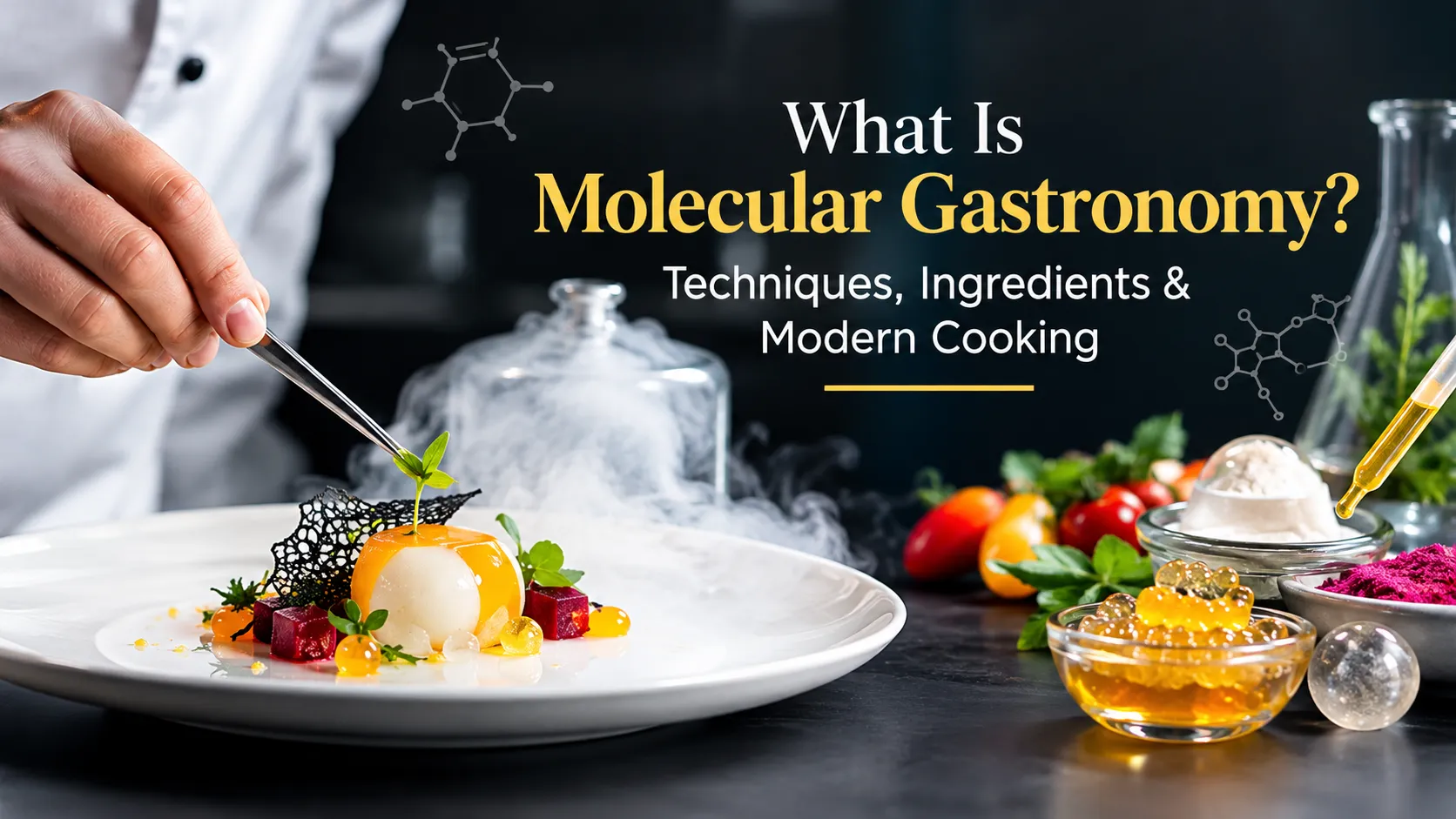

Food is constantly evolving, and modern chefs are finding new ways to transform familiar ingredients into unexpected textures, shapes, and presentations. One of the most fascinating areas of modern cuisine is molecular gastronomy, a style of cooking that combines culinary creativity with scientific principles.
If you have ever seen edible foams, liquid-filled spheres, transparent noodles, or desserts that change texture as you eat them, you may already have encountered molecular gastronomy.
But what is molecular gastronomy, and how does it actually work? From spherification and foams to gels and emulsions, this approach gives chefs new ways to experiment with food while exploring the science behind cooking.
What Is Molecular Gastronomy?
Molecular gastronomy is an approach to food that explores the physical and chemical transformations that occur during cooking and food preparation.
It examines how ingredients react to factors such as:
- Temperature
- Pressure
- Acidity
- Enzymes
- Emulsification
- Freezing
- Gel formation
- Foaming
- Concentration
The goal is not simply to make food look unusual. Molecular gastronomy can help chefs understand ingredients at a deeper level and use that knowledge to create new textures, presentations, and eating experiences.
It is closely associated with modernist cuisine, although the two terms are not exactly interchangeable.
What Does a Molecular Gastronomist Do?
A molecular gastronomist explores the science behind food preparation and the ways different techniques can change the characteristics of ingredients.
Depending on their background, a molecular gastronomist may work in culinary research, professional kitchens, food development, education, or experimental cooking.
Their work may involve studying questions such as:
- Why does an emulsion separate?
- How can a liquid be turned into a gel?
- What causes a foam to remain stable?
- How does temperature affect texture?
- How can an ingredient retain its flavor while changing its physical form?
This combination of culinary knowledge and scientific experimentation allows chefs to approach familiar ingredients in new ways.
How Does Molecular Gastronomy Work?
Molecular gastronomy uses scientific principles to control the texture, appearance, and behavior of food.
For example, a chef may use a gelling agent to turn a flavorful liquid into a soft gel. Another technique can create small spheres with a liquid center, while an emulsifier can help combine ingredients that normally separate.
The techniques are often precise, but they can also be adapted for creative home cooking.
Popular Molecular Gastronomy Techniques
There are many techniques associated with modernist and molecular cooking. Some are particularly popular among professional chefs and culinary enthusiasts.
1. Spherification
Spherification is one of the most recognizable molecular gastronomy techniques.
It involves creating small spheres from a flavored liquid. The outside develops a thin gel-like membrane while the inside remains liquid.
When the sphere is eaten, it can release the liquid filling in the mouth.
This technique can be used with ingredients such as fruit juices, sauces, cocktails, and other flavorful liquids.
2. Reverse Spherification
Reverse spherification uses a slightly different process and is useful for liquids containing ingredients that may interfere with standard spherification.
The technique allows chefs to create spheres with a delicate outer layer and liquid center.
It is particularly useful when working with dairy products, calcium-rich ingredients, or other challenging liquids.
3. Foams
Foams can transform a liquid into a light and airy preparation.
A flavored liquid can be aerated using specialist equipment or suitable culinary ingredients. The result can add a different texture and visual element to a dish.
Foams can be made from:
- Fruit juices
- Vegetable preparations
- Sauces
- Broths
- Herbs
- Dairy-based mixtures
A light foam can also be used as a finishing element for savory dishes or desserts.
4. Gels
Gelling is another important technique in modern cooking.
Certain ingredients can transform liquids into gels when used under the right conditions. Depending on the ingredient and concentration, the resulting gel can range from soft and delicate to firm and sliceable.
Gels can be used to create:
- Dessert components
- Sauce cubes
- Fruit gels
- Decorative elements
- Savory garnishes
5. Emulsification
An emulsion is created when two liquids that normally do not mix are combined into a stable mixture.
Mayonnaise is a familiar example of an emulsion. Modern cooking techniques can take this principle further by creating lighter sauces, dressings, and culinary preparations.
Emulsifiers can help improve stability and texture.
6. Dehydration
Dehydration removes moisture from food while concentrating its flavors.
Fruits, vegetables, herbs, and other ingredients can be dehydrated to create crispy garnishes, powders, chips, and concentrated flavor components.
For example, dehydrated fruit can provide both intense flavor and a crunchy texture.
7. Liquid Nitrogen
Liquid nitrogen can rapidly freeze ingredients because of its extremely low temperature.
In professional culinary environments, it may be used to create frozen desserts, dramatic textures, or unusual presentations.
Because liquid nitrogen requires specialized handling and appropriate safety procedures, it is not a technique to experiment with casually at home.
Common Molecular Gastronomy Ingredients
Molecular cooking often uses specialized ingredients that interact with food in specific ways.
Some commonly encountered ingredients include:
Agar-Agar
Agar-agar is a plant-based gelling agent derived from certain types of seaweed.
It can be used to create gels and other preparations and is popular in modernist cooking because it can produce different textures depending on concentration and preparation.
Sodium Alginate
Sodium alginate is commonly associated with spherification.
When it interacts with calcium under appropriate conditions, it can help create a gel membrane around a liquid.
Calcium Lactate
Calcium lactate is another ingredient used in certain spherification techniques.
It can provide a source of calcium for creating gel-like membranes around liquid preparations.
Xanthan Gum
Xanthan gum is a thickening and stabilizing ingredient used in sauces, dressings, and other preparations.
A small amount can significantly affect the viscosity of a liquid, so accurate measurement is important.
Soy Lecithin
Soy lecithin can be used as an emulsifier and is also associated with culinary foams and airs.
It can help chefs create light, airy textures from flavorful liquids.
Why Texture Is Important
One of the most interesting aspects of molecular gastronomy is its focus on texture.
Two foods can have similar flavors but create completely different experiences depending on their texture.
For example, a tomato flavor could be presented as:
- A traditional sauce
- A gel
- A foam
- A powder
- A sphere
The flavor remains recognizable, but the eating experience changes dramatically.
This allows chefs to separate flavor from familiar texture and present ingredients in unexpected forms.
Molecular Gastronomy in Desserts
Desserts are particularly suitable for experimentation.
Chefs can use modern techniques to create:
- Fruit pearls
- Chocolate gels
- Dessert foams
- Fruit powders
- Dehydrated garnishes
- Frozen preparations
- Flavored spheres
For example, a familiar fruit dessert could be transformed into several textures while retaining the original fruit flavor.
This approach can make presentation more interactive and visually interesting.
Molecular Gastronomy in Savory Cooking
Molecular techniques are not limited to desserts.
They can also be used with vegetables, meats, seafood, sauces, soups, and beverages.
A chef might transform a sauce into a gel, create a herb foam, make flavored spheres, or use a dehydrated ingredient as a crispy garnish.
The objective is generally to complement the dish rather than use unusual techniques simply for visual effect.
Is Molecular Gastronomy Only for Professional Chefs?
Not necessarily.
While professional kitchens may have access to advanced equipment and a wider selection of ingredients, beginners can experiment with simpler techniques at home.
Basic activities such as making gels, preparing culinary foams, experimenting with emulsions, or creating simple spherification recipes can introduce home cooks to the principles of modernist cooking.
However, it is important to understand the properties and recommended usage of every specialized ingredient before using it.
Equipment Used in Molecular Gastronomy
Specialized equipment can make certain techniques easier and more consistent.
Common equipment includes:
- Precision scales
- Pipettes
- Spherification spoons
- Silicone molds
- Whippers
- Fine strainers
- Dehydrators
- Thermometers
- Blenders
- Vacuum equipment
Precision is particularly important because many modernist recipes depend on specific ingredient ratios.
Even a small change in concentration can affect the final texture.
Tips for Beginners
If you are new to molecular gastronomy, start with simple techniques rather than attempting several advanced processes at once.
Measure Ingredients Accurately
Precision is important when working with specialized ingredients. A digital scale capable of measuring small quantities can be very useful.
Understand Each Ingredient
Before using an ingredient, learn what it does, how it reacts with other ingredients, and how it should be stored.
Start With One Technique
Spherification, simple gels, or culinary foams can be good introductions to the principles of modernist cooking.
Keep Notes
Record your ingredient quantities, temperatures, preparation times, and results. Small adjustments can make a significant difference.
Focus on Flavor
Modern techniques should enhance the food rather than distract from it. A visually impressive dish still needs balanced flavor.
Molecular Gastronomy vs Traditional Cooking
Traditional cooking and molecular gastronomy are not necessarily opposites.
In fact, many modern techniques are based on scientific principles that have always been present in everyday cooking.
Boiling, baking, fermentation, caramelization, emulsification, and thickening all involve physical or chemical changes.
The difference is that molecular gastronomy makes these transformations a central part of culinary experimentation.
A modern chef can therefore combine traditional recipes with contemporary techniques to create something that feels both familiar and innovative.
Final Thoughts
So, what is molecular gastronomy? At its core, it is the exploration of the science and transformations behind food, combined with culinary creativity.
From spherification and foams to gels, emulsions, and dehydration, molecular gastronomy gives chefs new ways to work with ingredients and explore texture, presentation, and flavor.
A molecular gastronomist looks beyond traditional cooking methods to understand why ingredients behave the way they do and how those properties can be used creatively.
Whether you are a professional chef, culinary student, or adventurous home cook, learning the fundamentals of molecular gastronomy can open up a fascinating new side of cooking.
Explore Chenab Gourmet's range of molecular gastronomy ingredients, culinary tools, and specialty kitchen equipment to experiment with modern cooking techniques and bring creative restaurant-style presentations into your kitchen.

























Sign in to leave a comment.