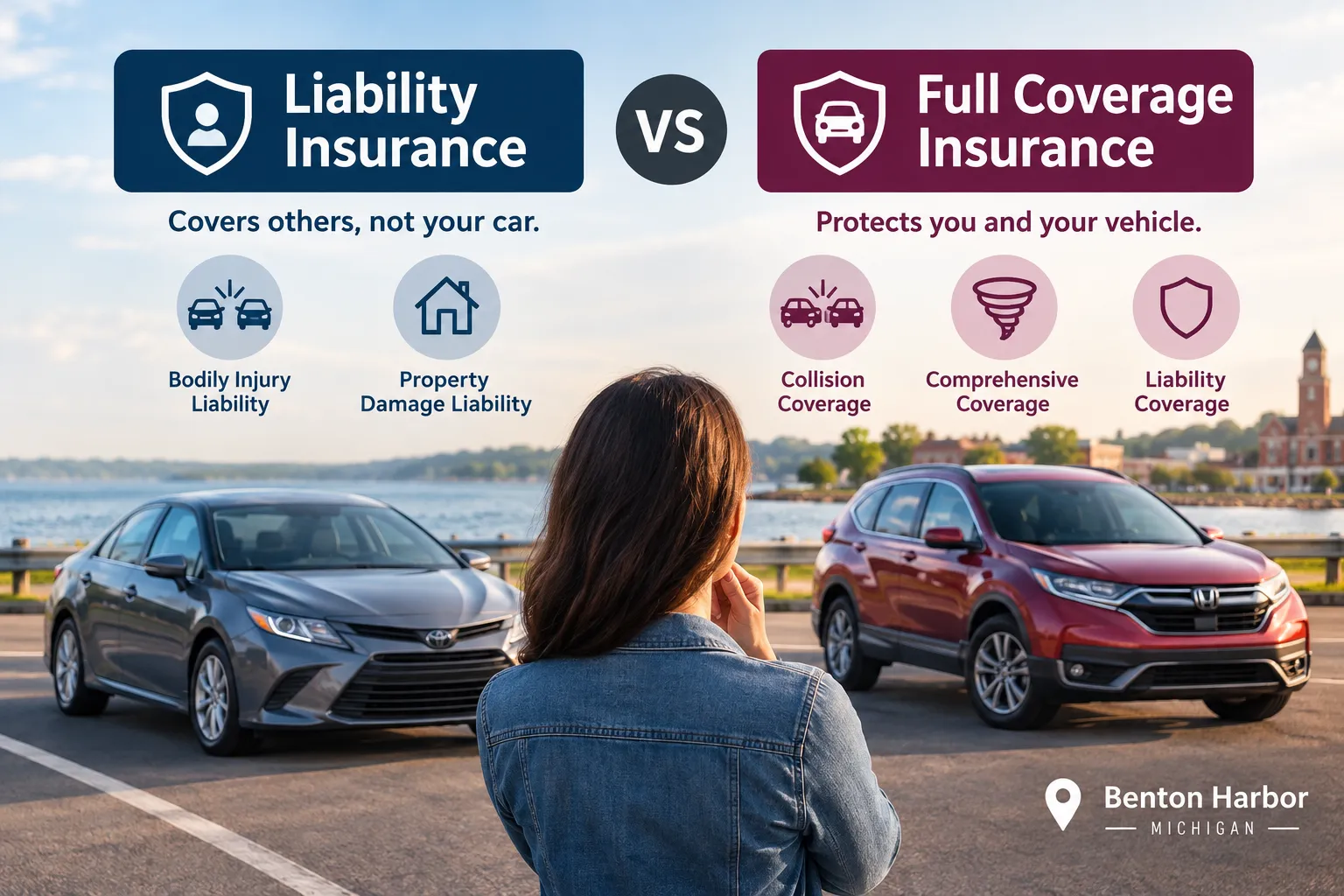

Choosing car insurance sounds simple until you start comparing policies. Liability insurance looks affordable. Full coverage costs more. The tricky part is understanding what you're actually paying for.
Many drivers assume "full coverage" means every possible accident, theft, or repair will be covered. That's not quite true. On the other hand, some people buy only liability insurance because it's the cheapest legal option, then discover after an accident that their own vehicle isn't protected.
If you're shopping for auto insurance in Benton Harbor, understanding this difference can save you hundreds—or even thousands—of dollars over time. The right policy depends on your car's value, your budget, your driving habits, and how much financial risk you're willing to accept.
This guide explains liability insurance and full coverage in plain English, compares their costs and benefits, and helps Benton Harbor drivers decide which option makes the most sense.
Liability Insurance vs. Full Coverage: The Short Answer
Here's the simplest way to think about it.
Liability insurance pays for damage or injuries you cause to other people if you're responsible for an accident. It protects others—not your vehicle.
Full coverage insurance usually combines liability insurance with collision and comprehensive coverage. That means it can also help pay for repairs or replacement of your own vehicle after many types of accidents or unexpected events.
The phrase "full coverage" is common in the insurance industry, but it's not an official policy type. It's really a bundle of coverages working together.
| Coverage Type | What It Usually Covers |
| Liability | Injuries and property damage you cause to others. |
| Collision | Damage to your car after a collision, regardless of fault. |
| Comprehensive | Theft, vandalism, hail, falling trees, fire, flooding, and similar non-collision events. |
| Full Coverage | Liability plus collision and comprehensive coverage, often with optional add-ons depending on the insurer. |
What Does Liability Car Insurance Cover?
Liability insurance exists because accidents don't just damage cars—they can injure people and destroy property.
Michigan requires drivers to carry liability insurance that meets state minimum requirements. These limits help cover expenses when you're legally responsible for an accident.
Bodily Injury Liability
This helps pay for another person's:
- Medical bills.
- Rehabilitation costs.
- Lost wages.
- Legal expenses if you're sued.
Imagine you accidentally rear-end another driver in downtown Benton Harbor. The other driver suffers a neck injury and needs physical therapy. Bodily injury liability helps cover those costs up to your policy limits.
Property Damage Liability
This covers damage you cause to someone else's property, including:
- Vehicles.
- Fences.
- Buildings.
- Utility poles.
- Mailboxes.
Think about sliding on icy Michigan roads and crashing into someone's parked truck. Property damage liability helps pay for repairs to that truck.
What Liability Insurance Does Not Cover
This is where many drivers get surprised.
Liability insurance generally won't pay for:
- Repairs to your own vehicle.
- Theft of your car.
- Flood damage.
- Hail damage.
- Vandalism.
- Falling tree branches.
If your vehicle is damaged and you're carrying liability only, you may have to pay the repair bill yourself.
What Does Full Coverage Car Insurance Include?
Full coverage expands protection beyond your legal responsibility to others.
Collision Coverage
Collision coverage helps repair or replace your car after:
- Hitting another vehicle.
- Running into a guardrail.
- Striking a pole.
- Rolling your vehicle.
- Single-car accidents.
Suppose you lose control during a snowstorm near Benton Harbor and hit a guardrail. Collision coverage may help repair your vehicle after you pay your deductible.
Comprehensive Coverage
Comprehensive protects against events that don't involve another moving vehicle.
Common claims include:
- Theft.
- Broken windshields.
- Fire.
- Flooding.
- Falling tree limbs.
- Animal collisions.
- Vandalism.
Michigan drivers frequently encounter deer on rural roads. If you hit a deer at night, comprehensive coverage typically applies because it's considered a non-collision event.
Liability Coverage Still Stays
Full coverage doesn't replace liability insurance. It includes it.
You're still protected if you injure someone or damage another vehicle while also protecting your own car against many common risks.
Why Michigan Drivers Often Choose Full Coverage
Michigan driving conditions are unique.
Winter storms, lake-effect snow, icy intersections, and frequent deer crossings all increase certain risks. Benton Harbor drivers also deal with summer storms that can bring hail, fallen branches, and localized flooding.
A vehicle parked outside overnight faces different risks than one stored in a garage.
That doesn't automatically mean everyone needs full coverage. Still, local conditions suggest comprehensive coverage may provide meaningful protection for many drivers.
How Much More Does Full Coverage Cost?
This is usually the biggest question.
Liability insurance almost always costs less because it covers fewer risks.
Full coverage costs more because the insurance company is also protecting your vehicle.
Several factors influence the difference:
Vehicle Value
A newer SUV generally costs more to insure than a 12-year-old sedan.
Driving History
Clean driving records often qualify for lower premiums.
Location
Rates can vary across Michigan based on traffic, accident frequency, weather patterns, and theft statistics.
Deductible Choice
Choosing a higher deductible often lowers your monthly premium.
For example:
- $500 deductible usually means a higher monthly payment.
- $1,000 deductible often reduces monthly costs but increases out-of-pocket expenses after a claim.
The cheapest policy isn't always the least expensive in the long run.
When Liability Insurance Might Make Sense
Liability-only insurance isn't automatically a bad decision.
Sometimes it's the practical one.
Your Vehicle Has Low Market Value
If your car is worth only $2,500 and full coverage costs nearly $1,000 annually, paying for extra protection may not always be financially efficient.
You Can Afford Unexpected Repairs
Some drivers maintain an emergency fund specifically for vehicle repairs.
You Own the Vehicle Outright
If there's no lender requiring additional coverage, liability-only becomes an available choice.
Still, there's a tradeoff.
A stolen vehicle or a serious collision could leave you replacing the car without insurance assistance.
When Full Coverage May Be the Better Option
Certain situations make full coverage easier to justify.
You Have a Loan or Lease
Lenders almost always require collision and comprehensive coverage until the loan is paid off.
Your Car Is Newer
Replacing a late-model vehicle can cost tens of thousands of dollars.
You Depend on Your Vehicle Daily
Missing work because your car can't be repaired creates costs beyond the repair bill itself.
Weather and Theft Risks Matter
If your vehicle sits outside during storms or in areas with higher theft risk, comprehensive coverage becomes more valuable.
Think of it like homeowner's insurance. You hope you never need it, but replacing everything after a disaster would be far more expensive than paying premiums.
Common Myths About Full Coverage Insurance
Myth 1: Full Coverage Covers Everything
Not exactly.
Most policies still have exclusions.
Routine maintenance, mechanical breakdowns, engine wear, and tire replacement generally aren't covered.
Myth 2: Liability Insurance Covers My Car If Someone Hits Me
Only if the other driver is responsible and their insurance pays.
Your own liability insurance doesn't repair your vehicle.
Myth 3: Older Cars Never Need Full Coverage
Age matters, but value matters more.
A well-maintained older truck worth $8,000 may still justify comprehensive and collision coverage.
Real-World Example: Liability vs. Full Coverage in Benton Harbor
Let's compare two drivers.
Driver A Has Liability Only
She owns a paid-off 2010 sedan.
A large tree branch falls during a Michigan storm.
Repair estimate: $3,800.
Insurance payment: $0.
She pays the full repair bill.
Driver B Has Full Coverage
He owns a 2021 crossover.
A deer runs into the road.
Repair estimate: $5,500.
Deductible: $500.
Insurance helps pay the remaining eligible repair costs after the deductible.
Both drivers experienced unexpected events. Only one policy protected the driver's own vehicle.
How to Decide Which Coverage Fits Your Situation
Ask yourself these questions instead of focusing only on price.
What's My Car Worth Today?
Use current market value, not what you originally paid.
Could I Replace My Car Tomorrow?
If replacing the vehicle would strain your finances, broader coverage deserves consideration.
Do I Drive Frequently?
More time on the road generally means greater exposure to accidents.
Where Is My Car Parked?
Street parking, apartment parking lots, and uncovered driveways may expose vehicles to additional risks.
What's My Budget?
A slightly higher monthly premium may prevent a much larger unexpected expense later.
Insurance isn't only about probability. It's also about financial consequences.
Optional Coverages Worth Considering
Full coverage can sometimes include or be paired with additional protections.
Uninsured and Underinsured Motorist Coverage
Helps if another driver doesn't have enough insurance.
Roadside Assistance
Useful for towing, battery jumps, flat tires, and lockouts.
Rental Reimbursement
Helps cover a rental vehicle while your car is being repaired after a covered claim.
Gap Insurance
Important for financed vehicles if the loan balance exceeds the vehicle's current value.
Not every driver needs every add-on. Choosing options based on your circumstances often provides better value than selecting every available feature.
Tips for Finding Affordable Full Coverage in Benton Harbor
If you want stronger protection without paying unnecessary premiums, try these strategies.
Compare Multiple Quotes
Rates can vary significantly between insurers for similar coverage.
Bundle Policies
Combining renters or homeowners insurance with auto insurance may qualify for discounts.
Maintain a Clean Driving Record
Safe driving often leads to better pricing over time.
Increase Your Deductible Carefully
Choose a deductible you could realistically pay during an emergency.
Review Coverage Every Year
A vehicle loses value over time. Coverage that made sense three years ago may deserve another look today.
Drivers shopping for auto insurance in Benton Harbor often discover that reviewing coverage annually helps identify discounts, adjust deductibles, or remove protections they no longer need.
Choosing the Right Auto Insurance in Benton Harbor
There's no universal answer because drivers have different priorities.
Liability insurance is designed to meet legal requirements and protect other people if you're responsible for an accident. It's often the lower-cost option, particularly for older vehicles with lower market value.
Full coverage goes further by protecting your own vehicle through collision and comprehensive coverage while still including liability protection. For many Michigan drivers—especially those with newer vehicles, loans, or daily commuting needs—that additional protection may reduce financial risk after unexpected events like collisions, theft, hail, or deer strikes.
If you're comparing policies through L.A. Insurance Benton Harbor, take time to look beyond the monthly premium. Compare deductibles, liability limits, collision coverage, comprehensive protection, and optional coverages side by side. A policy that appears slightly more expensive upfront may provide significantly more protection when you actually need to file a claim.
Final Thoughts
The difference between full coverage and liability car insurance isn't just about price—it's about what happens after something goes wrong.
Liability insurance helps protect you from the financial consequences of damaging someone else's property or causing injuries. Full coverage helps protect both your legal responsibility to others and your own vehicle against many common risks drivers face in Michigan.
For Benton Harbor drivers, weather, wildlife, daily commuting, and vehicle value all play a role in deciding which coverage fits best. The smartest choice is usually the one that matches your financial situation, your vehicle's value, and the level of protection you want—not simply the lowest premium on the page.



























Sign in to leave a comment.