
If you run a business in the UK, your website is often the first place potential customers interact with your brand. Whether someone finds you through Google, a social media post, a recommendation, or an online advert, your website needs to do more than simply look professional. It needs to work properly, load quickly, provide a smooth user experience, and make it easy for visitors to take action. This is where web development comes in.

Web development is the process of building, maintaining, and improving websites and web-based applications. It covers everything from the technical structure behind a simple business website to complex e-commerce platforms, customer portals, and web applications.
For UK businesses, understanding how web development works can help you make better decisions when creating a new website, redesigning an existing one, or choosing a web development company.
What Is Web Development?
Web development is the process of creating, building, testing, deploying, and maintaining websites and web applications.
While web design focuses mainly on how a website looks and how users interact with it, web development focuses on the technology that makes those experiences possible.
A modern website may involve:
- Front-end development
- Back-end development
- Database development
- API integrations
- Content management systems
- E-commerce functionality
- Website security
- Performance optimisation
- Hosting and deployment
- Ongoing maintenance
For example, when a customer visits an online shop, they may see product images, prices and navigation menus. Behind that interface, however, there may be databases, payment integrations, inventory systems, authentication tools and server-side code working together.
That technical infrastructure is a major part of web development.
Why Is Web Development Important for UK Businesses?
A business website has become an essential part of establishing credibility and generating enquiries online.
However, simply having a website is not enough.

Customers expect websites to be fast, mobile-friendly, secure and easy to use. If a site is difficult to navigate or takes too long to load, visitors may leave before contacting the business or making a purchase.
Good web development helps businesses create websites that are designed around both business objectives and customer needs.
A well-developed website can help you:
- Build trust with potential customers
- Generate enquiries and leads
- Sell products or services online
- Improve visibility in search engines
- Automate business processes
- Provide customer self-service
- Integrate different business systems
- Support digital marketing campaigns
- Create a stronger online presence
For smaller UK businesses, the website can effectively become a digital shopfront that is available around the clock.
For larger organisations, it may become a much more sophisticated platform connecting customers, employees, suppliers and internal systems.
What Is the Difference Between Web Design and Web Development?
Web design and web development are closely connected, but they are not the same thing.
Web design
Web design focuses on the visual and user experience aspects of a website.
It can include:
- Page layouts
- Colours
- Typography
- Branding
- Navigation
- User interface
- User experience
- Visual hierarchy
Web development
Web development focuses on building the technical functionality of the website.
It can include:
- HTML, CSS, and JavaScript
- Server-side programming
- Databases
- APIs
- Content management systems
- User accounts
- Payment systems
- Integrations
- Security
- Performance
Think of it this way:
Web design determines how a website looks and feels. Web development makes the website function.
For a successful business website, both areas need to work together.
What Are the Main Types of Web Development?
Web development can be divided into several areas depending on the complexity and purpose of a website.
1. Front-End Development
Front-end development covers the part of a website users see and interact with.
Common technologies include:
- HTML
- CSS
- JavaScript
- React
- Vue.js
Front-end developers make sure that websites work properly across desktops, tablets and smartphones.
For example, a restaurant website may have a menu, booking form, image gallery and contact section. Front-end development ensures these elements display correctly and respond properly when customers interact with them.
2. Back-End Development
Back-end development deals with the technology operating behind the website.
It may involve:
- Server-side programming
- Databases
- User authentication
- APIs
- Business logic
- Data processing
Technologies such as PHP, Laravel, Python and Django are commonly used to build different types of web solutions.
A customer may only see a login form, for example, but the back end is responsible for checking the user's credentials and securely retrieving their account information.
3. Full-Stack Development
Full-stack development combines front-end and back-end development.
A full-stack developer can work across different parts of a web project, from the user interface through to server-side functionality and databases.
This can be particularly useful for businesses developing custom web applications or more complex digital platforms.
4. E-commerce Development
E-commerce development focuses on websites that allow businesses to sell products or services online.
An e-commerce website may require:
- Product catalogues
- Shopping carts
- Payment gateways
- Customer accounts
- Order management
- Stock management
- Delivery options
- Discounts
- Reporting
Platforms such as WooCommerce and Shopify can be suitable for certain businesses, while larger or more specialised businesses may benefit from custom e-commerce development.
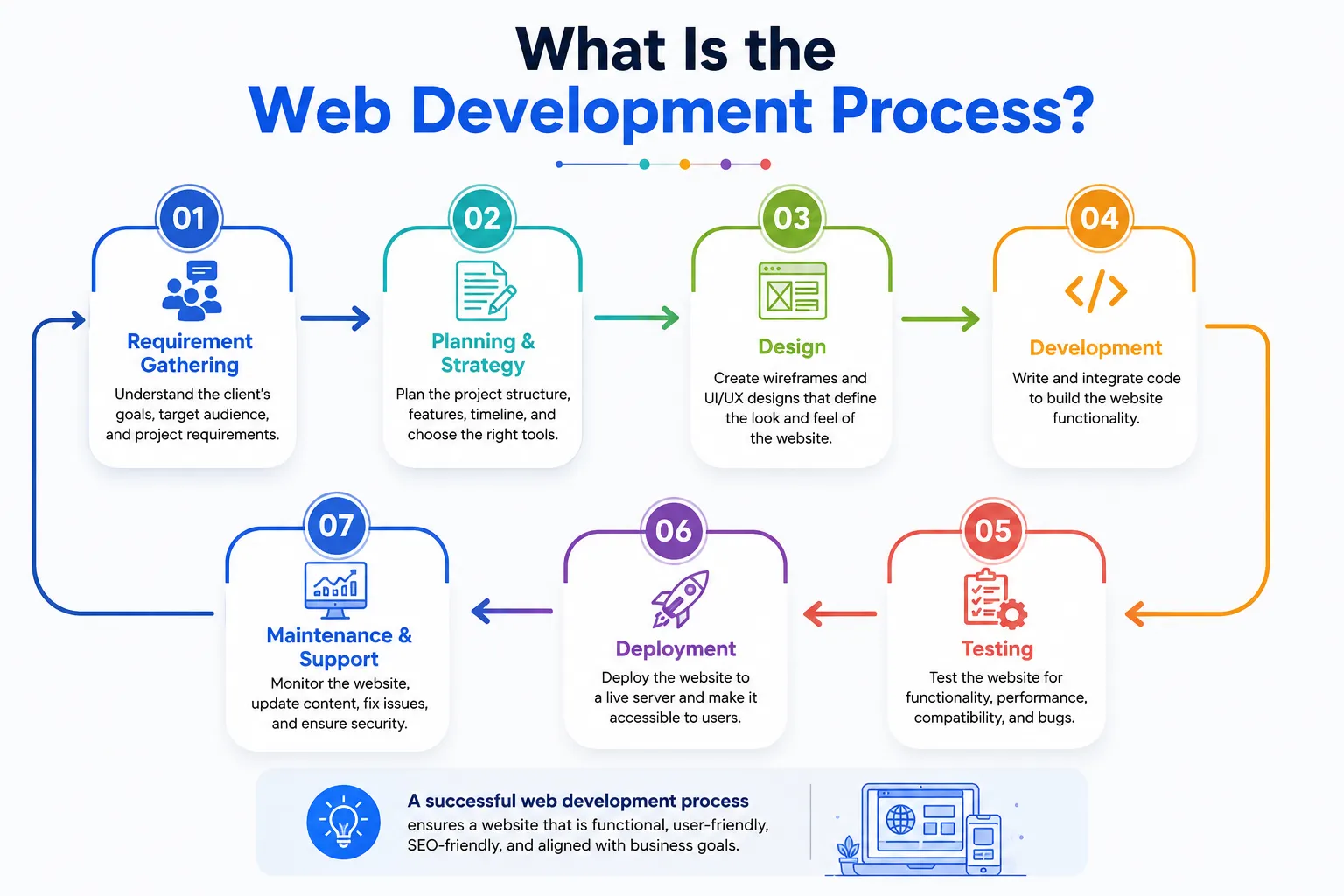
What Is the Web Development Process?
A professional web development process usually involves several stages.
Although every project is different, the process commonly looks like this.
Step 1: Discovery and Planning
The first stage is understanding the business and its goals.
Questions may include:
- Who is the target audience?
- What does the website need to achieve?
- What pages are required?
- Does the business need e-commerce?
- Are integrations required?
- What competitors are doing well?
- What SEO requirements need to be considered?
Good planning can prevent expensive changes later in the project.
Step 2: Website Structure
Next, the structure of the website is planned.
This includes:
- Navigation
- Page hierarchy
- Content structure
- User journeys
- Calls to action
- URL structure
A logical structure is important not only for users but also for search engines.
Step 3: Design
The visual design is then created based on the brand and target audience.
The design should balance aesthetics with usability.
A business website should not simply look attractive. Visitors should be able to quickly understand:
Who you are → What you offer → Why they should choose you → What they should do next.
Step 4: Development
Once the design is approved, developers begin building the website.
This is where the technical functionality is implemented.
Depending on the project, development could involve WordPress, Laravel, PHP, Python, React, Vue.js, Shopify, WooCommerce or a custom technology stack.
Step 5: Content Integration
Text, images, videos, product information and other content are added to the website.
SEO should also be considered at this stage.
Important elements include:
- Page titles
- Meta descriptions
- Heading structure
- Internal links
- Image optimisation
- Descriptive URLs
- Structured data where appropriate
Step 6: Testing
Before launch, the website should be thoroughly tested.
Testing can include:
- Mobile responsiveness
- Browser compatibility
- Forms
- Links
- Page speed
- Security
- Navigation
- Payment functionality
- Integrations
Testing is important because even small technical problems can affect the customer experience.
Step 7: Launch
Once testing is complete, the website can be deployed to the live environment.
The launch process may involve:
- Domain configuration
- Hosting
- SSL
- DNS
- Database configuration
- Analytics
- Search Console
- Redirects
Step 8: Ongoing Maintenance
Web development does not necessarily end when the website goes live.
Websites require ongoing maintenance to keep them secure, compatible and effective.
Maintenance may include:
- Software updates
- Security monitoring
- Backups
- Performance improvements
- Bug fixes
- Content updates
- Feature development
How Much Does Web Development Cost in the UK?
There is no single price for web development because the cost depends heavily on the project's requirements.
A simple brochure-style business website will generally require much less development work than a custom web application or e-commerce platform.
Factors that influence cost include:
- Number of pages
- Design requirements
- Custom functionality
- CMS requirements
- E-commerce functionality
- API integrations
- Database requirements
- User accounts
- Third-party systems
- SEO requirements
- Ongoing maintenance
Before choosing a developer, UK businesses should focus on value and suitability rather than simply choosing the cheapest quote.
A low-cost website that fails to generate enquiries or requires significant redevelopment later may ultimately cost more than investing in a suitable solution from the beginning.
Should Your Business Choose WordPress or Custom Web Development?
This depends on your business requirements.
WordPress can be a practical option for many small and medium-sized businesses that need a content-driven website and want to manage pages and blog content themselves.
Custom web development can be more appropriate when a business requires functionality that cannot easily be achieved through an existing platform.
For example, a company may need:
- A custom customer portal
- Complex workflows
- Bespoke dashboards
- Advanced API integrations
- Custom booking systems
- Business automation
- A SaaS platform
- Integration with internal systems
The right choice should therefore be based on what the business needs the website to accomplish, rather than which technology happens to be popular.
How Web Development Affects SEO
Web development and SEO are closely connected.
A technically strong website provides a better foundation for search visibility.
Developers should consider SEO during development rather than treating it as something to add after launch.
Technical areas that can affect SEO include:
Website speed
Slow websites can create a poor user experience and may affect search performance.
Mobile responsiveness
The website should work properly across smartphones, tablets and desktops.
Crawlability
Search engines need to be able to discover and understand important pages.
Site architecture
A logical hierarchy makes it easier for both users and search engines to understand the website.
URLs
Clean and descriptive URLs help communicate what a page is about.
Structured data
Relevant structured data can help search engines better understand entities, services, products and other information.
Internal linking
Well-planned internal links help users discover related content and help search engines understand relationships between pages.
This is particularly important for businesses investing in SEO, AEO and GEO.
Web Development and AI Search: Why It Matters
Search is changing.
People increasingly ask conversational questions through AI-powered search experiences rather than relying only on traditional keyword searches.
That means websites need to provide information in a way that both traditional search engines and AI systems can understand.
Good web development can support this by providing:
- Clear page structures
- Semantic HTML
- Structured data
- Crawlable content
- Fast performance
- Mobile-friendly experiences
- Logical internal linking
- Clear business information
- Author and organisation information
However, technical implementation is only one part of the equation.
The content itself needs to provide clear, useful and trustworthy answers.
For example, instead of creating a page that simply repeats:
"web development company UK"
a stronger page might explain:
- What web development means
- What services are included
- How development works
- Which technologies can be used
- How much projects can cost
- When businesses need custom development
- What businesses should look for in a development partner
This gives both users and search systems substantially more useful information.
How to Choose a Web Development Company
Choosing the right web development company is an important decision because your website can become a long-term business asset.
Before selecting a development partner, consider:
1. Relevant experience
Look at previous projects and check whether the company has worked on websites or applications similar to what you need.
2. Technical capabilities
Ask which technologies and platforms they work with and whether those technologies are appropriate for your project.
3. Development process
A professional company should be able to explain how it handles planning, design, development, testing and launch.
4. SEO knowledge
If organic search is important to your business, make sure SEO is considered during development.
5. Communication
Good communication can make a significant difference to the success of a project.
6. Scalability
Think beyond launch day.
Your website may need additional functionality as your business grows.
7. Ongoing support
Ask what happens after the website goes live.
Will the company provide maintenance, updates and technical support?
Common Web Development Mistakes Businesses Should Avoid
Businesses can make several mistakes when developing a new website.
Choosing a platform before defining requirements
Technology should support your business needs, not dictate them.
Focusing only on appearance
A visually attractive website that doesn't generate enquiries or provide a good user experience isn't doing its job.
Ignoring mobile users
A significant portion of website traffic comes from mobile devices, so responsive development is essential.
Treating SEO as an afterthought
Technical SEO should be considered from the beginning.
Forgetting website security
SSL, secure authentication, software updates and appropriate security practices are important for modern websites.
Not planning for growth
A website should ideally be capable of evolving with the business.
Launching without proper testing
Forms, links, integrations and key customer journeys should be tested before launch.
What Makes a Good Business Website?
A successful business website isn't necessarily the one with the most features.
It is the one that effectively connects the needs of the customer with the objectives of the business.
A strong website should generally be:
- Easy to navigate
- Fast
- Mobile-friendly
- Secure
- Accessible
- Search-friendly
- Easy to understand
- Professionally designed
- Focused on conversions
- Scalable
Most importantly, visitors should not have to work hard to understand what your business does or how they can contact you.
Frequently Asked Questions About Web Development
What is web development in simple terms?
Web development is the process of building and maintaining websites and web applications. It includes the technical work required to make websites function properly.
How long does web development take?
The timeline depends on the project's complexity. A simple business website may take considerably less time than a custom e-commerce platform or web application.
What is the difference between web design and web development?
Web design focuses primarily on the appearance and user experience of a website, while web development focuses on building its technical functionality.
Do small businesses need custom web development?
Not necessarily. Many small businesses can use platforms such as WordPress or Shopify. Custom development becomes more valuable when a business requires specialised functionality or integrations.
Is web development important for SEO?
Yes. Website architecture, performance, mobile usability, crawlability, structured data and other technical factors can influence how effectively search engines understand and access a website.
How much does a website cost in the UK?
Website development costs vary depending on functionality, design, integrations, platform, content and ongoing requirements. A simple business website will generally cost less than a complex custom application.
Should I hire a freelancer or a web development company?
It depends on your project's size and requirements. A freelancer may suit a smaller project, while a web development company can be useful when you need multiple disciplines, ongoing support, or more complex development.
Final Thoughts
Web development is much more than writing code or creating attractive web pages.
For a UK business, the right development approach can create a digital platform that supports marketing, sales, customer service and business operations.
Whether you need a straightforward business website, an e-commerce platform, a customer portal or a completely custom web application, the most important step is to start with your business objectives and customer requirements.
From there, the right combination of design, technology, SEO, functionality and ongoing support can turn your website into a long-term business asset.
Elegant Systems helps businesses with website development, web applications, custom software, mobile applications and digital marketing solutions. If you're planning a new website or looking to improve an existing one, the right development strategy can give your business a stronger foundation for long-term digital growth.

























Sign in to leave a comment.