

A low quotation can be attractive even when blanket prices in Kenya are already competitive, when an importer compares several offers. But the lowest unit price is not always the lowest buying cost. The difference may come from construction, size, material, finishing, or excluded costs.
For buyers sourcing wholesale blankets in Kenya, ask what the product includes and what it will cost after arrival.
Here are the questions a Kenyan importer should ask before treating a low quotation as a bargain for the business overall.
1. What exactly is included in the quoted price?
Start with the quotation itself. Ask whether the price covers the same product specification as the competing offer.
Check:
- Blanket size
- GSM
- Fibre composition
- Construction
- Finishing
- Packaging
- Individual polybag or bulk packing
- Carton quantity
- Labels and markings
- Minimum order quantity
- Incoterm and destination
Two suppliers can quote for what appears to be the same blanket while offering materially different products. A quote for 200 × 230 cm, for example, should not be compared directly with a smaller blanket simply because both are described as “double.”
This is one reason blanket cost comparison should begin with specifications rather than price alone.
2. Is the blanket actually the same weight?
Weight is one of the easiest areas to overlook. Buyers comparing blanket weight and quality should ask for the finished weight per piece, not just the fabric GSM.
GSM means grams per square metre. It can help indicate fabric density, but it does not tell you the complete finished weight of a blanket. Size, construction, borders, stitching, finishing and other components can change the final weight.
A supplier quoting a very low price may simply be offering a lighter product. That is not necessarily a problem if the product is intended for a low-price retail segment; blanket quality and price should still be compared.
Ask for both:
- GSM
- Finished blanket weight
Then compare products on the same size and construction basis.
3. What is the fibre or material composition?
The phrase “soft blanket” tells an importer very little. Ask exactly what fibres are used and whether the composition is consistent across the shipment.
When comparing blanket material and price, look beyond the fibre name. Ask about yarn, construction, finishing, and whether the specification is the same as the approved sample.
For synthetic blankets, the exact construction can affect hand feel, bulk, warmth, appearance and durability. A lower-priced product may use a different blend, lower-density construction, or simpler finish.
This is where blanket quality and price need to be evaluated together. Paying less can make sense when the specification is intentionally designed for a value segment. It makes less sense when a lower price is being achieved by quietly changing the product.
4. Does the lower GSM actually suit the customer?
A high GSM blanket is not automatically better for every buyer. The right specification depends on the intended use, climate, retail position, and customer expectations.
For Kenyan importers, the practical question is whether the blanket will perform appropriately for the market and sales channel where it will be offered.
Ask:
- Is the product intended for everyday household use?
- Is it positioned as a budget blanket?
- Is it meant for cooler regions or seasons?
- Is softness more important than bulk?
- Will customers expect a heavy, substantial feel?
- Is the product being sold individually or in value packs?
The best GSM is therefore not a universal number. It is the GSM that matches the product's intended use and price position.
5. What happens to the price after freight and import costs?
A supplier's factory or FOB quotation is only one part of the buying calculation.
For blanket importers in Kenya, the more useful figure is the landed cost: the amount required to get the goods into the intended market after applicable freight, insurance, duties, clearance, local transport and related charges.
Not every shipment will have the same cost structure, so buyers should calculate the complete transaction rather than assuming the lowest supplier quote wins.
6. Does the blanket size justify the price?
Blanket size affects material consumption, finished weight, packaging volume, and shipping efficiency. A cheaper blanket with a noticeably smaller usable area may not be cheaper on a like-for-like basis.
Instead of comparing price per piece alone, calculate price against:
- Finished size
- Finished weight
- Number of pieces per carton
- Cubic volume
- Expected retail position
This creates a more useful purchasing comparison for wholesale orders.
7. How consistent is the production?
A competitive first order is not enough. Importers need consistency between the approved sample and the commercial shipment.
A reliable inspection list should include measurable specifications, not vague descriptions such as “premium,” “export quality,” or “high quality.”
This is particularly important for repeat orders. If the first shipment sells well but the next shipment feels noticeably lighter or has different dimensions, customer confidence can suffer.
8. Is the finishing the same?
Finishing is easy to ignore when comparing photographs and quotations. Yet it can influence how a blanket feels and looks at the point of sale.
When comparing blanket suppliers in Kenya, ask whether both quotations include the same:
- Edge finishing
- Stitching
- Binding
- Printing or embossing
- Brushing
- Packaging
- Labels
9. How should thickness and GSM be compared?
Blanket thickness and GSM are related, but they are not interchangeable measurements.
A blanket can feel bulky because of its construction, loft, or finishing without having an extremely high GSM. Conversely, a higher-GSM material may not feel as thick as expected depending on fibre and construction.
That is why buyers should compare a sample with the stated specification. Measure the dimensions, check the weight, examine the surface, and assess softness and recovery after handling.
10. What does the supplier say about durability?
Price discussions often focus on what the blanket costs today. Retailers should also consider how the product performs after use and washing.
These questions help connect blanket material and price with actual customer value. A product that is cheaper but generates complaints, returns, or discounts may be more expensive for the importer in practice.
How Kenyan buyers can compare two quotations properly
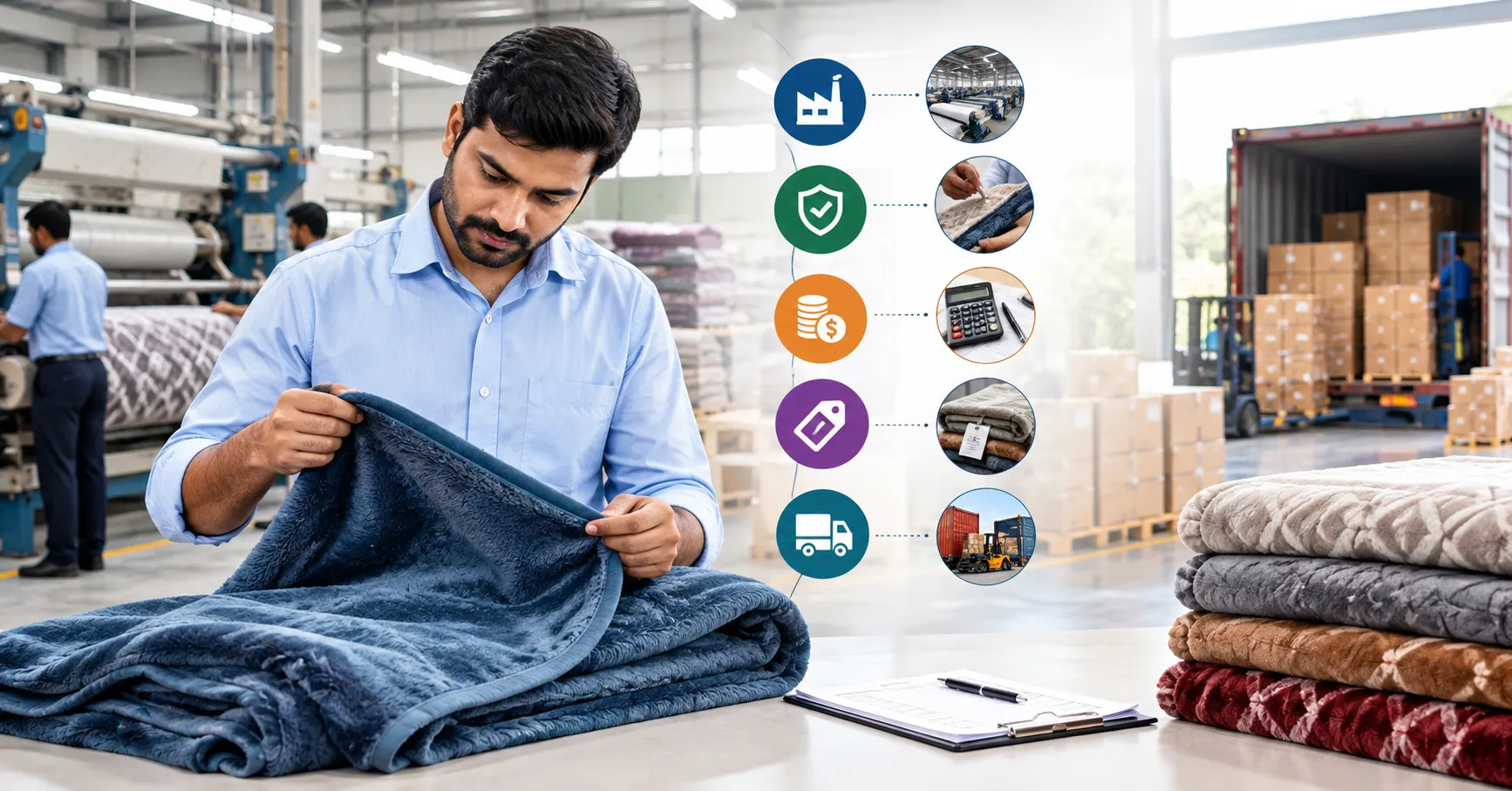
A useful comparison sheet should put both offers side by side. Include product size, GSM, finished weight, material, construction, packaging, pieces per carton, MOQ, price basis, freight assumptions, and estimated landed cost.
This approach makes the buying decision less dependent on the headline number.
Where Indian sourcing can fit
Indian textile manufacturers can be relevant when Kenyan buyers sourcing wholesale blankets in Kenya want a combination of product variety, customization, and export-oriented manufacturing. World Bank trade data shows India among the sources of blankets imported into Kenya in certain product categories, although the volume and value vary by classification.
JTI ( Jindal Textile Industries LTD) is one example of an Indian textile manufacturer and exporter that can be considered when buyers are evaluating blanket production, customization, and export supply. The important point for any importer is to match the manufacturer's capabilities with the exact product specification and commercial requirement.
The right questions matter more than the cheapest quote for wholesale blankets in Kenya.
A low quotation is worth investigating, not automatically accepting. The difference may come from a smaller size, lower GSM, different material, simpler finishing, lighter packaging, or costs that have not yet been added.
For buyers sourcing wholesale blankets in Kenya, the strongest purchasing decision usually comes from comparing equivalent specifications and the total landed cost. Price still matters, but it should be evaluated alongside product performance, consistency, freight efficiency, and the price customers are willing to pay.
The same logic applies when comparing blanket prices in Kenya, because a cheaper product is only a better deal when it delivers the required value at the required cost.
Google's current guidance for AI search emphasizes useful, original, non-commodity information and says there are no special technical requirements solely for appearing in AI Overviews or AI Mode. Strong foundational SEO and genuinely helpful content remain the better approach.
FAQs
1. Why can two blankets have very different prices?
Differences in GSM, size, fibre composition, construction, finishing, packaging, order quantity, and shipping terms can all affect the quotation. Always compare the full specification before deciding which offer is cheaper.
2. How should wholesale blankets in Kenya be compared between suppliers?
Compare the same size, GSM, finished weight, material, construction, and packaging first. Then compare MOQ, freight terms, and estimated landed cost. This gives a much more meaningful purchasing decision than comparing unit prices alone.
3. What should I ask blanket suppliers in Kenya before placing a bulk order?
Ask for the exact specification, sample, finished weight, GSM, material composition, dimensions, packing details, MOQ, production lead time, and quality-control process. Put the agreed specifications into the purchase documentation.
4. Is a higher GSM always a better blanket?
No. GSM is only one measure. A higher GSM can mean more material per square metre, but the right specification depends on construction, fibre, intended use, climate and the customer's expectations.
5. How does blanket weight and quality affect buying decisions?
Finished weight can help buyers identify differences between products of the same size, but it should not be used alone as a quality test. Combine weight with GSM, construction, material, finishing, and sample performance.
6. What is the best way to evaluate blanket material and price?
First identify the exact fibre composition and construction. Then compare the material specification with finished weight, size, finishing, and expected durability. This makes the price easier to judge in commercial terms.
7. What should a blanket quality checklist include?
A practical blanket quality checklist should cover size, GSM, finished weight, material composition, stitching, edge finishing, colour, surface feel, defects, packaging and sample-to-bulk consistency.
8. How do blanket thickness and GSM differ?
GSM measures mass per square metre, while thickness refers to how physically thick the material or finished blanket feels. Construction and loft can make two blankets with similar GSM feel different.
9. What should blanket importers in Kenya include in a blanket cost comparison?
Include product price, quantity, size, finished weight, packaging, freight, insurance, applicable import charges, clearance, local transport, and other relevant costs. Comparing only the supplier's unit price can give a misleading result.
10. Can JTI ( Jindal Textile Industries LTD) supply blankets for export markets?
JTI ( Jindal Textile Industries LTD) is an Indian textile manufacturer and exporter that can be evaluated for blanket requirements based on product specification, customization, order quantity, and export needs. Buyers should confirm the exact specification and commercial terms for their project.



























Sign in to leave a comment.