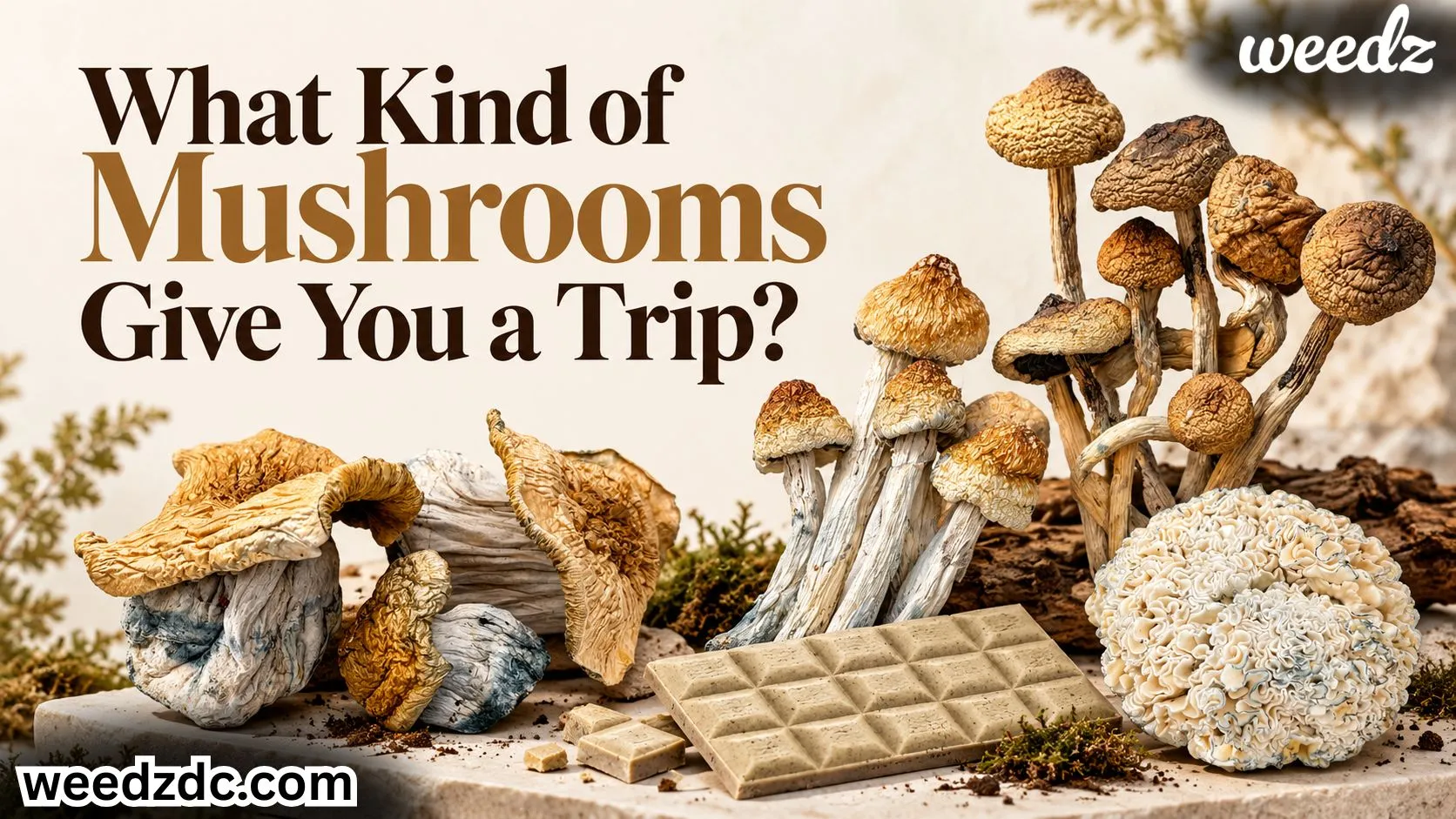

Mushrooms that give you a trip are commonly known as magic mushrooms or shrooms, and they contain the active compounds psilocybin and psilocin. These naturally occurring psychedelic compounds can produce changes in perception, mood, sensory experiences, and thinking.
Not every mushroom associated with psychedelic effects belongs to the same species or even the same genus. Several fungi contain psychoactive compounds, while others may have entirely different active chemicals and pharmacological effects.
Understanding the difference between these mushrooms is important because the term "magic mushrooms" is often used broadly. Some species contain psilocybin, while others contain different compounds that can produce substantially different effects and risks.
What Mushrooms Give You a Trip?
The mushrooms most commonly associated with psychedelic experiences are species that contain magic mushrooms compounds such as psilocybin and psilocin.
Psilocybin is converted by the body into psilocin, which interacts with serotonin receptors in the brain. This interaction is associated with changes in perception, cognition, mood, and sensory processing.
The effects can vary considerably depending on the individual, the mushroom species, the chemical composition of the material, and other circumstances. A psychedelic experience is therefore not necessarily identical from one person to another.
The term "trip" generally refers to the altered state of consciousness associated with psychedelic substances. Experiences may involve changes in visual perception, time perception, emotions, thought patterns, and the interpretation of sensory information.
What Are Psychedelic Mushrooms?
Psychedelic mushrooms are fungi that contain psychoactive compounds capable of producing altered states of consciousness.
The most widely discussed psychedelic mushrooms contain psilocybin and psilocin. These compounds belong to a broader group of psychedelic substances that can affect serotonin signaling in the brain.
Psilocybin-containing mushrooms have attracted significant scientific interest, particularly because researchers have investigated their effects in controlled clinical settings. Research has examined areas including mood, perception, consciousness, and other psychological processes.
It is important to distinguish scientific research from recreational claims. Findings from controlled studies do not necessarily mean that an uncontrolled experience will produce the same effects or outcomes.
Species Classifications
Several species of fungi contain these active compounds. The most widely referenced in scientific literature include:
- Psilocybe cubensis: A frequently studied species within clinical research due to its prevalence and characteristics under controlled cultivation.
- Psilocybe semilanceata: Commonly found in temperate grassland environments across various regions.
- Panaeolus cyanescens: A distinct genus of psychoactive mushroom found primarily in tropical and subtropical climates.
- Psilocybe azurescens: A species identified in specific coastal habitats, primarily within the Pacific Northwest.
- Amanita muscaria: Unlike the Psilocybe genus, this species contains muscimol rather than psilocybin, resulting in a fundamentally different pharmacological profile that carries significant risks of toxicity.
These classifications demonstrate why "magic mushrooms" should not be treated as a single biological category. Different species can contain different compounds and produce different pharmacological effects.
Psilocybe cubensis
Psilocybe cubensis is one of the best-known psilocybin-containing mushroom species.
It has been widely referenced in scientific literature and is frequently discussed in research concerning psilocybin mushrooms. Its prevalence has also contributed to its recognition outside academic settings.
The species belongs to the Psilocybe genus, a group that includes multiple species containing psilocybin and related compounds.
A key point when discussing Psilocybe cubensis is that the chemical composition of mushrooms can vary. The presence of a particular species does not necessarily mean that every specimen has identical concentrations of psychoactive compounds.
For that reason, scientific discussions generally distinguish between species identification and the actual chemical composition of a particular sample.
Psilocybe semilanceata
Psilocybe semilanceata is another well-known psilocybin-containing species.
It is commonly associated with temperate grassland environments and has been documented across various regions. Its distribution differs from that of tropical or subtropical species.
Like other psilocybin-containing fungi, its psychoactive properties are associated primarily with psilocybin and psilocin.
The species is particularly relevant to the broader scientific understanding of naturally occurring psilocybin-containing fungi because it demonstrates that these compounds occur across multiple species and ecological environments.
Panaeolus cyanescens
Panaeolus cyanescens belongs to a different genus from Psilocybe.
It is associated primarily with tropical and subtropical environments and is recognized as a psychoactive mushroom containing psilocybin-related compounds.
Its inclusion in discussions of psychedelic mushrooms highlights an important biological distinction: fungi with similar psychoactive compounds do not necessarily belong to the same genus.
Scientific classification is based on biological characteristics rather than simply on whether a mushroom produces psychedelic effects.
Psilocybe azurescens
Psilocybe azurescens is a species associated with specific coastal habitats, particularly areas of the Pacific Northwest.
It belongs to the Psilocybe genus and is recognized for containing psilocybin and related psychoactive compounds.
Its geographic association is one reason it frequently appears in discussions about the diversity of naturally occurring psilocybin-containing fungi.
As with other mushroom species, however, species names alone do not provide enough information to determine the chemical composition or potential effects of an individual specimen.
What About Amanita muscaria?
Amanita muscaria is often included in popular discussions about psychedelic or "magic" mushrooms, but it is pharmacologically different from psilocybin-containing species.
Instead of psilocybin and psilocin, Amanita muscaria contains compounds including muscimol and ibotenic acid.
Muscimol acts primarily on GABA-related signaling, producing a fundamentally different pharmacological profile from classical psychedelics such as psilocybin.
This distinction matters because the effects and risks associated with Amanita muscaria are not equivalent to those associated with Psilocybe species.
Amanita muscaria can also carry significant toxicity risks. It should therefore not be treated as simply another variety of psilocybin mushroom.
What Is the Difference Between Magic Mushrooms and Psychedelic Mushrooms?
The terms are often used interchangeably in everyday conversation, but their meanings can vary depending on context.
Magic mushrooms is a common informal term generally associated with mushrooms containing psilocybin or psilocin.
Psychedelic mushrooms is a broader descriptive term referring to mushrooms capable of producing psychedelic or otherwise altered states of consciousness.
In scientific discussions, researchers are more likely to identify the specific species and psychoactive compounds involved rather than relying on general terms.
This distinction is useful because not every psychoactive mushroom produces its effects through the same mechanism.
What Happens During a Psychedelic Mushroom Experience?
A psychedelic experience involving psilocybin can affect several aspects of perception and cognition.
People may experience changes in:
- Visual perception
- Time perception
- Emotional intensity
- Thought patterns
- Sensory awareness
- Sense of self
- Interpretation of surroundings
The experience can also vary substantially between individuals.
Environmental factors, psychological state, expectations, and individual sensitivity can influence how an experience is perceived. This is one reason controlled scientific research carefully manages the environment in which psychedelic substances are studied.
Psychedelic effects can also be unpredictable and may include anxiety, confusion, distress, nausea, or other unwanted reactions.
Are Mushroom Gummies the Same as Magic Mushrooms?
Mushroom gummies are edible products marketed using mushroom-related ingredients, but the term does not automatically mean that a product contains psilocybin.
Some mushroom gummies may contain non-psychoactive mushroom ingredients, mushroom extracts, or other compounds. Product names and marketing terminology alone therefore cannot establish their chemical contents.
This distinction is particularly important when discussing products described as "mushroom" products. A mushroom-themed product and a naturally occurring psilocybin-containing mushroom are not necessarily the same thing.
Consumers and researchers should distinguish between the biological mushroom species, the active chemical compounds, and the formulation of any commercial product.
What Are Mushroom Spores?
Mushroom spores are microscopic reproductive structures produced by fungi.
Spores are part of the natural reproductive cycle of mushrooms and are analogous in some ways to seeds in plants, although they are biologically different.
The presence of spores does not by itself indicate that a mushroom is psychoactive. Different fungi produce different spores, and many non-psychoactive mushroom species also reproduce through spores.
For scientific identification, researchers may consider spores alongside other biological characteristics, but a single characteristic is generally not enough to establish a reliable species identification.
What Is Golden Teacher Mushroom?
Golden teacher mushroom is a commonly used name associated with a particular variety or cultivated line of Psilocybe cubensis.
The name is widely recognized in popular discussions of psilocybin mushrooms. However, informal strain or variety names should not be confused with formal biological species classifications.
In this case, the broader species classification is Psilocybe cubensis, while "Golden Teacher" is a commonly used name for a particular variety.
This distinction is useful when reading scientific information because research generally identifies organisms using standardized taxonomic names rather than informal commercial or community names.
Are All Psychedelic Mushrooms the Same?
No. Different psychoactive mushrooms can contain different compounds, occur in different environments, and interact with the body through different pharmacological pathways.
For example, Psilocybe species are associated with psilocybin and psilocin, while Amanita muscaria contains muscimol and ibotenic acid.
Even among psilocybin-containing species, chemical composition can vary. This means that simply identifying something as a "magic mushroom" does not provide a complete description of its chemistry or potential effects.
Species, compounds, and context all matter when discussing psychedelic fungi.
Frequently Asked Questions
Q1. What kind of mushrooms make you trip?
The mushrooms most commonly associated with psychedelic trips are species containing psilocybin and psilocin, particularly species within the Psilocybe genus. Other fungi can contain different psychoactive compounds and should not automatically be considered equivalent.
Q2. Which mushroom is most commonly associated with psilocybin?
Psilocybe cubensis is one of the most widely recognized psilocybin-containing mushroom species and has been frequently discussed in scientific and popular literature.
Q3. Are psychedelic mushrooms the same as magic mushrooms?
The terms can overlap. Magic mushrooms usually refers to psilocybin-containing mushrooms, while psychedelic mushrooms can be used more broadly to describe fungi associated with psychedelic effects.
Q4. Does Amanita muscaria contain psilocybin?
No. Amanita muscaria does not contain psilocybin as its primary psychoactive compound. Its pharmacological effects are associated with compounds including muscimol and ibotenic acid.
Q5. Are mushroom gummies psychedelic?
Not necessarily. mushroom gummies can refer to many different products, and the term itself does not establish that a product contains psilocybin or another psychedelic compound.
Q6. What are the main species of psilocybin mushrooms?
Frequently referenced species include Psilocybe cubensis, Psilocybe semilanceata, and Psilocybe azurescens. Panaeolus cyanescens is another psychoactive species from a different genus.
Q7. Are mushroom spores psychedelic?
mushroom spores themselves are reproductive structures and should not be assumed to have the same psychoactive properties as mature mushrooms. Their presence does not establish that a particular fungus is psychoactive.
Final Thoughts
The mushrooms most commonly associated with psychedelic trips are fungi containing psilocybin and psilocin. Several species contain these compounds, with Psilocybe cubensis, Psilocybe semilanceata, Psilocybe azurescens, and Panaeolus cyanescens among the commonly referenced examples.
Amanita muscaria belongs in a different category because its primary psychoactive compounds include muscimol and ibotenic acid rather than psilocybin. Its pharmacological effects and toxicity considerations are therefore substantially different.
Understanding the difference between species, compounds, and informal product names can make information about psychedelic mushrooms much easier to interpret. Weedz DC can serve as a starting point for consumers interested in learning about different mushroom-related product categories, while scientific sources provide the appropriate context for understanding the underlying biology and pharmacology.





















Sign in to leave a comment.