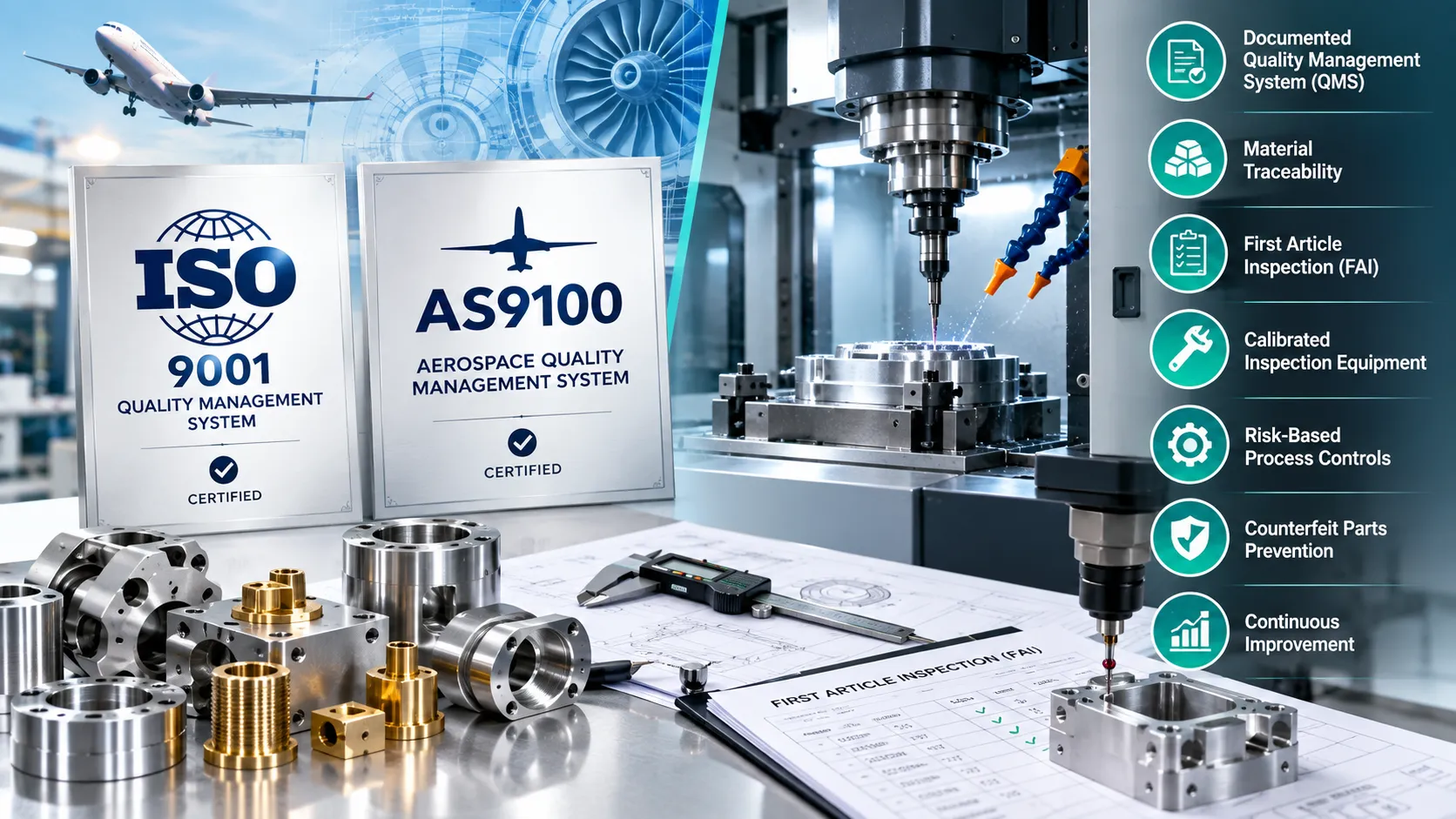

When a buyer searches for a CNC precision components manufacturer, they're usually not just looking for someone who can run a mill or a lathe. They're looking for a partner whose quality system, documentation, and process discipline can survive an audit, especially if the parts are headed into aerospace, defense, medical, or any other tightly regulated supply chain. That's where certifications like ISO 9001 and AS9100 come in, and why so many sourcing teams treat them as a non-negotiable filter rather than a nice-to-have.
This article breaks down what "AS9100-ready" actually means in practice, and what to look for when evaluating a precision CNC components manufacturer for your next project.
Why Certification Matters More Than Machine Specs
It's tempting to judge a manufacturer purely on the equipment list, 5-axis machining centers, CMM inspection, live tooling lathes. Those matter, but machines don't guarantee consistency. Certification frameworks like AS9100 exist because the aerospace and defense industries learned, often the hard way, that a single uncontrolled process step can turn a precision part into a safety liability.
AS9100 is built on top of ISO 9001 but adds requirements specific to aerospace: configuration management, risk management, counterfeit parts prevention, and first article inspection (FAI), among others. A manufacturer that holds AS9100 has already been audited on all of this, not just told a customer they follow "best practices."
Core Elements of an AS9100-Ready Manufacturer
1. A Documented Quality Management System (QMS)
Every process, from receiving raw material to final inspection, needs to be documented, controlled, and repeatable. This isn't paperwork for its own sake; it's what allows a manufacturer to trace a defect back to its root cause and prevent it from recurring.
2. Material Traceability
For regulated industries, every batch of raw material needs a paper trail back to the mill certification. A cnc precision components manufacturer that can't tell you which heat lot a part came from isn't going to pass an aerospace audit, and shouldn't be trusted with critical parts.
3. First Article Inspection (FAI)
AS9100 requires a full first article inspection report (per AS9102) on new or changed parts, verifying every dimension and characteristic against the engineering drawing before production runs. This catches design or process issues before they become scrap at scale.
4. Calibrated, Controlled Inspection Equipment
CMMs, gauges, and measuring tools need to be calibrated on a schedule and controlled so measurement results are actually trustworthy. A shop that can show calibration records for its inspection equipment is signaling that its dimensional data can be trusted.
5. Risk-Based Process Controls
AS9100 pushes manufacturers to identify risks in their processes: tooling wear, operator variation, supply chain disruption, and build controls around them, rather than reacting after a nonconformance happens.
6. Counterfeit Parts Prevention
This is unique to AS9100 and reflects aerospace's zero-tolerance stance on counterfeit materials entering the supply chain. Manufacturers need documented procedures for verifying supplier authenticity.
7. Continuous Improvement and Internal Audits
Certification isn't a one-time event. AS9100-certified manufacturers run internal audits, track corrective actions, and are re-assessed periodically to keep the certification active.
ISO 9001 vs AS9100: How They Relate
ISO 9001 is the foundation, a general quality management standard used across virtually every manufacturing industry. AS9100 layers aerospace-specific requirements on top of it. In practice, this means:
- Every AS9100-certified manufacturer is effectively ISO 9001-compliant, but not every ISO-certified manufacturer meets AS9100's stricter aerospace requirements.
- If your parts are going into aerospace, defense, or other high-reliability applications, AS9100 is the standard to look for specifically, not just ISO 9001.
- For general industrial or commercial parts, a strong ISO 9001 system may be entirely sufficient.
Buyers researching iso certified precision manufacturing companies india should keep this distinction in mind: certification level should match the application, not just the lowest common denominator a supplier happens to hold.
What to Ask a Manufacturer Before You Source
When evaluating a precision cnc components manufacturer, a few direct questions will tell you more than a certificate on a wall:
- Can you provide a copy of your current AS9100/ISO certificate and the certifying body's name, so I can verify it independently?
- What's your process for handling a nonconformance discovered after shipment?
- Can you walk me through a recent first article inspection report?
- How do you maintain material traceability from raw stock to finished part?
- What's your on-time delivery and first-pass yield rate over the last 12 months?
A manufacturer confident in its quality system will answer these without hesitation: and usually has the documentation ready to share.
The Bottom Line
Certification isn't a marketing checkbox, it's evidence of a manufacturing partner that has built repeatable, auditable processes around precision, traceability, and risk control. For buyers sourcing critical components, working with an AS9100-certified CNC precision components manufacturer significantly reduces the risk of downstream quality failures, audit findings, or supply chain disruptions.
Before signing off on a supplier, verify the certificate, ask for objective evidence of the practices behind it, and make sure the certification level actually matches what your application demands.
























Sign in to leave a comment.