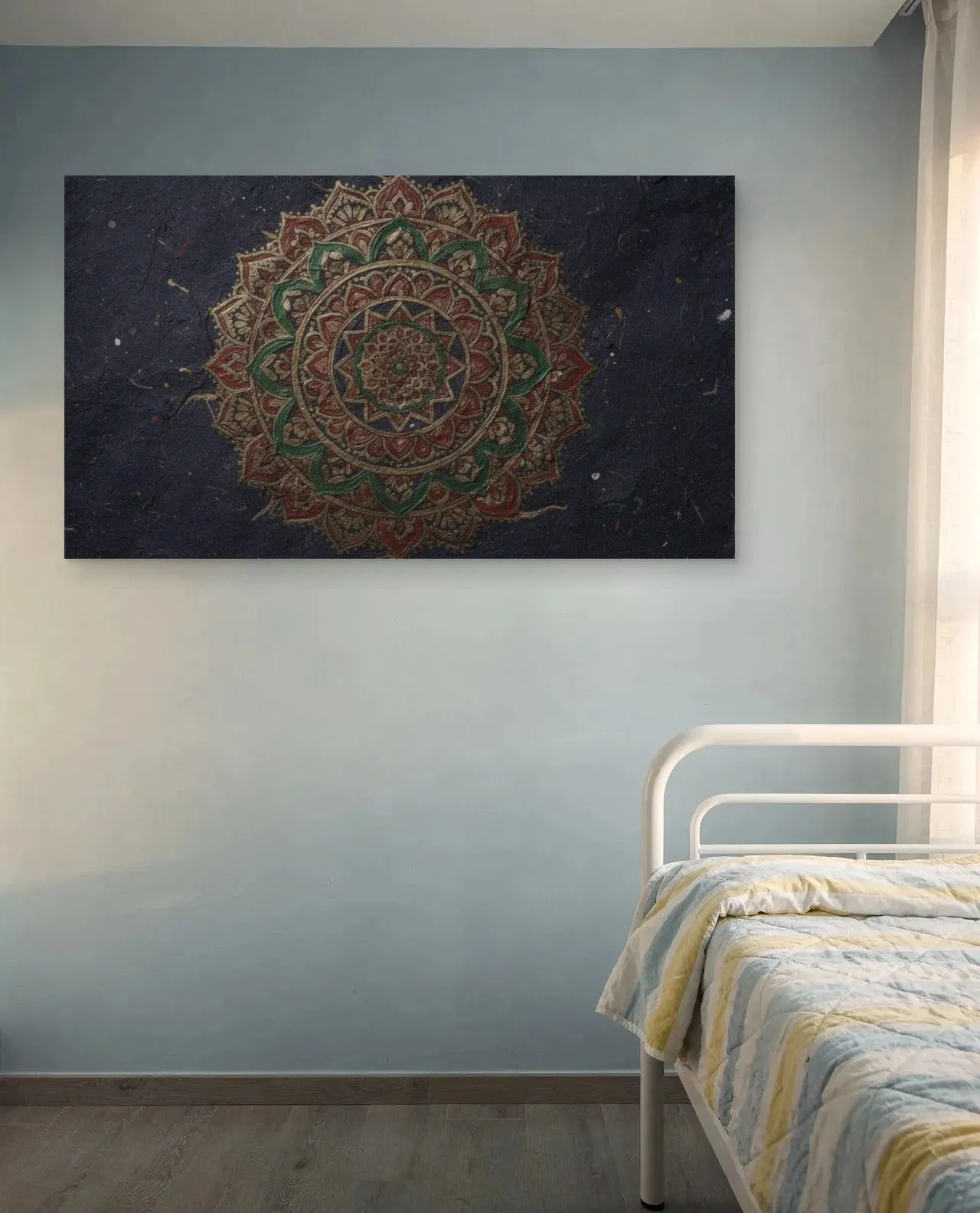

Some artwork catches your attention because of its colour. Some because of the subject. A mandala tends to do it for a different reason.
You look at the centre first, then your eyes naturally move outward, following the shapes and repeated details. There is a sense of order in the design, even when the pattern itself is incredibly intricate. It feels detailed without necessarily feeling messy.
That balance is probably a big part of what makes mandalas so appealing as home décor.
There Is Something Satisfying About Symmetry
We tend to notice balance quickly.
A mandala is usually organised around a central point, with patterns spreading outward in a carefully arranged sequence. Shapes repeat, lines mirror one another, and smaller details fit into a larger structure.
The result is visually predictable in a good way.
You can look at a mandala for a few seconds and appreciate the overall pattern, or spend much longer noticing the smaller elements hidden within it. It offers both impressions at once.
That makes it particularly effective on a wall, where artwork often needs enough visual interest to hold attention from across the room.
It Gives an Empty Wall a Sense of Purpose
An empty wall isn't necessarily a problem. Sometimes a room actually benefits from having some breathing space.
But there are walls that simply feel unfinished.
A well-chosen mandala can solve that without requiring a collection of frames, shelves or decorative objects. Its circular shape creates a natural focal point, while the detailed pattern adds character to an otherwise plain surface.
This works especially well above a sofa, console table, bed or reading corner.
The artwork doesn't have to fill the entire wall. In fact, leaving some space around it can make the design feel even more prominent.
The Centre Draws You In
One of the interesting things about mandalas is the way they are structured.
Unlike artwork where your eye might immediately move towards a person, landscape or particular object, a mandala often encourages you to look towards its centre first.
From there, the pattern expands outward.
There is no single detail that necessarily demands all your attention. Instead, your eyes keep moving between the centre and the surrounding shapes.
That creates a slightly different viewing experience from ordinary decorative artwork. You can notice something new each time you look at it.
Detailed Doesn't Always Mean Overwhelming
A common concern with highly patterned artwork is that it might make a room feel too busy.
With mandalas, symmetry helps keep that complexity under control.
Even when there are many lines, petals, circles and geometric elements, the repetition gives them a sense of consistency. Your eye recognises the pattern rather than seeing hundreds of unrelated details.
Of course, the surrounding room still matters.
If your furniture, rugs and accessories already have strong patterns, a simpler design may work better. In a quieter room, a more detailed piece can become the visual feature that brings everything together.
Colour Changes the Personality of a Mandala
The structure may stay similar, but colour can completely change how the artwork feels.
A mandala using earthy browns, muted greens and warm neutrals can complement a natural interior. Rich reds, oranges or golds can make the artwork feel more dramatic. Blues and cooler shades can create a calmer visual presence.
This is why choosing mandala art isn't only about finding a pattern that looks beautiful.
Think about the colours already present in your room.
You don't necessarily need an exact colour match. Sometimes choosing an artwork with one or two shades already present in the furniture or accessories is enough to make it feel connected to the space.
It Works Beyond One Decorating Style
Mandalas are sometimes associated mainly with spiritual or traditional interiors, but they can work in much more varied settings.
A simple black-and-white design can suit a contemporary room.
A colourful pattern can add warmth to an eclectic space.
A detailed, traditional-looking design can complement Indian-inspired interiors and other spaces built around textiles, wood and handcrafted elements.
This flexibility is one reason mandala wall art continues to find a place in modern homes. The artwork can carry cultural or symbolic meaning, but it can also simply be appreciated as a beautiful piece of design.
You don't have to decorate an entire room around it.
Size Matters More Than People Expect
The same design can look completely different depending on its size.
A smaller piece can create a quiet detail in a bedroom, hallway or corner. A larger artwork has enough presence to become the main feature of a wall.
Before choosing one, look at the furniture around the space.
A tiny artwork above a large sofa may disappear visually. On the other hand, an oversized piece in a narrow area can make the space feel crowded.
Taking a quick measurement of the wall before buying is a surprisingly useful step.
It also helps to consider the viewing distance. Fine details become much more enjoyable when the artwork is large enough for you to actually see them.
You Don't Need to Overdecorate Around It
One of the easiest mistakes is trying to make a mandala part of an already crowded display.
Because the artwork itself can contain so much detail, it often looks better when it has room around it.
A plain wall, simple furniture and one carefully chosen artwork can sometimes have more impact than a wall covered with multiple decorative pieces.
This is particularly true when the mandala has a strong centre and intricate outer pattern.
Let it be seen.
The empty space around the artwork isn't wasted space. It gives the design somewhere to breathe.
More Than Just a Decorative Pattern
There is also a reason mandalas can feel different from purely decorative geometric designs.
In various traditions, mandalas have been connected with ideas such as balance, wholeness and contemplation. Their meanings aren't identical across cultures or designs, so it is worth avoiding the idea that every mandala represents exactly the same thing.
For some people, that symbolism is an important part of the artwork.
For others, the attraction is simply the geometry and visual rhythm.
Either way, the design gives you something beyond a flat block of colour on a wall.
Why the Appeal Has Lasted
Interior trends change constantly.
Colours come and go. Certain furniture styles become popular and then disappear. Yet circular patterns and symmetrical designs have a quality that doesn't depend entirely on a particular decorating trend.
Perhaps that's why mandalas can feel both familiar and contemporary.
They have enough structure to feel intentional, enough detail to remain interesting, and enough variety in colour and style to fit different kinds of homes.
And ultimately, that's what makes a piece of wall art worth keeping around.
Not because it happens to be fashionable this year, but because you still enjoy looking at it months or years later.
A captivating mandala doesn't need to shout for attention.
Sometimes, its balance, repetition and quiet complexity are enough to make you stop and look.


















Sign in to leave a comment.