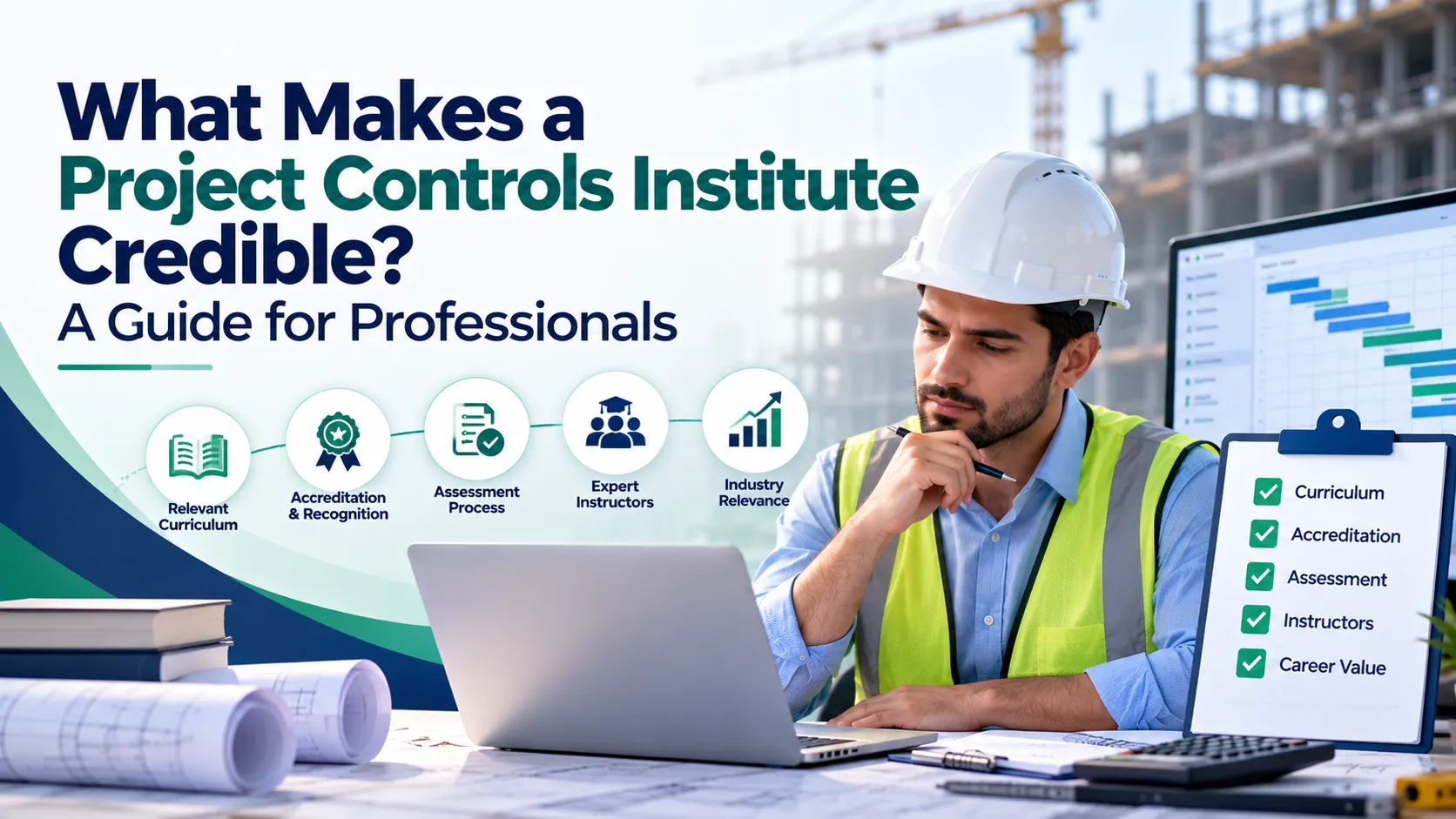


Choosing a project controls certification is an important decision for professionals who want to strengthen their skills and advance their careers. But how can you tell whether a project controls institute is credible? The answer goes beyond a professional-looking website or an impressive certificate. You should examine the curriculum, assessment process, instructor expertise, accreditation status, transparency, and relevance to real project work. Project Controls Institute PCI AI is one provider professionals can evaluate using these criteria.
What Makes a Project Controls Institute Credible?
A credible project controls institute clearly explains what its courses teach, how candidates are assessed, who awards the certification, and whether the credential is formally accredited or independently recognised. It should publish transparent eligibility requirements, fees, assessment policies, and learning outcomes. Professionals should verify these details before enrolling rather than relying on marketing claims or the certificate title alone.
Credibility is built through verifiable information, clear standards, relevant learning, and honest communication about what a qualification does—and does not—represent.
1. Check the Curriculum and Industry Relevance
A credible project controls institution should offer a curriculum that reflects the responsibilities professionals handle in real projects. Project controls involves more than monitoring a budget or updating a schedule. It connects cost, time, risk, progress, forecasting, and reporting to support better project decisions.
When reviewing a project controls course, look for coverage of relevant topics such as:
Project cost control: Comparing actual costs with approved budgets and identifying variances.
Project planning and scheduling: Monitoring milestones, delays, and schedule performance.
Risk management: Identifying uncertainties that could affect project cost or delivery.
Forecasting: Estimating likely final costs and completion dates.
Performance measurement: Using project data to understand progress and identify issues.
Integrated project controls: Connecting cost, schedule, risk, and progress information rather than treating them as separate activities.
The curriculum should also explain what learners are expected to understand or demonstrate after completing the programme.
For example, a cost engineer may need deeper knowledge of forecasting and cost variance analysis, while a project controls manager may need broader skills in integrated reporting, risk, and leadership. A credible institute should make it possible to judge whether the programme fits these needs.
2. Verify Accreditation and Certification Recognition
Accreditation is one of the most important factors to check, but the terminology can be confusing.
Accreditation generally refers to an independent assessment of an organisation, programme, or certification process against specified requirements. Certification is a credential awarded to a person after meeting the relevant conditions. A certificate issued by an organisation does not automatically mean that the organisation or credential is accredited.
Before enrolling, ask these questions:
Is the institute formally accredited by an independent accreditation body?
Which organisation provides the accreditation?
Does the accreditation cover the specific certification you are considering?
Can the accreditation claim be verified through the accreditor's official directory?
Do employers in your industry recognise the credential?
Be cautious of phrases such as “internationally recognised” or “based on international standards” unless the provider explains exactly what they mean and supplies evidence.
An institute may offer useful training without holding formal accreditation. The important point is to understand the distinction and decide whether the credential meets your professional needs.
3. Evaluate the Assessment Process
A credible professional certification should have a defined method for assessing candidates.
The assessment should test whether a person has demonstrated the competencies the credential claims to represent.
Look for the following details:
Assessment format: Is it a scenario-based exam, multiple-choice test, practical assignment, or another method?
Passing requirements: Is the pass mark published, and is the assessment process explained?
Eligibility rules: Are candidates required to meet specific experience or education requirements?
Exam integrity: Are identity checks, proctoring, and examination rules clearly explained?
Credential verification: Can employers or clients verify that a certificate is genuine?
Appeals and retakes: Are the relevant policies available to candidates?
Project Controls Institute (PCI AI) publishes information about its certification framework and examination process. Its PCL-AI credential is described as a scenario-based assessment covering integrated project controls, including cost engineering, forecasting, risk, project finance, and the governed use of AI.
When evaluating these claims, review the current certification scheme and candidate policies directly. Published procedures are useful evidence of transparency, but they do not by themselves establish independent accreditation or universal employer recognition.
4. Compare the Institute's Credentials With Your Career Goals
A credible institute should clearly distinguish between its programmes so candidates can choose the one that matches their professional needs.
For example, PCI AI describes three credentials:
PCL-AI — PCI AI Project Controls Leader: Focuses on integrated project controls, including planning, cost engineering, earned value, forecasting, risk, project finance, and governed AI use.
PFL-AI — PCI AI Project Finance Leader: Focuses on project finance, financial modelling, capital structure, bankability, and financing analysis.
PML-AI — PCI Project Management Leader – AI: Focuses on project management, leadership, governance, delivery, and AI-enabled project management.
These credentials have different purposes. A cost engineer or planner may find the integrated project controls curriculum more relevant, while a finance professional may prefer a project finance focus. A project manager looking to strengthen delivery and leadership skills may prefer the project management route.
Before choosing, compare the curriculum with the work you actually perform and the responsibilities you want to take on next.
5. Check Transparency, Governance, and Public Information
A credible institute should make important information easy to find. This includes its legal identity, certification policies, fee structure, assessment rules, credential verification process, and any limitations on recognition.
When reviewing an institute, look for:
A clear explanation of who owns and operates it.
Published certification and assessment policies.
Transparent exam, membership, and renewal fees.
A public method for verifying issued credentials.
Clear information about complaints, appeals, and recertification.
Honest disclosure of accreditation status and organisational development.
PCI AI identifies itself as Project Controls Institute Global, Inc., a Delaware non-stock corporation. Its website states that it intends to seek recognition as a tax-exempt organisation under Section 501(c)(3), but that status has not yet been granted. The institute also explicitly states that it is not currently accredited by ANAB, IAS, or an ISO/IEC 17024 accreditation body.
These details matter because they allow candidates to make informed decisions. A provider's stated commitment to international standards should not be confused with formal accreditation by an independent body.
6. Use This Checklist Before Enrolling
Before paying for any project controls certification, ask yourself:
Does the syllabus match my current role or career goals?
Are the eligibility requirements and assessment format clear?
Can I verify the provider's accreditation claims independently?
Is the total cost transparent?
Can employers verify the certificate?
Do employers in my target industry recognise the qualification?
Does the programme teach skills I can apply to real projects?
Are limitations, renewal conditions, and recognition policies clearly disclosed?
If you cannot find answers to these questions, contact the provider before making a commitment.
Final Thoughts
A credible project controls institute should be able to explain what its certification represents, how candidates are assessed, and what its accreditation status actually means. Take time to verify these details instead of relying on promotional claims alone. If you are considering Project Controls Institute (PCI AI), visit its to review the certification scheme, current policies, and PCL-AI, PFL-AI, and PML-AI programmes before deciding whether one fits your professional goals.
Frequently Asked Questions
Q1. What makes a project controls institute credible?
A credible institute provides a relevant curriculum, transparent assessment rules, verifiable credentials, clear fees, and accurate information about accreditation and recognition.
Q2. Is project controls certification the same as accreditation?
No. Certification is a credential awarded to a person after meeting specified requirements. Accreditation is an independent assessment of an organisation, programme, or process against defined criteria.
Q3. Is PCI AI an accredited project controls institute?
PCI AI states that its certification framework is developed with reference to ISO/IEC 17024 principles, but it is not currently formally accredited by an ISO/IEC 17024 accreditation body. Check its official disclosures for the latest status.
Q4. What should I check before choosing a project controls certification?
Review the syllabus, exam format, eligibility requirements, fees, accreditation status, credential verification process, and recognition within your target industry.
Q5. Can a project controls certification improve my career?
It may support professional development and demonstrate relevant knowledge, but it does not guarantee a job, promotion, or salary increase. Practical experience and employer requirements remain important.
Q6. What is the PCL-AI certification?
PCL-AI stands for PCI AI Project Controls Leader. According to PCI AI, it covers integrated project controls, including planning, cost engineering, earned value, forecasting, risk, project finance, and governed AI use.
Q7. How can employers verify a project controls certificate?
Check whether the issuing organisation provides a public credential verification service. Use the official register or verification link to confirm the credential's authenticity and status.
Q8. Should I choose a certification based only on its price?
No. Compare the curriculum, assessment quality, total cost, recognition, and relevance to your goals. A lower-priced credential is not automatically better value, and a more expensive one is not automatically more credible.
















Sign in to leave a comment.