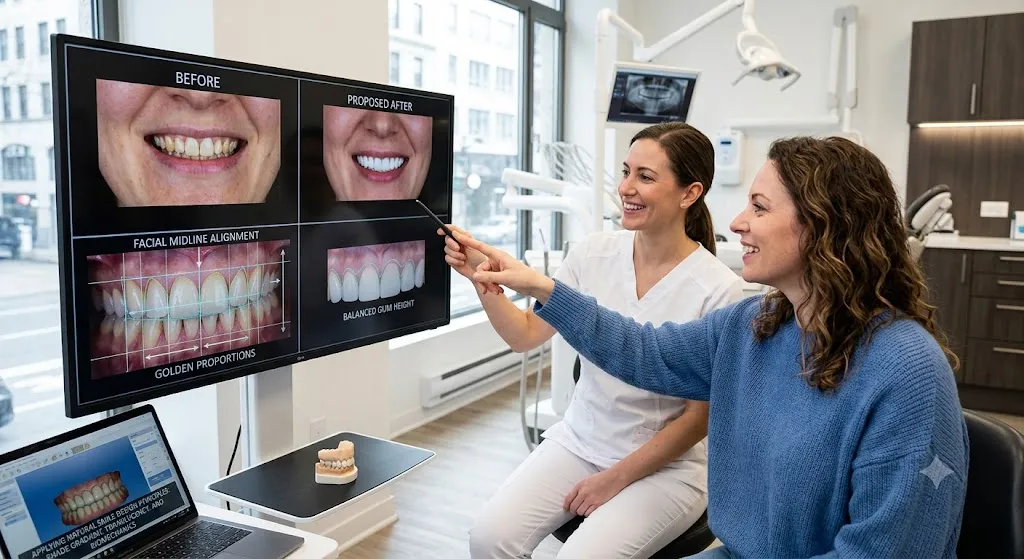

Ask most people what they fear about cosmetic dentistry and the answer is rarely pain or cost. It is looking "done". Teeth that are too white, too straight, too big, or somehow too perfect for the face they sit in.
That fear is reasonable. We have all seen smiles that look artificial from across a room. But the difference between a natural result and an obvious one is not luck. It comes down to a set of design principles that skilled cosmetic dentists and dental technicians work to. Understanding them will help you know what to ask for, and what to be wary of.

Perfect Symmetry Is Not the Goal
The first surprise for many people is that a natural smile is not perfectly symmetrical. Real teeth vary slightly in size, shape and angle from one side to the other, and our brains read that small variation as normal.
Research backs this up. In a well-known study published in the Journal of Esthetic and Restorative Dentistry, dentists and members of the public rated smile photographs that had been deliberately altered. General dentists and lay people could not spot even a 4mm shift in the centre line of the upper teeth, and lay people did not notice an uneven biting edge until it reached 3mm.
In other words, the eye of a trained professional is far more critical than everyone else's. A good cosmetic dentist uses that knowledge wisely: they correct what genuinely bothers you and what others notice, rather than chasing a mathematically perfect smile that ends up looking manufactured.
The Smile Should Follow the Lips
One of the most reliable signs of a natural smile is how the edges of the upper front teeth relate to the lower lip. In a youthful, relaxed smile, the biting edges of the upper teeth tend to form a gentle curve that roughly follows the line of the lower lip as you smile.
When teeth are made in a flat, straight line, the smile can look older, harder or artificial, even if every individual tooth is well made. This is why careful practices photograph and video your smile before designing anything. The teeth have to be planned around your lips and face, not in isolation.
Proportion Matters More Than Size
Oversized teeth are one of the most common reasons a smile looks unnatural. Veneers or crowns that are too long, too wide or too bulky make the whole mouth look crowded and can change how your lips sit.
Natural front teeth follow a pattern. The two central incisors are the largest and most dominant, the teeth either side are narrower and slightly shorter, and the canines turn gently back towards the side of the mouth. Keeping this hierarchy is what makes a smile look balanced. When every tooth is made the same width and length, the effect is flat and uniform, like a row of piano keys.
The size of the teeth should also suit the face. Someone with a narrow face and delicate features usually suits a different tooth shape from someone with broad features and a wide smile.
Colour Is About More Than White
Shade is where many smiles go wrong. Natural teeth are not a single flat colour. They are slightly warmer near the gum, brighter in the middle and more translucent at the biting edge, where light passes through the enamel.
A natural result reproduces those qualities. A tooth made in one opaque shade of bright white, with no translucency at the tip, reads instantly as artificial, especially in photographs and daylight.
The right shade also depends on the person. Skin tone, the colour of the whites of your eyes, and your age all influence what looks believable. The aim is teeth that look like the healthiest version of your own, not teeth that belong in a different mouth.
Texture and Surface Detail
Look closely at a natural front tooth and you will see fine surface texture: subtle vertical ridges and horizontal lines that catch the light differently across the tooth. Highly polished, perfectly smooth surfaces reflect light like glass, which is another giveaway.
Skilled technicians add this micro-texture deliberately. It is a small detail, but it is often the difference between teeth that look handmade and teeth that look mass-produced.
The Gums Frame the Smile
Teeth never exist on their own; the gums frame them. A natural smile has gum lines that sit at sensible heights, with the gum above the central incisors and canines usually slightly higher than above the teeth in between.
How much gum shows when you smile matters too. In the same 1999 study, general dentists and lay people found up to 4mm of visible gum acceptable, while orthodontists found more than 2mm unattractive. Most people do not need their gum line changed at all. But where a single gum line is noticeably uneven, correcting it before cosmetic work can make the final result look far more natural.
Less Tooth Removed, More Natural Result
Some of the most natural results come from the least invasive treatments. Whitening, gentle straightening with aligners and composite bonding can all transform a smile while keeping the natural tooth underneath.
Where veneers are needed, conservative preparation keeps them thin enough to sit flush with the teeth and gums. Bulky restorations placed on top of teeth that have not been shaped at all can look thick and protruding. Heavily cut-down teeth, on the other hand, sacrifice healthy tooth structure permanently. The skill is in finding the right balance for each case.
A Smile Has to Work in Motion
Finally, a smile is not a photograph. It moves when you talk, laugh and eat. A design that looks fine in a still image can show too much tooth when you speak, or change how you pronounce certain sounds.
That is why careful planning often includes video and a trial smile, a temporary version of the design placed over your teeth so you can see it, speak with it and check it before anything permanent is made.
How to Judge Whether a Result Will Look Natural
Before agreeing to cosmetic treatment, ask your dentist:
- Can I see before-and-after photos of cases similar to mine, taken in natural light?
- How will you decide on the shape, size and shade for my face?
- Will the design follow my lip line and include natural variation?
- Can I see a preview, and try a temporary version in my mouth?
- Which treatments could achieve this with the least removal of natural tooth?
- Can we make the design more subtle if I want to?
Many UK practices now publish their approach openly so you can judge it before booking; one Surrey practice sets out its planning process for smile makeovers at https://keppeladvanceddentistry.co.uk/smile-makeovers/. Whoever you choose, look for a dentist who talks about your face, your lips and your preferences before they talk about treatments.
The Bottom Line
A natural-looking smile is not the whitest, straightest or most symmetrical one. It is a smile designed around your face, with realistic proportions, layered colour, subtle texture and gums that frame it properly. The best cosmetic dentistry is often the kind nobody notices: people simply think you look well. If you remember one thing, make it this: ask to see your result before anything permanent happens.
























Sign in to leave a comment.