
PTFE is widely used in industrial applications because of its low friction, chemical resistance, and ability to perform under demanding conditions. However, not every application requires the same type of PTFE. When components are exposed to heavy loads, continuous movement, wear, or dimensional stress, standard PTFE may not always provide the required mechanical performance. Choosing between virgin and modified PTFE can therefore become an important part of solving an industrial sealing or component-performance problem.
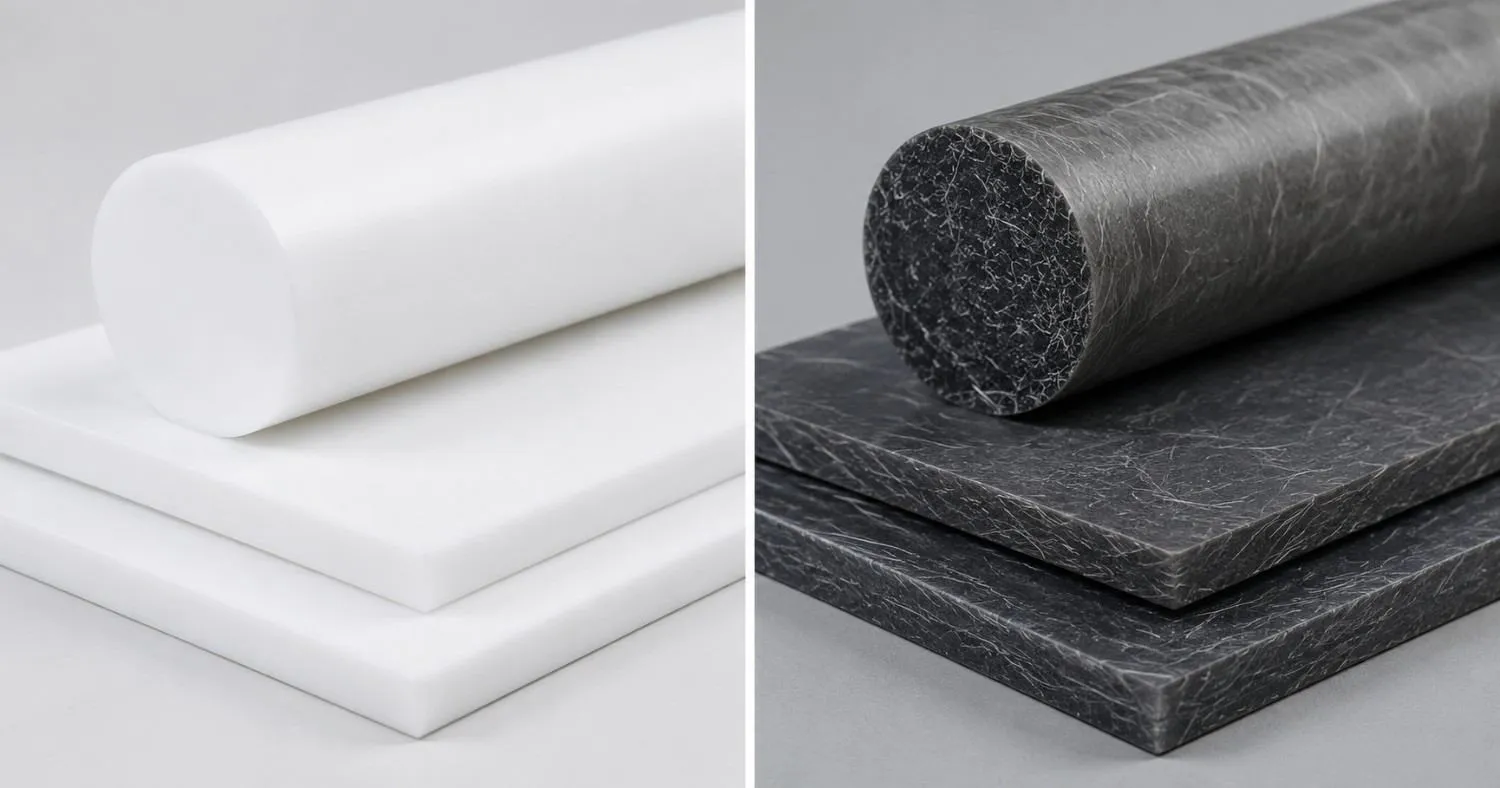
Virgin PTFE is made from PTFE resin without reinforcing fillers, while Glass-Filled PTFE contains glass fibres or glass filler incorporated into the PTFE base material to improve certain mechanical properties. Both materials retain many of PTFE's useful characteristics, but their performance can differ when subjected to load, wear, deformation, and demanding operating conditions.
Why Can Virgin PTFE Face Performance Challenges?
Virgin PTFE offers excellent chemical resistance and very low friction, making it suitable for many industrial applications. However, pure PTFE can have relatively low mechanical strength compared with reinforced PTFE compounds.
Under continuous pressure or heavy loads, virgin PTFE may experience deformation or creep. This can become a concern in applications where a component needs to maintain its shape and dimensions over an extended period.
For low-load applications, this may not create a major issue. But when equipment operates under demanding mechanical conditions, a reinforced PTFE compound may provide a more suitable solution.
How Does Glass-Filled PTFE Improve Mechanical Performance?
The addition of glass filler can improve several mechanical characteristics of PTFE. Glass reinforcement can increase hardness, stiffness, compressive strength, and resistance to deformation.
This makes Glass-Filled PTFE useful when a component needs to withstand higher mechanical stress than conventional virgin PTFE can comfortably handle.
For example, PTFE seals, bushes, bearings, and other components exposed to continuous pressure may benefit from the improved dimensional stability provided by glass reinforcement.
Better Wear Resistance for Demanding Applications
Wear is a common problem in moving industrial components. Repeated contact between surfaces can gradually remove material from a component, affecting its dimensions and performance.
Glass-filled grades can provide improved wear resistance compared with virgin PTFE in many applications. This can help extend component service life where repeated movement, friction, and mechanical contact are involved.
However, the actual wear performance depends on factors such as filler percentage, mating material, load, speed, temperature, and operating environment. Material selection should therefore be based on the complete application rather than a single property.
What About Dimensional Stability?
Dimensional stability is important for precision industrial components. A component that changes shape under pressure or temperature can affect the alignment and sealing performance of an assembly.
Virgin PTFE can experience creep and deformation under sustained loads. Glass reinforcement can help reduce these effects by increasing the rigidity of the material.
This makes glass-filled grades useful for applications where maintaining dimensions under mechanical stress is particularly important.
Chemical Resistance: Virgin vs Glass-Filled PTFE
Virgin PTFE is known for its excellent resistance to a wide range of chemicals. Adding glass filler can change the overall behaviour of the material, so chemical compatibility should be evaluated based on the specific compound being used.
For highly aggressive chemical environments, virgin PTFE may be preferred when maximum chemical inertness is the primary requirement. In other applications, the improved mechanical properties of glass-filled grades may provide a better balance between chemical resistance and mechanical performance.
Therefore, the right choice depends on which problem the component needs to solve.
How Should You Choose Between the Two?
The choice between virgin and glass-filled PTFE should be based on actual operating conditions. Important factors include:
- Operating temperature
- Mechanical load
- Pressure
- Sliding speed
- Chemical exposure
- Wear requirements
- Dimensional stability
- Mating surface
- Expected service life
- Installation conditions
If the application primarily requires chemical resistance and low friction under relatively low mechanical stress, virgin PTFE may be appropriate. If the component needs greater resistance to wear, deformation, or mechanical loading, a glass-filled grade may be worth considering.
Why Does Manufacturer Expertise Matter?
Selecting the right PTFE compound can be difficult when an application involves multiple operating challenges. Different filler percentages and material formulations can provide different performance characteristics.
Businesses looking for reliable industrial PTFE solutions may consult experienced ptfe manufacturers in india to discuss their specific requirements. A knowledgeable manufacturer can help evaluate factors such as load, temperature, chemical exposure, dimensional requirements, and expected wear before recommending a suitable material.
This approach can help prevent the common problem of selecting a material based only on price or a single advertised property.
Where Is Glass-Filled PTFE Commonly Used?
Glass-filled PTFE can be used in a variety of industrial components and systems, including:
- PTFE gaskets
- Seals and sealing rings
- Bushes and bearings
- Valve components
- Pump components
- Industrial machinery
- Hydraulic systems
- Chemical processing equipment
- Sliding components
- High-load mechanical applications
The specific grade should be selected according to the operating requirements of each application.
Is Glass-Filled PTFE Always Better Than Virgin PTFE?
Not necessarily. The two materials are designed to solve different performance requirements.
Virgin PTFE provides excellent chemical resistance, low friction, and a high level of material purity. Glass-filled PTFE adds reinforcement to improve mechanical properties such as stiffness, wear resistance, and resistance to deformation.
Choosing a reinforced material when it is unnecessary may not provide meaningful benefits, while using virgin PTFE in a high-load application could result in premature deformation or wear.
The goal should therefore be to select the material that best matches the application's actual conditions.
Conclusion
The main difference between Glass-Filled PTFE and virgin PTFE is the balance between chemical and mechanical performance. Virgin PTFE is valued for its excellent chemical resistance and low friction, while glass-filled grades are reinforced to provide improved mechanical strength, wear resistance, and dimensional stability.
For demanding industrial applications, understanding the differences between these materials can help reduce premature wear, deformation, maintenance requirements, and component failure. Evaluating temperature, load, pressure, chemical exposure, speed, and wear conditions is essential before making the final material selection.

























Sign in to leave a comment.