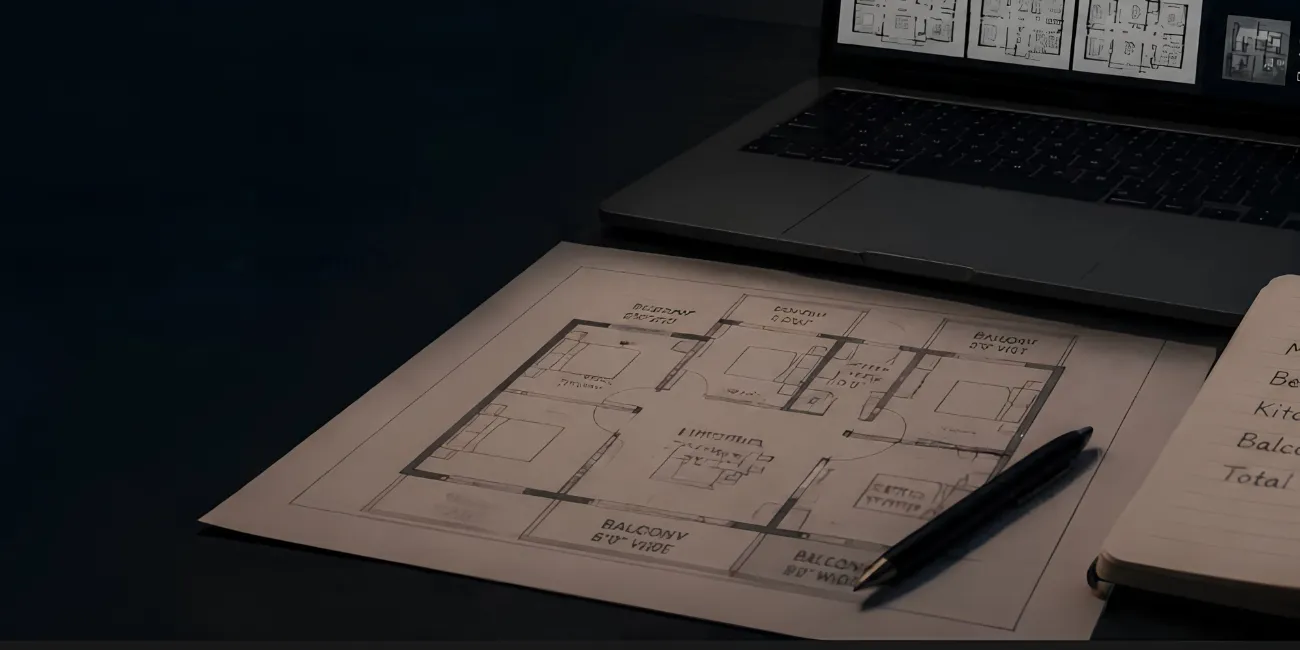

What Do You Need to Evaluate Before Purchasing a Property in Greater Noida?
Buying a property in Greater Noida is not simply about finding an attractive apartment at a price that fits your budget. The region has developed into a substantial residential market, with numerous projects, developers, apartment configurations, and evolving infrastructure. That variety gives buyers more choice, but it also makes the selection process more intricate.
A property may look appealing in a brochure and still require careful scrutiny before you make a financial commitment.
Whether you are searching for a 3 BHK in Greater Noida, a 4 BHK family home, or a property for long-term investment, the fundamental approach remains the same: examine the location, verify the project, understand the complete cost, and assess whether the property actually suits your requirements.
Here are the important things to check before buying a property in Greater Noida.

1. Start With the Exact Location
“Greater Noida” is a general geographical term. It should not be considered as if every project in the region has the same locational advantages.
Begin by finding out the exact sector, approach roads and immediate neighborhood of the project. Then look outside the project boundary.
Look at how close you are to schools, hospitals, retail centers, supermarkets, restaurants, public transport and other facilities that count in your everyday routine. If you are buying a home for your family, these seemingly mundane details can have far greater bearing on daily convenience than a long list of amenities inside the project.
Your commute also deserves careful thought.
If you are working in Noida, Delhi, Greater Noida or any part of NCR, check the actual route and approximate travel time during peak hours. On a map a route that looks easy can be very different during morning and evening traffic.
Also, it is important to distinguish between existing infrastructure and proposed infrastructure. “Future connectivity can be a property decision factor, but it should not be treated as an operational facility until it is, in fact, operational.”
The proposed extension of Aqua Line from Noida Sector 51 to Knowledge Park-V is a 17.435 km long corridor with 11 elevated stations as per the latest listings of NMRC. The proposed corridor would cater to the commuters from Noida, Greater Noida, says NMRC.
This is why it is important to know exactly where any infrastructure project is before putting a value on it in your property assessment.
2. Verify the Project on UP-RERA
For a new or under-construction property, RERA verification should be one of the first steps, not an afterthought.
The official Uttar Pradesh RERA portal provides a searchable database of registered projects and allows users to examine project-related information. The portal also provides facilities for checking registered promoters and projects, along with various project and regulatory services.
Search for the project using its name or registration details and compare the information available on the official record with the information provided by the sales team.
Depending on the project and information uploaded, buyers may be able to examine details relating to:
- RERA registration number
- Promoter information
- Project status
- Registered completion timeline
- Approved plans
- Land-related information
- Project specifications
- Uploaded certificates and documents
- Other project disclosures
For an under-construction project, this exercise becomes particularly significant because the buyer is relying partly on the developer's future delivery rather than inspecting a completed property.
It is also worth remembering that RERA registration is a regulatory requirement and a source of project information; it should not be treated as a substitute for your own legal and financial due diligence.
3. Understand the Developer's Track Record
The developer behind a project can influence several aspects of the home-buying experience, from construction execution to possession and eventual maintenance.
However, looking only at the brand name is rarely sufficient.
Research the developer's completed and ongoing projects. Where possible, examine:
Possession history
Construction quality
Common-area maintenance
Resident feedback
Project management
Post-possession maintenance
History of completed developments
Any publicly available regulatory or legal information
Visiting a completed project by the same developer can sometimes provide more practical insight than reading a promotional brochure.
Speak with residents if possible. Ask straightforward questions: Was possession delivered as expected? How is the maintenance? Are there recurring issues? How responsive is the management?
This does not mean the experience of one completed project automatically predicts the outcome of another. Every development has its own characteristics. Nevertheless, a developer's historical record provides useful context when evaluating a new property.
4. Compare the Actual Cost, Not Just the Advertised Price
One of the easiest mistakes in property research is comparing projects solely on their headline prices.
A starting price rarely tells you the complete financial requirement.
Before comparing property prices in Greater Noida, request a detailed cost sheet and identify every applicable component. Depending on the project, the total acquisition cost may include:
- Basic apartment price
- Floor-rise charges
- Preferential location charges
- Parking-related charges
- Club or infrastructure charges
- Maintenance-related payments
- Registration expenses
- Stamp duty
- Applicable taxes
- Other project-specific charges
The exact structure varies from project to project, so avoid assuming that every development follows the same pricing model.
A useful approach is to calculate the all-in acquisition cost and compare properties on that basis.
For example, if one apartment has a lower advertised base price but significantly higher additional charges, the headline comparison can be misleading.
Ask for important financial terms in writing. Keep the cost sheet, payment schedule, and other relevant documents for your records.
5. Look Carefully at the Floor Plan
A 3 BHK is not automatically equivalent to another 3 BHK.
Two apartments may have similar advertised areas but considerably different layouts, proportions, and usable spaces. This is why the floor plan deserves careful examination.
Look at the:
- Carpet area
- Room dimensions
- Living and dining arrangement
- Bedroom placement
- Kitchen configuration
- Balcony size and position
- Storage provisions
- Natural light
- Ventilation
- Utility areas
- Privacy between bedrooms
Try to visualize your actual furniture and daily routine.
Will the living room accommodate the furniture you already own? Does the kitchen have a practical work triangle? Is there sufficient wardrobe space? Are the bedrooms appropriately sized? Does the balcony serve a genuine purpose or merely appear attractive on a floor plan?
These questions can reveal far more about the suitability of an apartment than its headline square footage.
For families comparing a 3 BHK and 4 BHK in Greater Noida, the decision should also consider how much usable space each configuration provides rather than focusing exclusively on the number of bedrooms.
6. Visit the Project Before Making a Decision
Online research is useful. Photographs, floor plans, virtual tours, and project websites can help narrow down your choices.
But a physical visit provides information that digital material cannot fully replicate.
During a property site visit, look beyond the sample apartment.
Observe the approach road, entry and exit points, surrounding construction, open areas, neighboring developments, and the general environment. If the project is under construction, distinguish between completed work, ongoing construction, and proposed development.
Ask practical questions during the visit:
- What is currently available?
- Which configurations are being offered?
- What are the apartment specifications?
- What is included in the quoted price?
- What is the payment schedule?
- What is the registered project timeline?
- Which amenities are operational or planned?
- What construction work remains?
A site visit should not be treated merely as a sales appointment. It is an opportunity to verify whether what you have seen online corresponds with the physical development.
7. Check the Surrounding Development
A residential project does not exist in isolation.
The neighborhood surrounding your apartment will influence everyday life just as much as the internal amenities of the project.
Check what is already operational around the property. Look for schools, hospitals, grocery stores, restaurants, shopping areas, public transport, and other daily-use facilities.
Then examine what is genuinely planned for the surrounding area.
This is where buyers need to exercise some discernment. Real estate marketing frequently highlights future infrastructure, proposed commercial developments, and upcoming connectivity. Such information can be relevant, but it should be verified through official or reliable sources.
For instance, if a future metro corridor is mentioned as a major location advantage, determine whether it is operational, under construction, approved, proposed, or merely being discussed.
NMRC's current information identifies the Sector 51–Knowledge Park-V corridor as an upcoming project, rather than an operational metro line.
That distinction matters when evaluating a property based on future connectivity.
8. Think About Your Purpose Before Choosing the Property
The right checklist depends partly on why you are buying.
If you are buying for end use
Your priorities may include:
- Daily commute
- Apartment layout
- School access
- Healthcare
- Neighborhood environment
- Natural light and ventilation
- Maintenance
- Family requirements
- Everyday convenience
A beautiful project may still be unsuitable if the location creates an impractical daily commute.
If you are buying for investment
The analysis becomes broader.
Consider These:
- Rental demand
- Local employment
- Existing and future housing supply
- Resale activity
- Holding costs
- Tenant profile
- Project positioning
- Local infrastructure
- Potential liquidity
Avoid basing the decision entirely on an assumption that property prices will rise by a particular percentage.
Real estate performance is influenced by multiple variables, including the specific micro-market, project, supply conditions, economic environment, and investment horizon. Future appreciation is not guaranteed simply because a locality is developing.
9. Read the Documents Before Paying
Before making a substantial financial commitment, read the relevant documents carefully.
A verbal assurance from a salesperson, an attractive brochure, or a message on WhatsApp should not be treated as equivalent to a contractual commitment.
Review the documents applicable to your transaction, including the relevant project and payment documentation. If there are clauses or legal matters you do not understand, consider obtaining independent professional advice before signing.
Keep copies of:
- Cost sheets
- Payment schedules
- Booking documents
- Allotment documents
- Agreements
- Receipts
- Project-related correspondence
- Relevant RERA information
The objective is simple: know what you are agreeing to before money changes hands.
UP-RERA also provides resources relating to project registration, complaints, agreements, and other regulatory processes, making the official portal a useful starting point for project verification.
Final Checklist for Homebuyers:
Before buying a property in Greater Noida, ask yourself:
- Have I verified the project on UP-RERA?
- Have I checked the exact sector and location?
- Have I examined the surrounding development?
- Have I checked the actual commute during busy hours?
- Have I researched the developer's completed projects?
- Have I compared the complete cost rather than only the base price?
- Have I studied the carpet area and floor plan carefully?
- Have I visited the project personally?
- Have I verified important infrastructure claims?
- Have I understood the payment schedule and contractual terms?
- Have I reviewed the relevant documents before committing?
Buying a home is a substantial financial decision, and the pressure to make a quick choice can sometimes overshadow the importance of verification. A more methodical approach is usually straightforward: verify the project, inspect the location, calculate the complete cost, understand the apartment, and read the documents.
For buyers who are exploring residential projects in Greater Noida, these processes can make property comparisons more coherent and less dependent on promotional claims.


























Sign in to leave a comment.