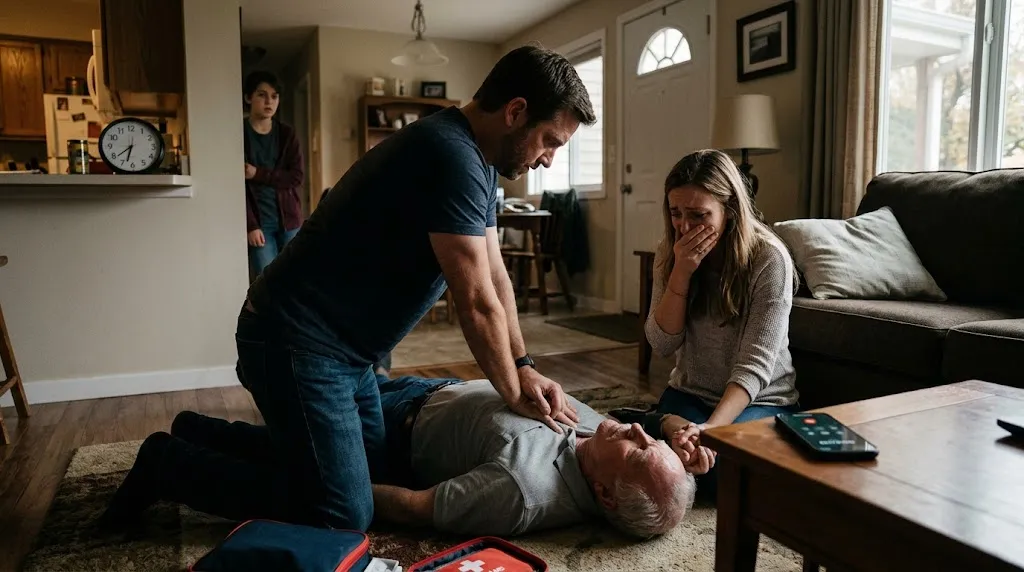

A woman collapses in a waiting room. A man slumps over at a bus stop on Kennedy Road. In both cases the ambulance is coming, but it isn't there yet. What happens in that gap, the stretch of time between the collapse and the sound of sirens, shapes almost everything that follows. It's an uncomfortable truth, and it's a hopeful one too, because that gap belongs to whoever happens to be standing nearby.
Many of the people who look for CPR training near Peel Memorial already work in care. Personal support workers. Clinic staff. Students on placement. Family members who have spent long afternoons in hospital corridors. They've watched how quickly a normal day turns.
Why Do the First Few Minutes Carry the Most Weight?
When a heart stops, circulation stops with it. Oxygen stops reaching the brain almost immediately, and damage starts building within a few minutes. Every minute without chest compressions makes a good outcome less likely.
The Heart and Stroke Foundation of Canada estimates that roughly 60,000 cardiac arrests happen outside of hospital in this country every year. Only 1 in 10 people survives one. That number is hard to sit with.
Here's the part worth holding onto. Survival rates can double when someone acts fast, starts CPR and uses an AED. Not a specialist. Just someone who happened to be there and knew what to do with their hands.
What Is the Chain of Survival, in Plain Language?
You'll hear the phrase "chain of survival" in every first aid course. It sounds technical. It isn't.
- Recognize the emergency and call 911.
- Start chest compressions right away.
- Use an AED as soon as one is within reach.
- Hand over to paramedics for advanced care.
- Support the person through recovery afterward.
A chain is only as strong as its weakest link, and the first three links have nothing to do with a hospital. They belong to whoever is closest. Around busy parts of Brampton, whether that's a hospital campus, a transit stop, a warehouse floor or a school pickup line, the closest person is almost always an ordinary bystander.
Why Do People Freeze When Someone Collapses?
Ask anyone who has been in the room. The freeze is real, and it isn't cowardice.
Part of it is the bystander effect. A crowd gathers, everyone quietly assumes someone else is better qualified, and nobody moves. Part of it is fear of causing harm. Cracking a rib. Making things worse. Being blamed later.
Some people hesitate because cardiac arrest rarely looks the way it does on television. The person may gasp, twitch or make strange noises, and it can seem as though they're still breathing when they aren't. That's called agonal breathing, and it fools people constantly.
Then there's the legal worry. Ontario has Good Samaritan legislation that protects people who voluntarily step in and act reasonably during an emergency. Knowing that ahead of time removes one more excuse to stand still.
What Does a Calm First Response Actually Involve?
Training doesn't make you fearless. It gives your hands something to do while your brain catches up.
- Check whether the person responds. Tap the shoulders, shout, look at the chest.
- Call 911 and put the phone on speaker. The dispatcher will coach you through it.
- Send one specific person for the nearest AED. Point at them. Vague requests get ignored.
- Push hard and fast in the centre of the chest, about twice a second, and let the chest come all the way back up between pushes.
- Keep going. Trade off with someone else every couple of minutes, because good compressions are genuinely tiring.
That's the whole job. No heroics. Just steady repetition that holds the line until paramedics take over.
What If There's an AED and Nobody Knows How to Use It?
This worry stops people more often than it should. An AED talks you through the whole thing. You open the lid, it starts giving instructions out loud, and it won't deliver a shock unless it reads a rhythm that needs one.
You can't harm someone by switching it on and doing what it says. The far more common harm is the cabinet on the wall that nobody opens.
What Does Ontario Expect From Workplaces?
If you supervise staff, this stops being a personal choice. Ontario Regulation 1101 under the Workplace Safety and Insurance Act sets the baseline, and WSIB enforces it:
- 1 to 5 workers per shift — one worker holding Basic First Aid
- 6 or more workers per shift — one worker holding Intermediate First Aid
- 200 or more workers per shift — a fully equipped first aid room with a qualified attendant
Certificates are valid for three years. On June 22, 2026, WSIB modernized its First Aid Program to align with the CSA Z1210:24 national standard. Course names changed, so Emergency became Basic and Standard became Intermediate, but the thresholds, the three-year validity and the kit requirements stayed exactly the same. Certificates issued before that date remain valid until their printed expiry.
Sitting above all of it is the Ontario Occupational Health and Safety Act, which gives employers a general duty to protect workers. Clinics, group homes and care settings aren't exempt just because some staff already hold clinical skills.
How Much Time Does Learning This Really Take?
Less than most people expect. Blended learning splits a course in two. You work through the theory online at your own pace, then attend a shorter in-class session for the hands-on part.
That in-class portion is what fixes the freezing. You kneel on the floor. You push on a manikin until your shoulders complain. You practise placing AED pads, the awkward handover when a second person arrives, and saying out loud what you need them to do.
Courses run through Red Cross and Heart & Stroke authorized partners, which is what makes a certificate recognized by employers and regulators. It's worth taking a minute to browse the upcoming courses and see which level matches the work you actually do. Standard First Aid, CPR/AED Level C and BLS all teach the same core response at different depths, for different roles.
If you're looking for CPR or first aid training near Peel Memorial Centre, Kennedy Road South near Queen Street, the Bramalea City Centre area or the surrounding neighbourhoods, you can reach out to Coast2Coast First Aid & Aquatics in that part of the city. The skill takes a weekend to learn. The chance to use it can arrive on any ordinary Tuesday.



















Sign in to leave a comment.