
Kabir signed his first office lease on a Tuesday afternoon, feeling like he had finally arrived. He had spent two years running his fintech startup out of his apartment and a rotation of coffee shops, and this new space, four rooms above a printing press in Navrangpura, felt like proof that things were moving forward. He signed a two year agreement, ordered desks for twelve people, and told his team the good news.
Three months later half those desks sat empty, two of his engineers had shifted to remote work permanently while his sales lead was travelling more than she was sitting at a desk, the office that once felt like a milestone now felt like a monthly expense he could not quite justify, the expense it takes every month could have been invested somewhere else.
Kabir's situation is not unusual, businesses across the city are growing and changing shape faster than a fixed lease can keep up with. Teams expand, contract, go hybrid and shift priorities within a single quarter. The idea of locking into one space for years no longer matches how most companies actually operate in 2026.
This is exactly why more founders, consultants, and regional teams are rethinking what an office should look like in the first place. Before anyone signs another agreement, it helps to understand what has actually changed in coworking space in Ahmedabad, and why the old rulebook does not apply anymore.
Why Ahmedabad Is Becoming a Serious Coworking Market
Ahmedabad has spent decades known for textiles and manufacturing. That reputation is only half the story now. The city has quietly become a base for startups, financial services firms, and even global capability centres looking for a cost effective alternative to Mumbai or Bengaluru. Walk through SG Highway or Prahlad Nagar today and you will see glass fronted business centres sitting next to old textile warehouses, a visual reminder of a city in transition.
This shift shows up clearly in the numbers. Nationally, flexible workspace operators leased 10.2 million square feet of office space in the first half of 2025 alone, a 43% jump over the previous year and the strongest six month figure ever recorded. Coworking spaces made up 76% of that flexible space activity. Closer to home, Ahmedabad recorded around 2.0 million square feet in annual office transactions in 2025, holding above its post pandemic average even after a year on year correction. That is not a market cooling down. That is a market maturing.
For someone in Kabir's position, this matters in a very practical way. He is no longer choosing between working from his living room and committing to an expensive multi year lease. There is now a third option built specifically for businesses at his stage, one that scales with him instead of boxing him in.
That third option, though, comes in more than one shape. Knowing the difference between them is where most business owners get stuck.
Understanding the Difference Between Shared Desks, Private Cabins, and Managed Offices
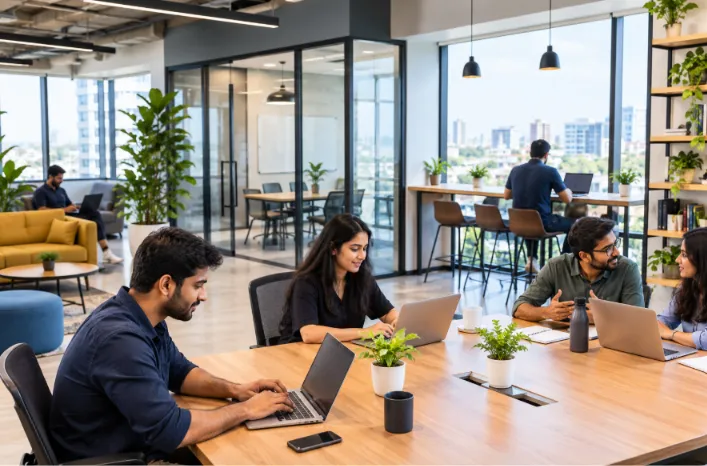
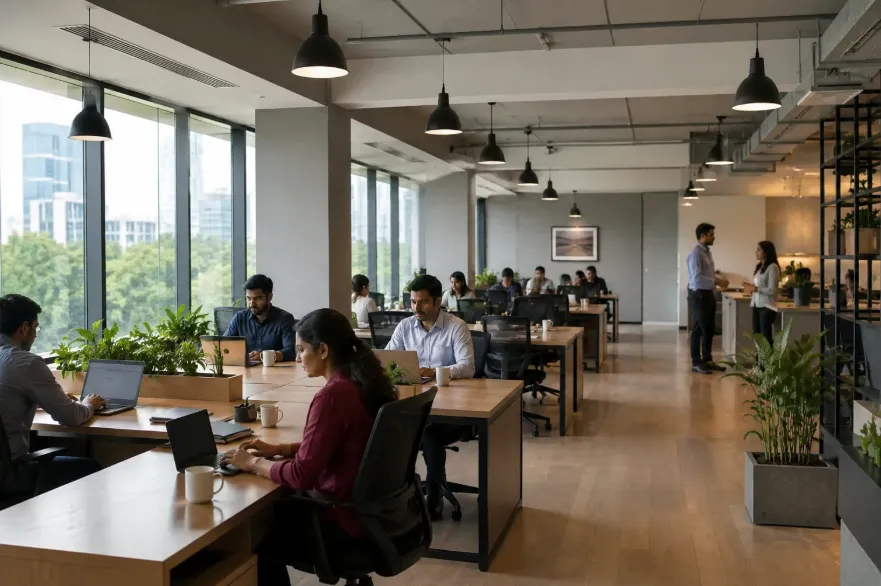
Not every flexible workspace looks the same, and that confusion trips up a lot of first time renters. A shared workspace gives you a hot desk or a dedicated desk in a common area, ideal for freelancers or very small teams who value flexibility over privacy. A private cabin gives a small team its own enclosed space within a larger coworking floor, useful once conversations get sensitive or focus becomes harder to maintain in an open layout. A managed office goes a step further, offering a fully built out space customised for a larger team, with the coworking operator handling everything from furniture to IT setup.
Shared office space in Ahmedabad works well for a two person consulting outfit. It rarely works for a sixteen person engineering team that needs meeting rooms booked back to back. This is not a small distinction. Choosing the wrong format is often what makes a business owner say a coworking space did not work for them, when really it was the format that did not fit.
Kabir learned this the hard way. When his team was six people, a shared desk setup with occasional access to a meeting room was more than enough. By the time he hired his tenth employee that same setup felt cramped and noisy during client calls. He eventually moved into a private cabin within a coworking facility keeping the flexibility he needed while giving his team a quieter space to work from.
Getting the format right solves one problem. The next question most business owners ask is whether any of this actually saves money, or whether it just feels more convenient.
What a Flexible Workspace Actually Saves You
It is easy to compare coworking to traditional office rent and stop there, the real savings usually sit somewhere else. A conventional office means furniture costs, IT setup, ongoing maintenance, security staff and someone internally managing all of it. A flexible workspace in Ahmedabad typically folds all of that into one predictable monthly cost, which changes how a founder plans their budget.
This predictability has become a genuine business priority, not just a nice to have. Large corporates now drive 72% of flexible workspace demand across India, with global capability centres alone accounting for over half of all flex seats booked. When companies with far bigger budgets than a typical Ahmedabad startup are choosing flexible spaces for cost efficiency, it says something about where the real value lies.
For Kabir, the savings were not dramatic on paper but they were meaningful. Instead of paying a facilities manager and covering unpredictable maintenance bills, he redirected that budget toward hiring one more engineer. It was not a huge amount of money. It was the right amount of money spent on something that actually moved his business forward.
Cost matters, but Kabir would tell you the space also changed something less measurable about how his team worked and who they met.
Location, Community and Why They Matter More Than They Seem
There is a temptation to treat office location as a minor detail once remote work becomes common. That temptation is worth resisting. A well located address still shapes how clients perceive a business, especially in Ahmedabad's key commercial corridors like SG Highway, Prahlad Nagar and CG Road. A polished meeting room in the right part of the city can do more for a first impression than a stack of slides ever will.
There is also a quieter advantage that does not show up in any spreadsheet. Sharing a floor with other businesses creates small informal moments of connection. A conversation over coffee in the common area, a chance introduction between two founders a passing comment about a shared vendor problem. None of this is dramatic but it adds up, and builds connections that will be fruitful in future.
Kabir experienced this directly. A casual conversation with another founder at his coworking space, someone he had only nodded at in the hallway a few times turned into an introduction to a potential client three weeks later. He never would have made that connection sitting alone in a private office.
Community and location are not soft perks then. They function as real business assets. Still none of this matters if the underlying agreement has terms that quietly work against you which brings up the part most people skip entirely.
What to Actually Check Before Signing an Agreement
Choosing the right coworking format and location is only half the decision. The other half lives in the fine print, and this is where a little diligence saves a lot of frustration later. Before signing anything, it is worth checking the lock in period and how much notice is required to scale up or down. It is worth confirming how many hours of meeting room access are included and what happens beyond that limit. Internet reliability, power backup, and how hidden charges are structured all deserve a direct question rather than an assumption.
This due diligence matters more now than it did a few years ago, simply because expectations have risen. As larger enterprises and global capability centres move into flexible spaces, the standard of service across office space providers in Ahmedabad has climbed with them. A business owner today has every reason to ask sharper questions and expect clear answers.
Kabir's second workspace decision looked nothing like his first. This time he asked about scalability clauses before discussing rent, he also confirmed exactly what "unlimited meeting room access" actually meant in practice. He walked away from one otherwise appealing space because the lock in period did not match how unpredictable his team's growth had been, it felt slower in the moment but it saved him from repeating his first mistake.
A Few Things Worth Keeping in Mind
- Match your workspace format to your current team size not your five year plan.
- Ask about lock in flexibility before you ask about the rent.
- Treat community and location as genuine business assets not soft extras.
- Compare total cost of ownership, not just the number on the monthly invoice.
- Reassess your space needs whenever your headcount shifts in a meaningful way.
The Office That Grows With You
Looking back, Kabir does not think of his first lease as a mistake exactly. It taught him what to look for the second time around. What changed between his first office and his current one was not the size of the space or even the price. It was his understanding that a workspace should adjust to a business, not the other way around.
That is really the question underneath everything in this article. Is your office helping your business move forward, or is it something your business has to work around? For a growing number of companies in Ahmedabad, the answer is pushing them toward spaces built for flexibility rather than permanence. As more founders, consultants, and teams reach that same realisation, the businesses that treat their workspace as adaptable infrastructure, rather than a fixed cost locked in for years, tend to be the ones with room to keep growing.
If you are weighing this decision for your own team, it might be worth walking through a space in person before deciding anything on paper. Sometimes the right fit becomes obvious the moment you see how a room actually feels to work in.



























Sign in to leave a comment.