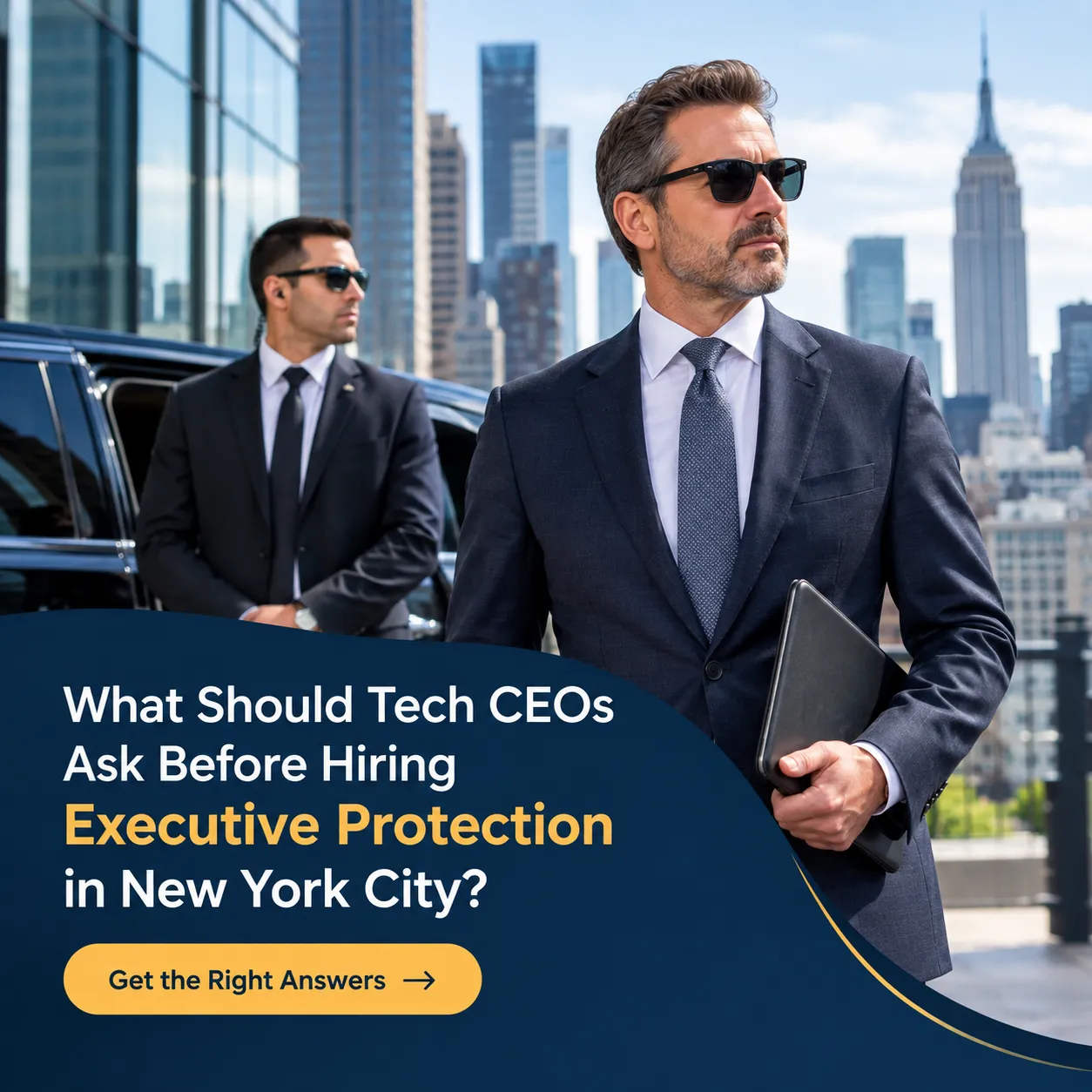

Executive protection services for tech leaders should start with six questions. Is the team licensed in New York? Who will actually be in my detail? How do you assess risk? What is your plan when something goes wrong? How do you protect my privacy? What does your contract cover? A good provider answers all six clearly, in writing, before you sign.
Key Takeaways
- Verify New York State licensing first.
- Ask for a written threat and risk assessment, not a generic quote.
- Check how the team handles travel, events, and digital exposure.
- Confirm insurance, backup staffing, and a clear chain of command.
- Choose based on fit and experience with tech leaders, not price alone.
Why Tech CEOs Face Different Risks?
An executive protection agency serving a tech founder handles problems a traditional client may not face. Your schedule is often public through conferences, funding announcements, and social media. Layoffs, product failures, or controversial decisions can bring angry employees, investors, or strangers to your door. Add New York's crowds, dense traffic, and constant event traffic, and a casual walk to a meeting becomes a planning exercise.
Questions About Licensing and Legal Standing
Executive protection in New York City operates under strict state rules, so start here.
- Is the company licensed in New York State? Security firms must hold a state license, and individual guards need a registration card from the New York Department of State.
- Is every person in my detail registered? Ask for proof for each one, not just the company.
- Will anyone be armed? If so, ask what permits they hold and how they are trained. Armed work has separate legal requirements.
- Do you carry insurance? Request proof of general liability and workers' compensation coverage. Without it, an incident could become your legal problem.
If an answer is vague, treat that as your answer.
Questions About Experience and Team Quality
Executive protection services are only as good as the people delivering them. Dig into the details.
- How many years have your protection agents worked in this field, and where?
- Have they protected business leaders, not only celebrities or event crowds?
- Are your agents former law enforcement, military, or private-sector trained?
- Will the agents I meet in the interview be the ones assigned to me?
- What is your replacement process if an agent is sick or leaves?
Ask for references from clients in similar situations, and actually call them.
Questions About Risk Assessment and Planning
A strong executive protection agency begins with analysis, not bodies. Ask what the process looks like.
- Threat assessment: Do they review your public profile, past incidents, and online chatter about you?
- Route and venue planning: Do they scout your office, home, regular restaurants, and event venues in advance?
- Advance work: Before a Manhattan conference or a dinner in Midtown, will someone check entrances, exits, and the nearest hospital?
- Written plan: Will you receive a document you can review, not just a verbal promise?
Standard guard coverage is also a different product from close protection. Make sure you know which one you are buying.
Questions About Travel and Daily Movement
New York leaders move constantly between offices, airports, and meetings. Ask how the provider handles:
- Secure driving and alternate routes during heavy traffic
- Coordination with your assistant or chief of staff
- Out-of-state and international trips
- Arrivals and departures at JFK, LaGuardia, and Teterboro
If you spend time in other cities, ask whether the provider can arrange coverage there or only works locally.
Questions About Privacy and Digital Exposure
Physical safety and online exposure now overlap. A good executive protection agency should at least ask about:
- Home address exposure in public records
- Location tags in your or your family's social posts
- Who has access to your calendar and travel plans
Also ask how they protect your information. Your schedule, home details, and family routines should never be shared outside the team, and your contract should say so.
Questions About Contracts and Cost
Price matters, but a low quote can hide gaps. Ask:
- What exactly is included: hours, agents, vehicles, planning, reporting?
- How are overtime and last-minute changes billed?
- How much notice do you need to cancel or adjust coverage?
- What happens if the assigned agent is not the right fit?
Compare quotes from at least three providers, and make sure each one covers the same scope.
Red Flags to Watch For
- No written proof of licensing or insurance
- Pressure to sign quickly
- Promises of "total security" or guaranteed results
- No questions about your own habits and risks
- Refusal to share references
Frequently Asked Questions
1. What do executive protection services include for a tech CEO?
They typically include risk assessment, close protection, secure transportation, event and travel security, and residence or office coverage, depending on the plan.
2. How much does executive protection cost in New York City?
Costs vary by team size, hours, and risk level. Ask for an itemized quote so you can compare providers fairly.
3. Is a licensed security guard the same as an executive protection agent?
Not exactly. A licensed guard may cover a site, while a close protection agent focuses on a specific person and requires more planning and training.
4. How do I know if an executive protection agency is legitimate?
Check their New York State license, confirm agent registrations, request insurance documents, and speak with past clients.
5. When should a tech founder start considering protection?
Consider it after a funding round, public controversy, rapid growth in visibility, or any direct threat. Earlier planning is easier than reacting to an incident.
View Directions




























Sign in to leave a comment.