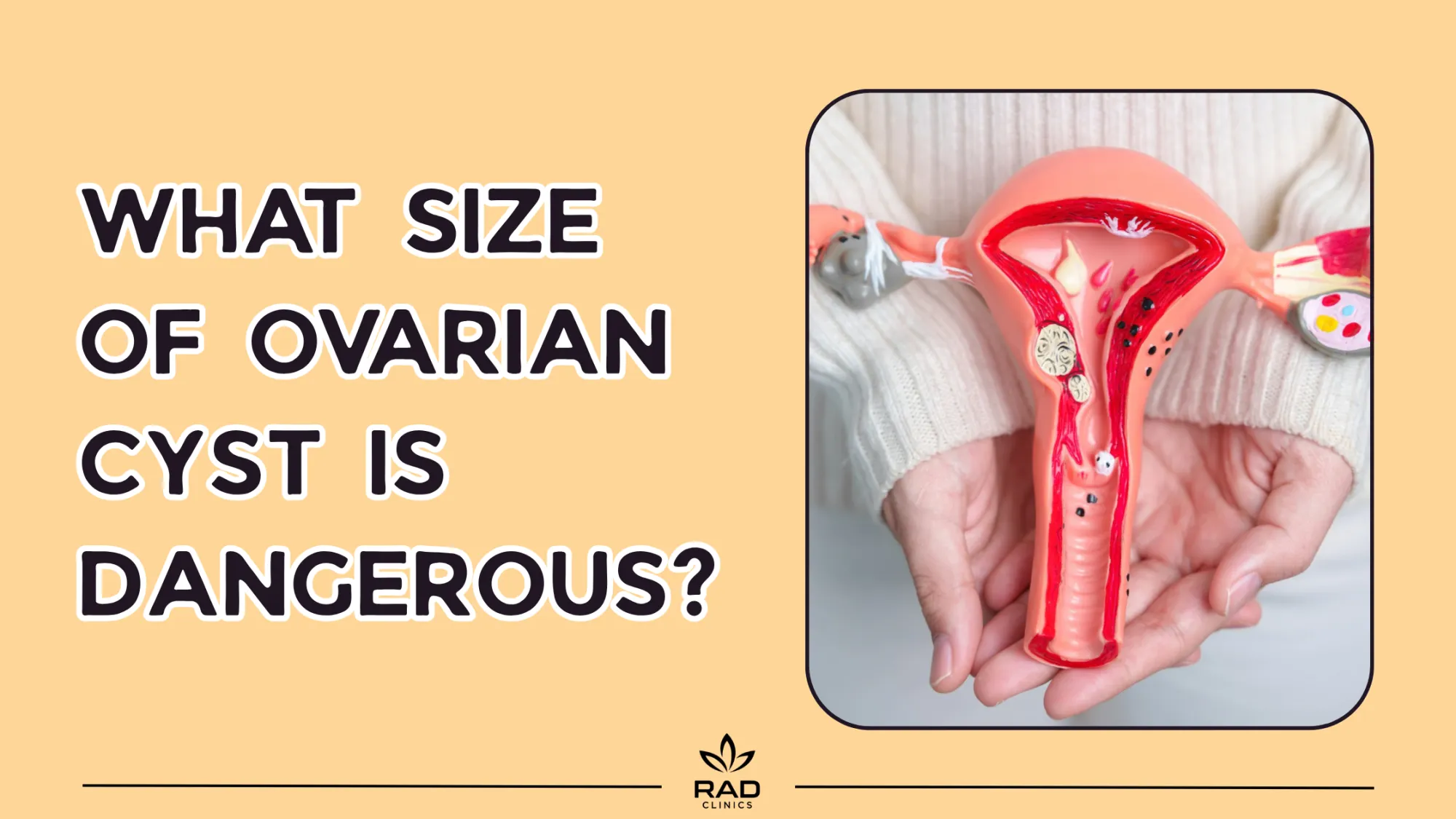

There is no single ovarian cyst size that is automatically dangerous. Doctors assess its ultrasound appearance, symptoms, growth and your menopausal status alongside its measurements. Before menopause, a simple cyst under 5 cm often needs no treatment if it causes no symptoms; larger or complex cysts may need monitoring or specialist assessment. Sudden severe pain needs urgent attention, whatever the size. This guide explains measurements in centimetres and millimetres, why small cysts can hurt, and how UK care pathways work. At RAD Clinics, pelvic ultrasound helps assess cysts and inform your next steps.
What size of ovarian cyst is dangerous in cm or mm?
No cm or mm measurement separates every harmless cyst from a dangerous one. One centimetre equals 10 millimetres: a 50 mm cyst is 5 cm, and a 70 mm cyst is 7 cm.
For a simple cyst causing no symptoms before menopause, RCOG patient guidance describes these usual approaches:
- Under 5 cm (50 mm): treatment and routine follow-up are generally unnecessary.
- Between 5 and 7 cm (50–70 mm): follow-up ultrasound is usually offered, commonly after a year.
- Over 7 cm (70 mm): further assessment with MRI and/or surgery may be considered.
These are management thresholds, not cancer cut-offs. They do not apply automatically to painful, complex or postmenopausal cysts. Your clinician may recommend earlier assessment.
What is considered a large ovarian cyst?
“Large” is a descriptive term, not a diagnosis. Size becomes more relevant when a cyst requires monitoring, causes pressure or cannot be fully assessed on ultrasound. Ask what its appearance and measurements mean together. Our guide to ovarian cyst types and scans explains the terminology you may encounter.
Can a 2 cm, 3 cm or 5 cm ovarian cyst cause pain?
Yes, but finding a cyst does not prove it explains your pain. NHS information on functional cysts confirms that these usually harmless, cycle-related cysts can sometimes cause pelvic pain. Pain severity does not reliably indicate cyst size.
Can a 2 cm or 3 cm ovarian cyst cause pain?
A 2 cm (20 mm) or 3 cm (30 mm) fluid-filled structure before menopause may be a normal developing follicle. RCOG describes normal follicles as commonly around 2–3 cm. Interpretation depends on its appearance and your menstrual cycle.
Persistent pain deserves assessment even when the finding is small. Tell your clinician whether it relates to periods, sex, urination or bowel movements. Endometriosis, bladder problems and bowel conditions can cause similar symptoms.
Does a painful 5 cm cyst need treatment?
A 5 cm (50 mm) cyst causing pain warrants clinical review rather than relying on guidance for symptom-free cysts. Your clinician will consider the scan findings and whether the pain is likely to come from the ovary. A women’s health ultrasound scan can help assess the ovaries and surrounding pelvic organs.
Is a 6 cm ovarian cyst dangerous?
A 6 cm (60 mm) cyst is not automatically dangerous. A simple, symptom-free cyst before menopause may be monitored, whereas pain, growth or complex features can change the plan. Do not wait for a scheduled follow-up if new symptoms develop.
What size of complex ovarian cyst is dangerous?
There is no universal dangerous size for a complex cyst. “Complex” describes its internal appearance: it may contain blood, thicker material, partitions or solid areas instead of only clear fluid.
Functional cysts arise during the menstrual cycle. A haemorrhagic cyst contains blood; an endometrioma is associated with endometriosis. A dermoid develops from egg-producing cells and may contain fat or hair. These findings do not automatically mean cancer, but their management differs from that of a simple cyst.
RCOG guidance on ovarian masses considers ultrasound features alongside clinical findings. Irregular solid areas, projections within the cyst or concerning fluid around the organs may prompt specialist investigation, even in a smaller cyst. A gynaecologist decides whether observation, further tests or surgery is appropriate.
Does ovarian cyst size indicate cancer risk?
Size alone cannot diagnose or exclude ovarian cancer. A large cyst can be benign, while a smaller abnormal mass may need investigation. Ultrasound appearance, menopausal status, symptoms and relevant family history inform the assessment.
Most ovarian cysts are non-cancerous. Where findings raise concern, a doctor may request blood tests such as CA125 and arrange specialist review. As NHS diagnostic guidance explains, raised blood markers can also occur with non-cancerous conditions, including endometriosis and fibroids. A blood result must be interpreted with the wider clinical picture.
Are ovarian cysts more concerning after menopause?
After menopause, cysts need a different assessment because cancer risk is higher than before menopause. However, some simple cysts need no routine surveillance.
The RCOG update issued in December 2025 states that simple cysts measuring 3 cm or less, affecting one side and consisting of a single chamber, do not require routine follow-up. Persistent symptoms still need assessment. This recommendation does not apply to every cyst measuring 3 cm or less.
Is a ruptured ovarian cyst dangerous?
A ruptured cyst can be dangerous if it causes significant internal bleeding. Some ruptures settle with monitoring and pain relief, but you cannot judge the severity from the original cyst measurement. Sudden pain can also result from ovarian torsion, where the ovary twists and its blood supply is threatened.
Follow NHS pelvic pain advice: call 999 or go to A&E for severe or worsening pelvic pain, or pain with faintness, dizziness, shoulder-tip pain, breathing difficulty or heavy vaginal bleeding. Do not drive yourself.
Contact NHS 111 urgently for pelvic pain with sickness, fever, or possible pregnancy. Do not assume new pain is a known cyst or wait for a routine private scan.
What size ovarian cyst needs to be removed?
No single measurement means every cyst must be removed. Surgery may be recommended for persistent or enlarging cysts, troublesome symptoms, suspicious findings or complications. A simple cyst over 7 cm may lead to discussion of further imaging or surgery rather than automatic removal.
NHS treatment guidance describes keyhole surgery for many cysts, with open surgery sometimes needed for particularly large or potentially cancerous masses. Your gynaecologist should explain the options and any implications for fertility. Before menopause, preserving healthy ovarian tissue is an important consideration where appropriate.
RAD Clinics provides diagnostic pelvic ultrasound; decisions about ovarian surgery belong with a gynaecologist.
Are cysts in the womb the same as ovarian cysts?
No. The ovaries sit beside the womb, so an ovarian cyst is not inside the womb. People sometimes use “cyst in the womb” to describe different pelvic findings. Ask which organ is involved and what the report actually says.
Our pelvic scan service examines the uterus and ovaries. Where broader abdominal assessment is indicated, the upper abdomen and pelvis scan covers a different examination scope; ask which appointment suits your symptoms.
How are ovarian cysts assessed in the UK?
For ongoing symptoms without emergency signs, start with your GP. Assessment may include examination, ultrasound and appropriate blood tests, followed by monitoring or referral to a gynaecologist.
Ultrasound may involve scanning across your lower abdomen and an internal transvaginal scan, with your consent. Bring previous reports so the clinician can compare findings. Before a private appointment, review our clinical team and scan fee guide, and confirm preparation instructions.
If you live near our Milton Keynes clinic, Northampton clinic or St Neots clinic, ask which location currently offers the pelvic scan you need. Share the report with your GP to agree follow-up.
When should you see a specialist?
Ask about a gynaecology review for persistent pain, a growing or complex cyst, or concerning scan findings. Seek review for ongoing bloating, early fullness or symptoms after menopause, even with a small cyst.
For non-emergency concerns, contact RAD Clinics to arrange a pelvic ultrasound and clarify the appropriate appointment. Your scan findings can help your GP or gynaecologist plan the next step.


























Sign in to leave a comment.