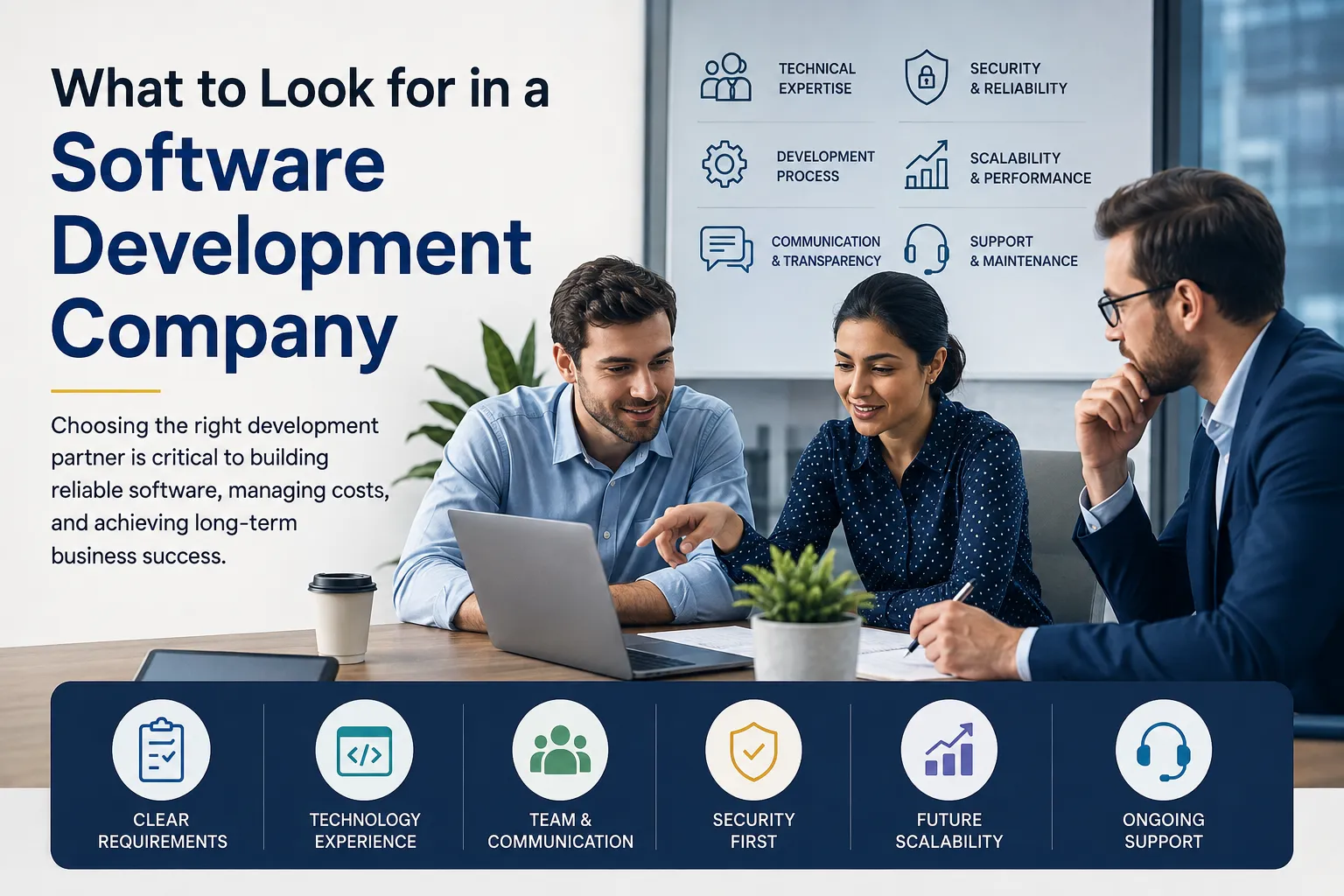

Choosing a software development company is a major business decision. The right partner can help turn an idea into a reliable product, modernize outdated systems, reduce operational costs, and create new opportunities for growth. The wrong choice can lead to missed deadlines, unexpected costs, security problems, and software that fails to meet business requirements.
With hundreds of development companies offering similar services, comparing providers based only on price or technical skills is rarely enough. Businesses need to look at the complete picture: technical expertise, communication, development processes, security, scalability, business understanding, and long-term support.
Whether you are a startup founder building your first product, a CTO replacing legacy software, or an enterprise planning a digital transform ination initiative, knowing what to look for in a software development company can make the selection process much easier.

1. Start With a Clear Understanding of Your Business Needs
Before evaluating development companies, define what you actually need.
A software development partner should understand your business problem before discussing technologies, features, or pricing. A strong technical team will ask questions about your users, workflows, goals, existing systems, expected growth, and business constraints. This is particularly important when working with specialized providers, such as an AI Software Development Company in Dover, where understanding the business use case is essential before selecting the right AI technologies or development approach.
For example, a logistics company may need a custom platform to manage deliveries, drivers, customer notifications, and real-time tracking. The goal is not simply to "build an app." The software needs to solve specific operational problems, improve efficiency, and support the company's long-term objectives.
Before contacting vendors, clarify:
- What business problem are you trying to solve?
- Who will use the software?
- Which features are essential?
- Do you need web, mobile, or both?
- Does the product need to integrate with existing systems?
- What are your security and compliance requirements?
- What is your expected launch timeline?
- What budget range is realistic?
- What should the software achieve after launch?
The clearer these requirements are, the easier it becomes to compare software development companies objectively.
2. Evaluate Relevant Technical Expertise
Technical expertise should match your project's requirements.
A company may have experienced developers, but that does not automatically mean it is the right partner for your project. Look for experience with the technologies, architectures, platforms, and integrations your product requires.
Depending on the project, this may include:
- Custom software development
- Web application development
- Mobile app development
- Cloud development and migration
- Artificial intelligence and machine learning
- API development and third-party integrations
- Enterprise software development
- Database architecture
- UI/UX design
- Quality assurance and automated testing
- DevOps and deployment
- Cybersecurity
For example, an organization building an AI-powered customer support platform needs more than general web development experience. The development team should understand APIs, data pipelines, model integration, security, scalability, and user experience.
Ask potential partners:
- Have you built products similar to ours?
- Which technologies would you recommend and why?
- How do you approach architecture and scalability?
- How do you test the software?
- How do you handle integrations with third-party platforms?
The quality of the answers can reveal how deeply the company understands your project.
3. Review Their Portfolio and Case Studies
A portfolio gives you evidence of what a software development company has actually delivered.
Do not look only at screenshots. Examine the type of problems the company has solved and whether those projects are comparable to yours.
Look for:
- Similar industries or business models
- Comparable technical complexity
- Large-scale applications
- Mobile or web products
- AI implementations
- Enterprise systems
- API integrations
- Cloud infrastructure
- Measurable business outcomes
For example, if a company has developed an internal enterprise platform that reduced manual processes, that experience may be more relevant to a B2B software project than a portfolio containing only simple marketing websites.
Whenever possible, ask for case studies that explain the original challenge, solution, implementation process, and outcome.
4. Look for Strong Communication Skills
Communication is one of the most important factors in a successful software project.
Even an excellent development team can struggle if communication is inconsistent. Business requirements change, technical challenges appear, and decisions need to be made throughout development.
A reliable software development company should provide clear communication through:
- Regular project updates
- Defined communication channels
- Sprint reviews
- Project management tools
- Technical documentation
- Requirement discussions
- Progress reports
- Clear escalation processes
You should also know who your primary contact will be.
For example, if a business owner has to explain the same requirement repeatedly to different developers, the project can quickly become inefficient. A dedicated project manager or product contact can help keep communication organized.
Good communication is not about having constant meetings. It is about making sure the right information reaches the right people at the right time.
5. Understand Their Development Process
Ask how the company manages a project from beginning to end.
Most professional development teams use an Agile methodology or another structured development approach. The specific framework matters less than whether the process provides visibility and accountability.
A typical process may include:
Discovery and Planning
The team studies the business requirements, users, technical environment, and project goals.
UI/UX Design
Designers create user flows, wireframes, prototypes, and interfaces before development begins.
Development
Developers build the product in manageable stages, often using sprints.
Quality Assurance
The software is tested for functionality, usability, compatibility, performance, and security.
Deployment
The application is prepared for production and released to users.
Maintenance
The team monitors the product, resolves issues, applies updates, and supports future improvements.
Ask potential partners how you will review progress during each stage. A transparent process reduces uncertainty and gives stakeholders opportunities to provide feedback before problems become expensive to fix.
6. Check Their Approach to Security
Security should not be treated as an afterthought.
Software can handle sensitive customer information, financial data, business records, credentials, or proprietary information. Security weaknesses can therefore create financial and reputational risks.
Ask how the company handles:
- Authentication and authorization
- Data encryption
- Secure API development
- Access control
- Vulnerability testing
- Secure coding practices
- Database security
- Backup and recovery
- Cloud security
- Security updates
If your business operates in a regulated industry, ask about relevant compliance requirements as well.
A development partner should be able to explain security decisions in understandable terms rather than simply saying that the application will be "secure."
7. Consider Scalability From the Beginning
A software product that works for 500 users may not work the same way for 500,000 users.
Scalability refers to the ability of software and infrastructure to handle increasing users, transactions, data, and workloads without major performance problems.
This matters particularly for:
- SaaS companies
- E-commerce platforms
- Fintech applications
- Healthcare technology
- AI applications
- Enterprise systems
- Customer-facing mobile applications
A development company should consider scalability during architecture planning rather than waiting until performance problems appear.
For example, an online marketplace expecting rapid growth may need an architecture that can scale its database, APIs, storage, and application infrastructure independently as demand increases.
8. Evaluate Their Ability to Integrate With Existing Systems
Many businesses do not need completely isolated software.
New applications often need to communicate with existing CRMs, ERPs, payment gateways, analytics platforms, marketing tools, databases, or internal systems.
This makes integration experience extremely important.
Ask whether the development company has experience with:
- REST and GraphQL APIs
- Payment gateways
- CRM integrations
- ERP systems
- Cloud services
- Authentication providers
- Business intelligence platforms
- Third-party SaaS platforms
- Legacy systems
A company that understands integration architecture can help prevent duplicate data, manual processes, and disconnected systems.
9. Look Beyond the Initial Development Cost
Price matters, but the lowest proposal is not necessarily the lowest-cost solution.
Software costs can include much more than development hours.
Consider:
- Discovery and planning
- UI/UX design
- Development
- Testing
- Cloud infrastructure
- Third-party services
- Security
- Deployment
- Maintenance
- Technical support
- Future development
For example, a company may quote a low initial price by excluding testing, documentation, or post-launch support. The project may appear inexpensive initially but become more expensive later.
Instead of asking only, "How much will development cost?" ask:
"What will the total cost of ownership look like over the next two to three years?"
This provides a more realistic basis for comparison.
10. Ask About Post-Launch Support
Launching software is not the end of the project.
Applications require ongoing maintenance because operating systems, browsers, cloud services, security standards, and third-party APIs change over time.
Ask potential development partners about:
- Bug fixes
- Technical support
- Monitoring
- Security patches
- Performance optimization
- Feature updates
- Infrastructure management
- Service-level agreements
- Emergency support
A long-term support agreement can be particularly useful for businesses that depend heavily on their software operations.
11. Assess Their Product and Business Thinking
The best development partners do more than write code.
They understand why the software is being built.
Suppose a company wants to build a mobile ordering application. A purely technical provider might focus on screens, APIs, and database tables. A stronger product-oriented partner may also ask about customer acquisition, conversion rates, order abandonment, payment behavior, and operational workflows.
That broader thinking can help identify opportunities to improve the product before development resources are committed.
Look for a company that can contribute to:
- Product strategy
- Technical consulting
- User experience
- Feature prioritization
- Technology selection
- Digital transformation
- Process improvement
This becomes especially valuable when requirements are still evolving.
12. Evaluate AI and Emerging Technology Capabilities
AI is becoming part of many software products, but adding AI simply because it is popular can create unnecessary complexity.
A capable technology partner should help determine whether AI actually provides business value.
Potential applications include:
- Intelligent search
- Document processing
- Predictive analytics
- Recommendation systems
- AI-powered customer support
- Workflow automation
- Natural language interfaces
- Data analysis
- Generative AI features
For example, an insurance company may use AI to classify documents and extract information from claims. The value comes from reducing manual processing, not from simply adding an AI chatbot.
Ask potential partners:
- What AI technologies have you implemented?
- How do you evaluate AI accuracy?
- How do you protect customer data?
- What are the infrastructure costs?
- How will the AI feature integrate with existing workflows?
- What happens when an AI model produces an incorrect result?
AI development should be connected to a measurable business objective.
13. Check Ownership of Code and Intellectual Property
Intellectual property should be clearly defined before development starts.
Your contract should explain who owns:
- Source code
- Designs
- Documentation
- Databases
- Custom algorithms
- Product assets
- Deployment configurations
Also clarify whether the company uses proprietary components, open-source libraries, or third-party services.
Clear ownership terms can prevent disputes later, particularly if your software becomes an important business asset.
14. Verify Project Management and Transparency
A software project needs more than developers. It needs coordination.
Ask how the company tracks:
- Tasks
- Deadlines
- Development progress
- Bugs
- Requirements
- Change requests
- Project risks
Tools such as Jira, ClickUp, Trello, or similar platforms can provide useful visibility, but the tool itself is not the most important factor.
What matters is whether the company maintains a reliable process for tracking commitments and communicating changes.
15. Watch for Common Warning Signs
Some problems become visible before a project starts.
Be cautious if a provider:
- Gives an unusually low quote without understanding requirements
- Promises an unrealistic delivery timeline
- Cannot explain its development process
- Avoids technical questions
- Has no relevant portfolio
- Provides vague contracts
- Does not discuss security
- Refuses to explain ownership terms
- Has unclear communication processes
- Cannot describe post-launch support
None of these factors automatically means a company is unsuitable, but they are reasons to ask additional questions.
16. Create a Vendor Evaluation Checklist
Before making a decision, compare potential partners against the same criteria.
A practical checklist can include:
| Evaluation Area | What to Check |
|---|---|
| Technical expertise | Relevant technologies and architecture experience |
| Portfolio | Similar projects and measurable outcomes |
| Communication | Reporting, meetings, documentation |
| Development process | Discovery, Agile, QA, deployment |
| Security | Secure development and data protection |
| Scalability | Architecture for future growth |
| Integrations | APIs and third-party systems |
| Cost | Development and long-term ownership costs |
| Support | Maintenance and post-launch services |
| Product thinking | Business and user-focused recommendations |
| AI expertise | Relevant AI implementation experience |
| IP ownership | Source code and asset ownership |
| Transparency | Contracts, milestones, risks, and reporting |
Using the same framework for every candidate makes comparison easier and reduces the chance of selecting a vendor based purely on sales presentation.
17. Consider a Discovery Phase Before Full Development
For complex projects, jumping directly into development can be risky.
A discovery phase can help clarify:
- Business requirements
- User journeys
- Technical architecture
- Product scope
- MVP features
- Integrations
- Security requirements
- Estimated development effort
- Potential technical risks
The result may include product requirements, wireframes, technical architecture, a development roadmap, and a more accurate cost estimate.
For startups, this can help prevent spending a large portion of the budget on features that users do not actually need.
For enterprises, discovery can help identify dependencies and integration challenges before development begins.
18. Choose a Partner That Can Grow With Your Business
Your technology needs may change significantly after launch.
A startup may initially need an MVP and later require advanced analytics, mobile applications, AI capabilities, or enterprise integrations.
An established company may need to modernize legacy applications, migrate workloads to the cloud, or build new digital products.
A software development company with capabilities across custom software, web and mobile applications, AI, product development, consulting, and digital transformation can provide continuity as these needs evolve.
Bitrupt, for example, works across these areas, allowing businesses to approach software development as an ongoing technology partnership rather than a one-time coding project.
The right relationship should make it easier to improve the product as business requirements change.
19. Best Practices When Hiring a Software Development Company
Before signing a contract, keep these practices in mind:
- Define the business problem first.
Technology should support a clear business objective. - Start with realistic requirements.
Avoid trying to build every possible feature in version one. - Review relevant case studies.
Look for evidence of solving similar technical and business problems. - Discuss security early.
Security requirements should influence architecture from the beginning. - Clarify ownership and contracts.
Define intellectual property, deliverables, payment terms, and responsibilities. - Establish communication expectations.
Agree on meetings, reports, project tools, and escalation procedures. - Plan for maintenance.
Decide who will handle updates, bugs, monitoring, and future improvements. - Think about scalability.
Build an architecture that can evolve with the business. - Measure outcomes.
Define success using metrics such as revenue, productivity, adoption, conversion, cost reduction, or customer satisfaction. - Treat the development company as a technology partner.
The strongest relationships are based on collaboration rather than simply handing over requirements.
Frequently Asked Questions
1. What should I look for in a software development company?
Look for relevant technical expertise, proven project experience, clear communication, a structured development process, strong security practices, scalability knowledge, transparent pricing, and reliable post-launch support.
2. How much does it cost to hire a software development company?
The cost varies considerably depending on project complexity, features, technology, integrations, development location, security requirements, and ongoing support. A discovery phase can provide a more accurate estimate before full development begins.
3. Should I choose a company based on the lowest development price?
Price should be one factor rather than the only factor. A lower initial quote may exclude important services such as testing, security, documentation, infrastructure, or maintenance. Compare the overall value and expected total cost of ownership.
4. Why is post-launch support important?
Software requires ongoing maintenance because dependencies, operating systems, APIs, security requirements, and business needs change. Post-launch support helps keep applications secure, stable, and useful over time.
5. How can I tell whether a software development company is reliable?
Review relevant case studies, speak with the team responsible for delivery, ask about their development and QA processes, clarify contracts and ownership, check communication practices, and ask how they handle risks and post-launch support.
Conclusion
Choosing a software development company is ultimately about finding a partner that understands both technology and business objectives.
Technical skills matter, but they are only part of the decision. You also need to consider communication, security, scalability, development processes, costs, support, product thinking, and the company's ability to adapt as your business grows.
A strong development partner should help you make better technology decisions, identify risks early, and build software that delivers measurable business value.
Whether you need custom software, a web or mobile application, AI capabilities, product development, or a broader digital transformation strategy, taking the time to evaluate potential partners carefully can significantly reduce project risk and improve long-term results.




















Sign in to leave a comment.