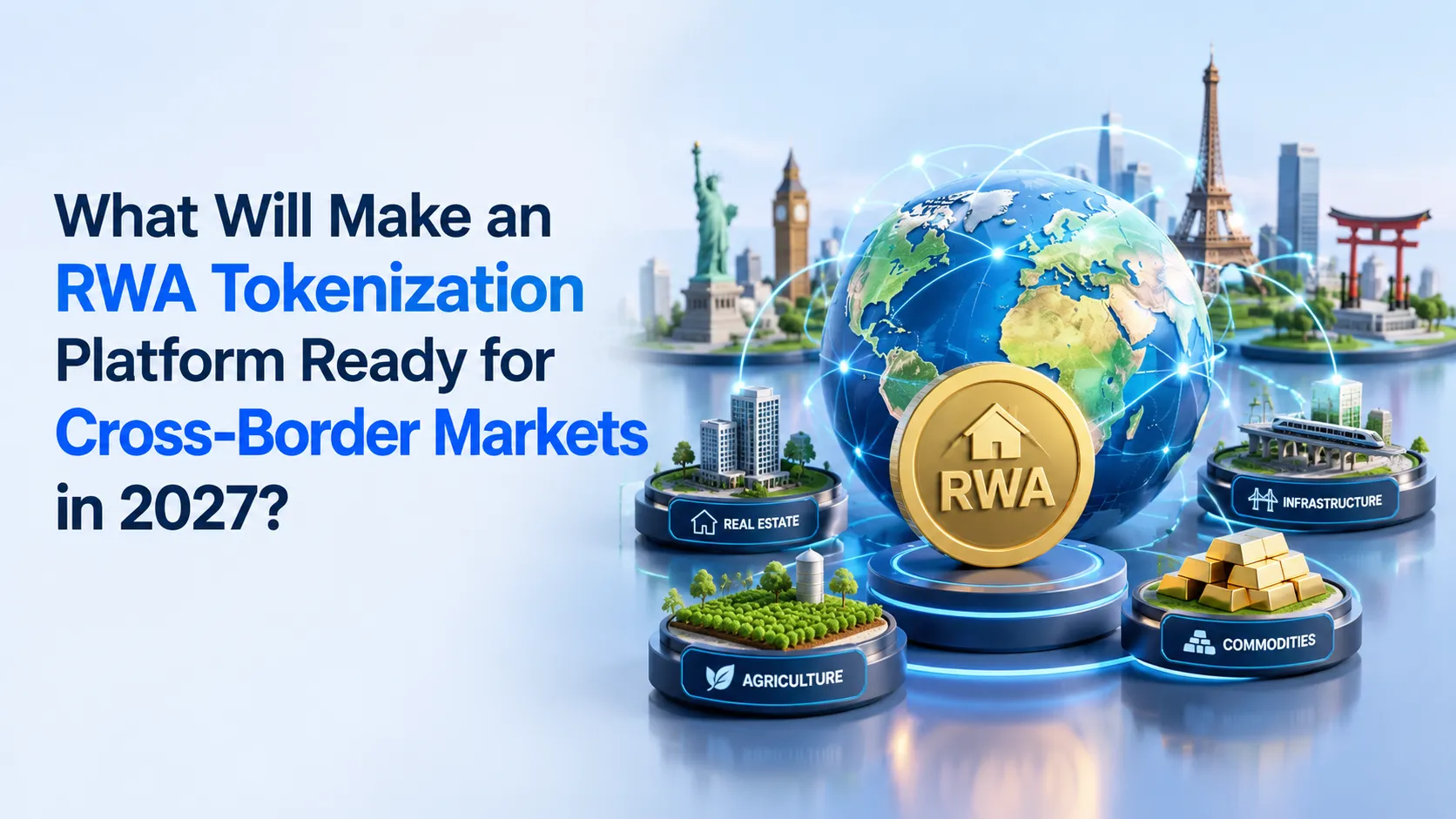

Real-world assets are moving into digital markets as financial institutions, asset managers, property firms, and businesses examine token-based ownership models. Real estate, private credit, commodities, funds, invoices, and other assets can be represented through blockchain-based tokens, creating new ways to issue, transfer, and manage ownership interests.
By 2027, operating across several countries may require more than issuing tokens on a blockchain. An RWA tokenization platform may need to support different legal frameworks, investor eligibility rules, currencies, payment systems, identity standards, reporting requirements, and transfer restrictions. Businesses planning RWA tokenization platform development will therefore need to consider international market requirements from the beginning rather than treating cross-border access as a later feature.
For an RWA tokenization company, this means the platform architecture must account for differences between jurisdictions while maintaining a consistent user experience. The following areas may become especially relevant for platforms seeking participation from investors and asset issuers across international markets.
1. Multi-Jurisdiction Compliance Frameworks
A cross-border token platform may serve investors and issuers from countries with different securities regulations, tax rules, ownership restrictions, and licensing requirements. A token classified as a security in one jurisdiction may be treated differently elsewhere. This makes jurisdiction-specific compliance an important part of platform planning.
The platform may need separate rules for investor onboarding, token transfers, asset eligibility, reporting, and secondary trading depending on the user's location. Instead of applying one compliance model to every participant, an international platform can use jurisdiction-based policy configurations.
Method: Jurisdiction Mapping
Before launching in a new market, businesses can map local requirements covering securities, digital assets, investor accreditation, data protection, taxation, custody, and money movement. These requirements can then be reflected in the platform's operational rules.
An RWA tokenization development company can use this approach to create separate compliance paths for different countries while maintaining a common platform environment.
2. International Identity and KYC Infrastructure
Cross-border participation depends heavily on knowing who is buying, holding, or transferring tokenized assets. Investors may come from different countries and may use different identity documents, business structures, and verification systems.
An RWA tokenization platform may therefore require identity verification that supports passports, national identity documents, company registration records, proof of address, beneficial ownership information, and other verification data.
Method: Risk-Based Investor Onboarding
A platform can classify users according to factors such as residence, investor category, source of funds, business type, and intended investment activity. Additional checks can be requested when the transaction or investor profile requires them.
For businesses involved in RWA tokenization development, this approach can make investor onboarding more suitable for international participation without treating every user in exactly the same manner.
3. Currency and Cross-Border Payment Support
Tokenized assets can attract investors who operate with different currencies. A property token might be priced in US dollars while an investor deposits euros, Singapore dollars, pounds, or another currency.
Supporting international markets may therefore require connections with payment providers, banking systems, stablecoin infrastructure, or other approved settlement methods. Currency conversion and settlement records also need appropriate accounting and reporting processes.
Method: Multi-Currency Settlement
A platform can display asset prices in several currencies while maintaining a designated settlement currency for transactions. Exchange rates can be obtained through approved financial data providers, while payment records can be linked to the relevant wallet or investor account.
For an RWA token development project, this creates a practical framework for handling international purchases without changing the underlying token structure for every currency.
4. Transfer Restrictions Based on Investor Location
Not every tokenized asset can necessarily be transferred to every investor. Local regulations may restrict who can purchase certain securities, where an asset can be sold, or how frequently tokens can change hands.
A cross-border RWA platform may therefore need transfer controls at the smart contract and application levels. These controls can check whether a wallet belongs to an approved investor before allowing a transfer.
Method: Whitelisted Wallets
Verified investors can be associated with approved blockchain addresses. Before a transfer takes place, the smart contract can check the wallet's status and apply restrictions based on jurisdiction, investor type, or asset-specific rules.
This method can be useful for a Real-world asset tokenization company dealing with regulated assets that require restrictions after issuance.
5. Smart Contracts Designed for International Rules
Smart contracts manage many activities associated with tokenized assets, including ownership records, distributions, transfers, voting, and redemption. For international markets, these contracts may need additional logic related to investor eligibility and regional restrictions.
For example, a token representing an interest in a private credit product could have different transfer rules for retail investors and professional investors. Another asset could be restricted in particular countries.
Method: Modular Contract Architecture
Rather than placing every rule inside one large contract, businesses can use separate modules for ownership, transfers, compliance checks, distributions, and corporate actions. This makes it easier to adjust individual components when market requirements change.
An RWA tokenization platform development company can use modular contract structures when creating products intended for several regulatory environments.
6. Interoperability Across Blockchain Networks
Cross-border markets may also involve multiple blockchain networks. Asset issuers may select one network for issuance while investors or financial institutions may operate on another.
A platform that only supports one blockchain could face limitations when working with different institutional ecosystems. Interoperability may therefore become an important consideration in RWA tokenization platform development.
Method: Multi-Chain Asset Support
Platforms can create infrastructure for multiple networks while maintaining a common asset management layer. Depending on the use case, token movement between networks may involve approved bridges, wrapped representations, or controlled issuance and redemption mechanisms.
The approach needs careful assessment because moving tokenized assets across networks can introduce additional security, compliance, and accounting considerations.
7. Cross-Border Data and Privacy Controls
International platforms handle large amounts of investor and transaction information. This can include identity details, financial information, corporate records, wallet addresses, and transaction histories.
Different countries may impose different requirements concerning personal data storage, processing, and transfer. An international RWA platform therefore needs a data architecture that considers where information is stored and who can access it.
Method: Regional Data Management
Sensitive personal information can be separated from blockchain transaction records. The blockchain can maintain required transaction information while private identity records remain within approved systems with suitable access controls.
For an RWA tokenization company, this separation can reduce unnecessary exposure of personal information while preserving the audit trail associated with token ownership and transactions.
8. Proof of Asset Ownership and Reserve Information
Cross-border investors may want reliable information about the physical or financial asset represented by a token. This becomes particularly relevant for real estate, commodities, funds, private credit, and other asset classes where off-chain records determine the underlying value.
The platform may need connections with property records, custodians, auditors, valuation providers, financial institutions, or other authorized data sources.
Method: Asset Verification Layer
An asset verification layer can connect token records with supporting documents and approved external data. Information such as valuation updates, ownership documents, reserve records, and asset status can be associated with the relevant tokenized asset.
This gives investors and administrators a structured way to review information connected with the asset without relying solely on blockchain records.
9. International Tax and Reporting Support
Tax treatment can differ considerably between countries. Investors may face different obligations based on residence, asset class, transaction type, holding period, and income received.
A cross-border platform does not necessarily need to act as a tax authority, but it can provide transaction records that support reporting and accounting processes.
Method: Region-Based Reporting
The platform can organize transactions by investor jurisdiction, asset class, transaction type, distribution, and date. Reports can then be generated for administrators, issuers, accountants, and other authorized parties.
For RWA tokenization development, this type of reporting infrastructure can become particularly useful as tokenized assets move from small pilot projects into wider financial markets.
10. Institutional Custody and Wallet Infrastructure
Institutional investors may have different custody requirements compared with individual users. Banks, funds, asset managers, and corporate investors may prefer controlled wallets, multi-signature arrangements, transaction approval workflows, and institutional custody providers.
A cross-border RWA platform may therefore need more than a standard crypto wallet connection.
Method: Multiple Custody Models
Businesses can support self-custody, qualified custody, managed wallets, and institutional wallet structures depending on the asset and jurisdiction. Transaction permissions can also be divided among multiple authorized participants.
An RWA tokenization development company working with institutional clients can incorporate these options during the platform planning stage instead of adding them after deployment.
11. International Liquidity and Secondary Markets
Issuing a token does not automatically create liquidity. For cross-border markets, platforms may need relationships with regulated marketplaces, trading venues, brokers, or other approved participants.
Secondary trading may also require restrictions based on investor location and asset classification. The platform must therefore consider both market access and compliance.
Method: Controlled Secondary Trading
Tokenized assets can be listed only for eligible investors and markets. Trading rules can be linked with identity verification and wallet permissions so that transfers follow the conditions established for the asset.
This approach may help businesses manage international secondary-market participation while keeping asset-specific restrictions in place.
12. Language, Currency, and Regional User Experience
International participation also depends on how easily users can understand the platform. Investors from different countries may expect local currency displays, regional date formats, language options, and familiar payment methods.
These may appear to be user interface considerations, but they can influence whether investors understand transaction details and platform procedures.
Method: Regional Platform Configuration
Businesses can offer localized interfaces while maintaining one administrative environment. Currency displays, legal notices, onboarding requirements, investor documents, and support information can be adjusted according to the user's location.
For an RWA tokenization platform development company, regional configuration can support international operations without creating a completely separate platform for every market.
13. Governance for Cross-Border Asset Management
Tokenized assets may involve decisions related to distributions, refinancing, property management, fund activity, asset sales, or other corporate actions. When investors are located across countries, governance procedures may require additional consideration.
Token holders may need voting rights, notices, records, and participation rules that reflect the legal structure of the underlying asset.
Method: Programmable Governance Rules
Governance functions can be connected to verified wallets and defined investor rights. The platform can record voting activity, participation eligibility, and approved decisions while keeping governance procedures linked to the legal documents governing the asset.
This can make the relationship between token ownership and investor participation easier to manage.
14. Strong Security and Continuous Monitoring
Cross-border platforms can become attractive targets because they may connect valuable assets, investor funds, wallets, and financial information. Security therefore needs to cover smart contracts, wallets, APIs, identity systems, databases, and administrative accounts.
Security testing should take place before launch and continue throughout the platform's operation.
Method: Layered Security Monitoring
Businesses can use smart contract audits, wallet controls, role-based permissions, transaction monitoring, anomaly detection, penetration testing, and incident response procedures. Regular reviews can also help identify weaknesses introduced through software updates or new integrations.
For RWA tokenization, security should be considered throughout the platform lifecycle rather than treated as a one-time technical task.
What Businesses Should Consider Before 2027
Businesses planning international RWA platforms may need to evaluate their projects from both technology and market perspectives. The asset structure, target jurisdictions, investor categories, blockchain network, custody model, payment method, compliance requirements, and secondary-market strategy should be considered together.
An RWA tokenization company entering cross-border markets may also need relationships with legal advisors, financial institutions, custodians, identity providers, payment companies, auditors, and regulated marketplaces. Technology can support these processes, but the legal structure surrounding the asset remains an important part of the overall model.
For companies considering an RWA tokenization platform development project, starting with a limited number of jurisdictions can also provide a practical path. Once operational requirements are tested, additional markets can be added according to regulatory and business requirements.
Conclusion
An RWA tokenization platform ready for cross-border markets in 2027 may need to combine jurisdiction-based compliance, international identity verification, multi-currency settlement, transfer restrictions, smart contract controls, blockchain interoperability, data privacy, asset verification, tax reporting, institutional custody, secondary-market functions, localized interfaces, governance tools, and continuous security monitoring. The objective is not simply to place real-world assets on a blockchain, but to create an infrastructure that can account for the different legal, financial, technical, and operational conditions found across international markets. Businesses considering RWA tokenization development should therefore define their target jurisdictions and asset classes before selecting their technology architecture, while an RWA token development project should keep investor eligibility and asset-specific rules in consideration from the beginning. Blockchain App Factory provides RWA tokenization development services for businesses planning blockchain-based asset platforms and digital ownership solutions.
FAQs
1. What is an RWA tokenization platform?
An RWA tokenization platform is a blockchain-based system used to represent interests in real-world assets through digital tokens. Depending on the project, these assets can include real estate, commodities, private credit, funds, invoices, and other financial or physical assets.
2. Why is cross-border support important for RWA tokenization?
Cross-border support can give asset issuers access to investors and financial participants in multiple jurisdictions. However, international participation also introduces different regulatory, taxation, identity, payment, custody, and transfer requirements.
3. What compliance features may an international RWA platform require?
Depending on the jurisdiction and asset, the platform may require KYC and AML procedures, investor eligibility checks, wallet whitelisting, transfer restrictions, transaction monitoring, reporting systems, and jurisdiction-specific rules.
4. Can RWA tokens operate across multiple blockchains?
Yes, depending on the technical and legal structure. Multi-chain support can allow tokenized assets to interact with different blockchain ecosystems, although cross-chain transfers require careful consideration of security, ownership records, compliance, and asset accounting.
5. What role do smart contracts play in RWA tokenization?
Smart contracts can manage token ownership, transfers, investor restrictions, distributions, voting, redemptions, and other predefined activities. For regulated assets, contracts can also include rules that restrict transfers according to investor or jurisdiction requirements.
6. How can an RWA platform support different currencies?
A platform can display asset values in multiple currencies and connect with approved payment or settlement providers. Depending on the project, it may also support regulated stablecoins or other digital settlement methods.
7. What does an RWA tokenization development company provide?
An RWA tokenization development company may provide services covering platform architecture, smart contracts, token creation, wallet integration, compliance modules, investor management, asset management, payment integration, blockchain integration, and administrative systems.
8. What is the difference between RWA tokenization and RWA token development?
RWA tokenization refers to the broader process of representing real-world assets through blockchain-based tokens. RWA token development focuses more specifically on creating the token, its smart contract, ownership logic, transfer rules, and related technical components.
9. How can businesses prepare an RWA platform for 2027?
Businesses can begin by identifying their target asset class and jurisdictions, reviewing applicable regulations, defining investor categories, selecting suitable blockchain infrastructure, planning custody and payment systems, and designing compliance and reporting functions around the intended markets.






















Sign in to leave a comment.