What Your IB Maths Predicted Grade Reveals About Your Exam Preparation

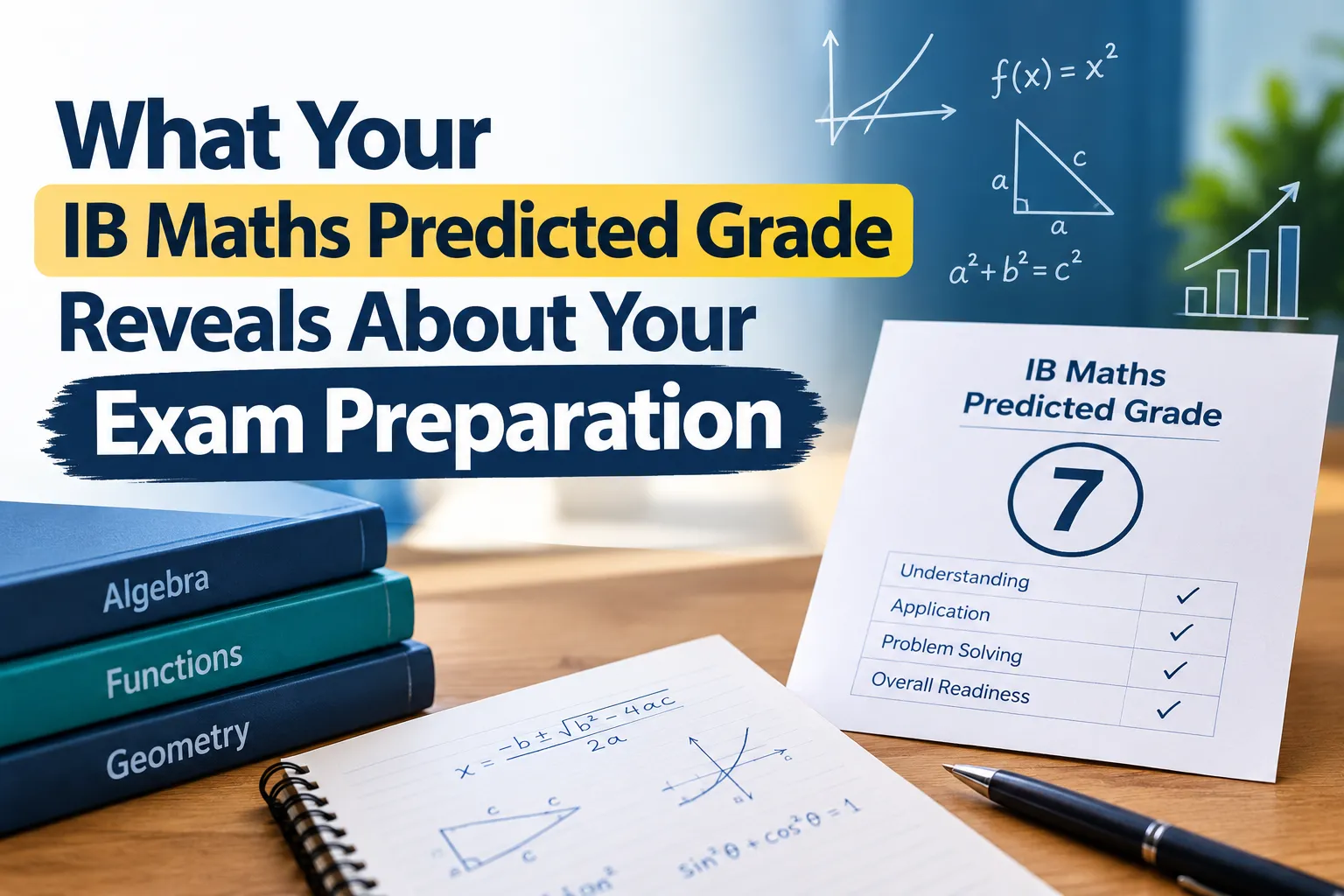
Your IB Maths predicted grade is your teacher’s evidence-based estimate of the grade you will earn in the final exam. It reflects your recent mock results, Internal Assessment (IA) progress, classwork consistency, and exam technique. If it is lower than you hoped, it usually points to specific preparation gaps (such as weak problem-solving habits or poor time management) rather than a lack of ability. Gaps like these can be fixed.
Every year, thousands of IB students open their predicted grade report, see a number in Maths, and feel one of two things: relief or a sinking stomach.
Either way, most students make the same mistake. They treat the number as a verdict. In reality, it is closer to a mirror. It reflects how you have been preparing, often more accurately than you would like to admit.
At Teaching Academy, we work with IB students every week, and we see the same patterns repeat. A predicted 5 who “understands everything” in class but loses marks in exams. A predicted 4 who works hard but studies in a way that doesn’t stick. A predicted 7 who is quietly coasting on past performance. This article explains what your predicted grade is really telling you, and what to do about it.
What Is an IB Maths Predicted Grade?
A predicted grade is the grade your teacher believes you are on track to achieve in the May or November session, on the IB’s 1 to 7 scale. Universities use it when making conditional offers, which is why it carries so much weight.
Teachers don’t pick the number at random. They typically draw on:
- Mock exam performance
- Progress on the Internal Assessment (the exploration)
- Class tests and homework quality
- Your ability to apply concepts to unfamiliar problems
- Your trend over time, not just one good or bad result
Remember the structure of the final assessment. In Mathematics: Analysis and Approaches (AA) and Applications and Interpretation (AI), the IA contributes 20% of your final mark at both SL and HL. The rest comes from written papers, with Paper 3 added at HL. A predicted grade has to account for all of this, so it is a blend of several skills, not just “how good at maths you are.”
Why Your Predicted Grade Is a Preparation Report, Not a Talent Score
Here is the uncomfortable truth: in IB Maths, the gap between a 4 and a 6 is rarely about intelligence. It is almost always about process.
Consider what the IB actually rewards. Method marks, clear working, correct use of notation, interpreting results in context, and managing a long paper under pressure. None of these come from natural talent. They come from deliberate practice.
So when you read your predicted grade, ask a different question. Not “Am I good at maths?” but “What does this number say about how I am preparing?”
What Each Predicted Grade Typically Reveals
These are patterns, not rules. Your own situation may differ, but this gives you a starting framework.
Predicted 7: Strong preparation, but watch for complacency
A 7 usually signals solid conceptual understanding and good exam habits. The risk is different here. High achievers sometimes stop doing past papers because they feel confident, then get caught out by an unfamiliar question style or a careless slip under time pressure.
What to do: Keep practising full papers under timed conditions, and push into the hardest questions on each paper. At HL, make Paper 3 problem-solving a regular habit, not a last-minute task.
Predicted 6: Good foundations, but marks are leaking
A 6 student generally understands the syllabus well. What separates a 6 from a 7 is usually precision: arithmetic errors, incomplete working, misreading command terms, or losing marks on the final step of a multi-part question.
What to do: Review your mistakes by category. If you keep making the same type of error, that is a habit to fix, not bad luck. Mark your own work strictly against the markscheme to see exactly where method marks slip away.
Predicted 5: Understanding exists, but exam technique is inconsistent
This is the most common profile we see. A 5 student often follows lessons comfortably but struggles when questions are worded differently or combine multiple topics. Their revision tends to be passive: re-reading notes, watching solution videos, copying worked examples.
What to do: Shift from passive to active revision. Close the notes and attempt problems cold. Spend more time on questions you can’t do than on ones you can.
Predicted 4: Gaps in foundations or inconsistent revision
A 4 typically points to weak spots that have compounded over time. Perhaps algebra fluency is shaky, or topics such as functions, calculus, or statistics were never fully secured. Because IB Maths builds on itself, an early gap quietly undermines later chapters.
What to do: Diagnose before you drill. Identify exactly which topics are weak, rebuild them from the ground up, and then practise exam-style questions. Random practice at this stage wastes energy.
Predicted 3 or below: Preparation needs a reset, not panic
A low predicted grade is stressful, but it is also useful information, and it arrives early enough to act on. At this level, the issue is usually foundational understanding combined with irregular practice. A structured plan, consistent support, and a realistic timeline can change the trajectory significantly.
Five Preparation Habits Your Grade Might Be Exposing
Whatever your predicted grade, these are the habits that most often explain it.
1. Passive revision. Reading and highlighting feel productive but build little recall. Retrieval practice, meaning attempting questions from memory, is far more effective.
2. Avoiding past papers. Many students save past papers for “later” and then run out of time. Past papers teach you the examiners’ language, the pacing, and the question patterns.
3. Neglecting the Internal Assessment. Since the IA is 20% of your grade, a rushed or superficial exploration can pull down an otherwise strong result. Start early, choose a topic you genuinely find interesting, and get feedback on drafts.
4. Poor calculator fluency. Both AA and AI papers include calculator sections, and efficient use of your GDC saves minutes and prevents errors. Practise with the exact model you will use in the exam.
5. Ignoring mistakes. Students often glance at corrected work and move on. Keeping an error log, where you record what went wrong and why, is one of the highest-return habits you can build.
How to Turn Your Predicted Grade Into an Action Plan
A predicted grade only becomes useful when you act on it. Here is a simple five-step approach.
- Request a breakdown. Ask your teacher where you are losing marks: which papers, which topics, which question types.
- Audit your last mock. Sort every lost mark into one of three buckets: knowledge gap, application gap, or careless error. Each needs a different fix.
- Build a weekly schedule. Short, frequent sessions beat marathon weekends. Plan topic review, timed practice, and error-log review.
- Practise under exam conditions. Time yourself, use only permitted materials, and mark honestly.
- Get targeted support early. The earlier you address a gap, the cheaper it is to fix.
Can a Predicted Grade Actually Change?
Yes. Predicted grades are not locked in. Teachers update them as new evidence arrives, such as a strong mock result, a well-developed IA draft, or sustained improvement in tests. Universities may also consider your trajectory.
More importantly, your predicted grade is not your final grade. It is a snapshot taken partway through the journey. Students who respond to it with a clear plan often outperform it, while those who ignore it sometimes fall short of it.
When One-to-One Support Makes the Difference
Classroom teaching moves at the pace of the group. If you have a specific weakness, such as trigonometric identities, integration techniques, probability, or the structure of your IA, a tutor can address it directly, in the way that suits your thinking.
Many families searching for an IB Maths Tutor in Mumbai are looking for exactly this: someone who knows the IB syllabus, understands how the papers are marked, and can diagnose why a student is stuck rather than simply re-teaching the chapter. At Teaching Academy, our approach starts with diagnosis. We look at your mock papers, your IA progress, and your working style, then build a plan around the gaps that are costing you the most marks. Whether you are aiming to move from a 5 to a 6, secure a 7 for a competitive university offer, or rebuild confidence after a disappointing mock, structured support can shorten the path considerably.
Frequently Asked Questions
Is a predicted grade the same as my final IB Maths grade?
No. It is an estimate made before the final exams. Your final grade is determined by your actual performance in the papers and your moderated IA.
How accurate are IB Maths predicted grades?
They are based on real evidence, so they are usually a reasonable guide. But students can and do finish above or below their prediction, depending on the effort and strategy they apply afterwards.
Can I improve my IB Maths predicted grade?
Yes. Improving mock results, submitting a stronger IA, and showing consistent progress can all lead your teacher to revise your prediction.
What is the fastest way to raise my IB Maths grade?
Identify exactly where you are losing marks, then fix those areas through active practice, past papers, and an error log. Targeted tutoring can speed this up significantly.
Does the IA really matter that much?
Yes. It counts for 20% of your final mark in AA and AI at both SL and HL, and unlike an exam, you have time to refine it.
Should I choose AA or AI?
That depends on your strengths and university plans. AA leans toward algebraic and abstract reasoning, while AI focuses on modelling and real-world data. Speak to your teacher and check your target course’s requirements before deciding.
Final Thoughts
Your IB Maths predicted grade is not a prediction of your potential. It is a progress report on your preparation, and preparation is something you control.
If your number is high, protect it with disciplined practice. If it is lower than you wanted, treat it as a clear signal about where to focus your effort. Either way, the students who improve the most are the ones who stop asking “Why did I get this grade?” and start asking “What do I do next?”
If you would like personalised guidance, Teaching Academy offers focused IB Maths support, including help from an experienced IB Maths Tutor in Mumbai, to turn your predicted grade into the final result you are aiming for.



Sign in to leave a comment.