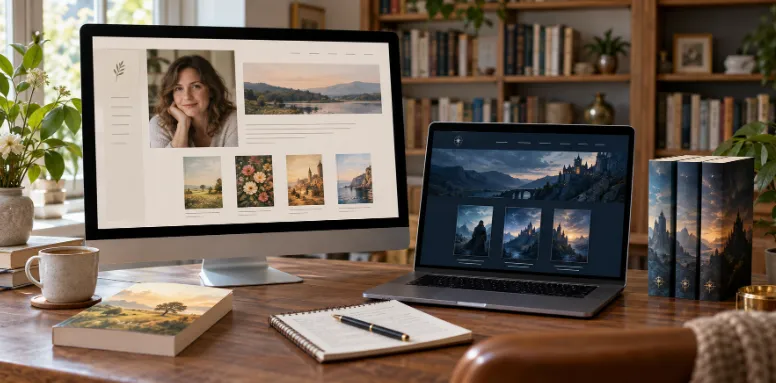

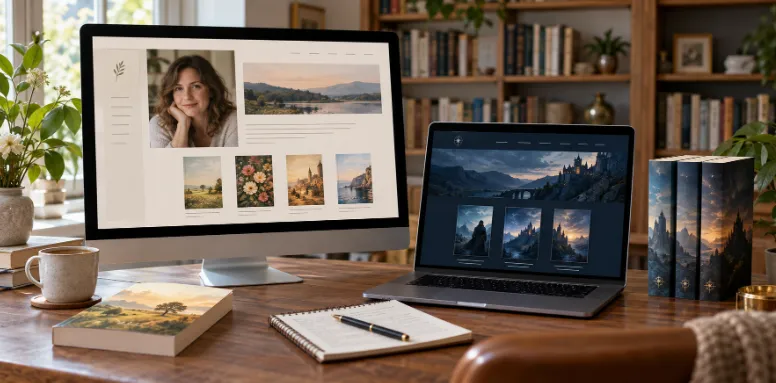
Authors who publish under more than one name, genre, or series eventually face a practical question: should everything remain on one website, or should each identity have its own online home?
A separate website can give readers a clearer experience when the audiences, brands, and publishing schedules are substantially different. It can also double the author’s technical maintenance, content work, costs, and administrative responsibilities.
The decision should therefore be based on reader expectations and business needs, not on the assumption that every pen name or series requires its own domain.
Begin with the reader’s point of view
A website helps visitors understand who the author is, what they write, and which book they should consider next.
If one site can answer those questions without confusing visitors, a separate site may be unnecessary. An author who publishes two related historical-mystery series under the same name can usually organize them on individual series pages within one website.
The decision becomes more complicated when the same person writes children’s picture books under one name and explicit crime fiction under another. The audiences, visual expectations, retailer categories, media opportunities, and age considerations are very different. Combining them may make navigation awkward and weaken the identity of both brands.
Ask what a reader expects after searching for the name printed on the book. The destination should immediately confirm that the person has reached the correct author and show books relevant to that search.
Understand the difference between a page and a website
A book, series, and pen name do not automatically need separate websites.
In many cases, a dedicated page is sufficient. One author website can contain:
- A main page for each genre
- A page for each series
- Individual book pages
- Different newsletter options
- A media page
- Separate navigation paths for different audiences
Jane Friedman recommends giving an established series a clear place in the main navigation of an author website. Her guidance also emphasizes that each book should have a dedicated page containing the information readers need. Her author-website recommendations provide a useful framework for organizing multiple titles without automatically creating multiple sites.
A separate domain should solve a problem that good site architecture cannot solve adequately.
Create a separate site when the pen name is a distinct public identity
A pen name may function as more than a name printed on a cover. It can represent a separate professional identity with its own biography, visual style, audience, newsletter, social accounts, media positioning, and release schedule.
A dedicated website is more likely to make sense when:
- The pen name writes in a substantially different genre
- Readers are not intended to connect the two identities
- The brands use different biographies or public positioning
- One identity addresses adults and another addresses children
- The tone and visual presentation would conflict
- Publishers or agents handle the identities separately
- Each name has enough books and activity to support a full site
Jane Friedman’s guidance on establishing a pen name recommends securing a domain for that name. This gives the author control over the identity’s main online destination even if a full website is not built immediately.
Buying the domain early can prevent confusion or opportunistic registration. However, domain ownership does not require the author to maintain a complex website from the first day.
Keep one site when the connection benefits readers
Some authors use different names for publishing or contractual reasons while still serving closely related audiences.
If the books share themes, readership, or professional context, separating them may make discovery more difficult. Readers who enjoy one series could miss another they would also value. Media contacts may struggle to understand the author’s complete background, while the author must build authority for two domains instead of one.
One site is often enough when:
- The genres are closely related
- The same author identity is public
- Readers commonly move between the books
- There are only one or two titles under the second name
- The author cannot maintain two sites properly
- Separate navigation can keep the material clear
- The marketing strategy intentionally connects the names
The site can say that the author “also writes as” the pen name and provide a dedicated section for those titles.
This approach allows the author to build one mailing list, maintain one media page, and direct backlinks and searches toward one central domain.
Consider privacy before connecting identities
Some writers use pen names because they do not want the identities connected publicly.
A separate website can support that separation, but it does not guarantee anonymity. Domain registration, copyright records, payment systems, mailing-list details, author photographs, analytics accounts, and social profiles can expose connections.
Authors seeking meaningful privacy should consult qualified legal and technical professionals. They should also review publishing contracts to understand how their real name and pseudonym may appear in copyright, royalty, publicity, and rights records.
The Authors Guild explains that publishing contracts frequently govern the use of an author’s name, approved biographical information, likeness, and promotional materials. Its model-contract commentary provides context, although authors should obtain individual advice for their circumstances.
Do not make promises of secrecy to readers, collaborators, or family members without understanding which records may become public.
Evaluate whether a series has become an independent brand
Most individual series do not need separate websites. A well-designed series page can include reading order, descriptions, character information, maps, bonus material, purchase links, reviews, and newsletter registration.
A separate series site becomes more reasonable when the property has developed beyond the author’s ordinary book pages. This may happen when it includes:
- A large number of titles
- Several contributing authors
- Adaptations or licensed products
- Games, teaching resources, or extensive bonus material
- A highly active fan community
- Events organized around the fictional world
- A distinct business or publishing team
Even then, the author’s main site and the series site should link to each other clearly. Readers should not have to determine whether two apparently official sites are competing or unrelated.
Before creating a second site, consider whether a subdirectory such as authorname.com/series-name/ can support the content. This is often easier to maintain and allows the material to benefit from the authority of the existing domain.
Review search behavior
Search results can reveal whether a separate site would reduce confusion.
Search for the pen name, author name, series title, and individual book titles. Look at what currently appears:
- Do readers encounter an unrelated person with the same name?
- Does the publisher’s page outrank the author’s information?
- Are retailer pages the only useful results?
- Is the series frequently confused with another property?
- Do interviews use inconsistent names?
- Is the author’s main site relevant to the query?
A dedicated site may help when the pen name has a substantial body of work but no clear official destination. On the other hand, launching a new domain means beginning with little authority, few links, and limited search history.
Do not duplicate the same biography, book descriptions, and blog posts across both sites without a clear purpose. Decide which site is the primary source for each identity and create meaningful distinctions between them.
Calculate the maintenance burden honestly
A second website involves more than purchasing another domain.
It may require:
- Hosting and renewal fees
- Security monitoring
- Software updates
- Backups
- Accessibility checks
- Analytics and search monitoring
- Privacy and cookie information
- New content
- Newsletter integration
- Broken-link reviews
- Media-kit updates
- Technical support
An abandoned website can create a worse impression than a clearly organized section within an active site. Outdated publication dates, insecure forms, broken purchase links, and old biographies undermine confidence.
The author should know who will maintain each site and how often it will be reviewed. If there is no realistic maintenance plan, keep the structure simpler.
Decide how newsletters and reader data will work
Two websites do not necessarily require two completely independent mailing systems, but readers should understand what they are joining.
If the audiences are different, provide separate signup choices. Someone subscribing for illustrated children’s-book activities may not expect promotional emails about adult horror.
Possible structures include:
- One list with interest tags
- Separate lists within the same email platform
- Completely separate accounts for identities requiring greater separation
- One general author newsletter with clearly described content
The signup form should state what subscribers will receive and how often. Do not automatically move subscribers from one pen-name list to another unrelated brand without appropriate permission.
The website structure should support the communication strategy, not dictate it.
Give each identity a coherent visual system
A separate website is most useful when it creates a recognizably different experience.
The design should reflect the books without turning every page into a theatrical extension of the cover. Visitors still need readable text, accessible navigation, quick loading, and clear purchasing paths.
When identities share one site, use visual cues to distinguish them. Different accent colors, imagery, typography, and landing-page layouts can guide readers while preserving a consistent technical structure.
Avoid making visitors pass through an elaborate choice screen before they can see any useful information. If most people arrive from searches or direct book links, send them to the relevant author, series, or title page immediately.
Plan redirects before changing domains
An author may begin with one site and later decide that a pen name deserves a separate domain. This transition should be planned carefully.
Identify which pages will move, recreate or improve them on the new site, update internal links, and use permanent redirects where appropriate. Update links on retailer profiles, publisher pages, social accounts, newsletters, media biographies, and directory listings.
Do not simply delete the original pages. They may have earned backlinks, search visibility, bookmarks, or links from old interviews.
Keep a clear relationship between the sites when the identities are publicly connected. A short note and link can reassure readers that both destinations are official.
Build for the author’s likely future
The correct structure depends partly on what the author expects to publish next.
One novel under a pen name may not justify an independent site. A contracted six-book series with its own audience and release schedule may justify securing the domain and building a dedicated platform earlier.
Consider the next three to five years:
- Will the pen name continue publishing?
- Will the series expand?
- Will the audiences overlap?
- Will one identity become the main career focus?
- Could film, translation, educational, or licensing activity change the site’s purpose?
- Is the author prepared to produce separate newsletters and content?
Professional author websites should make a writer’s work easier to understand, not create additional brands that cannot be maintained. The right structure may be one well-organized site, two focused websites, or a central author site supported by a distinct series destination.
A separate website is justified when it gives a substantial audience a clearer, more useful experience and supports a lasting publishing identity. If it mainly creates another empty homepage, a strong page within the existing author site is usually the better choice.



























Sign in to leave a comment.