When Pupillary Evaluation Changes: Which Measurement Deserves a Closer Look?

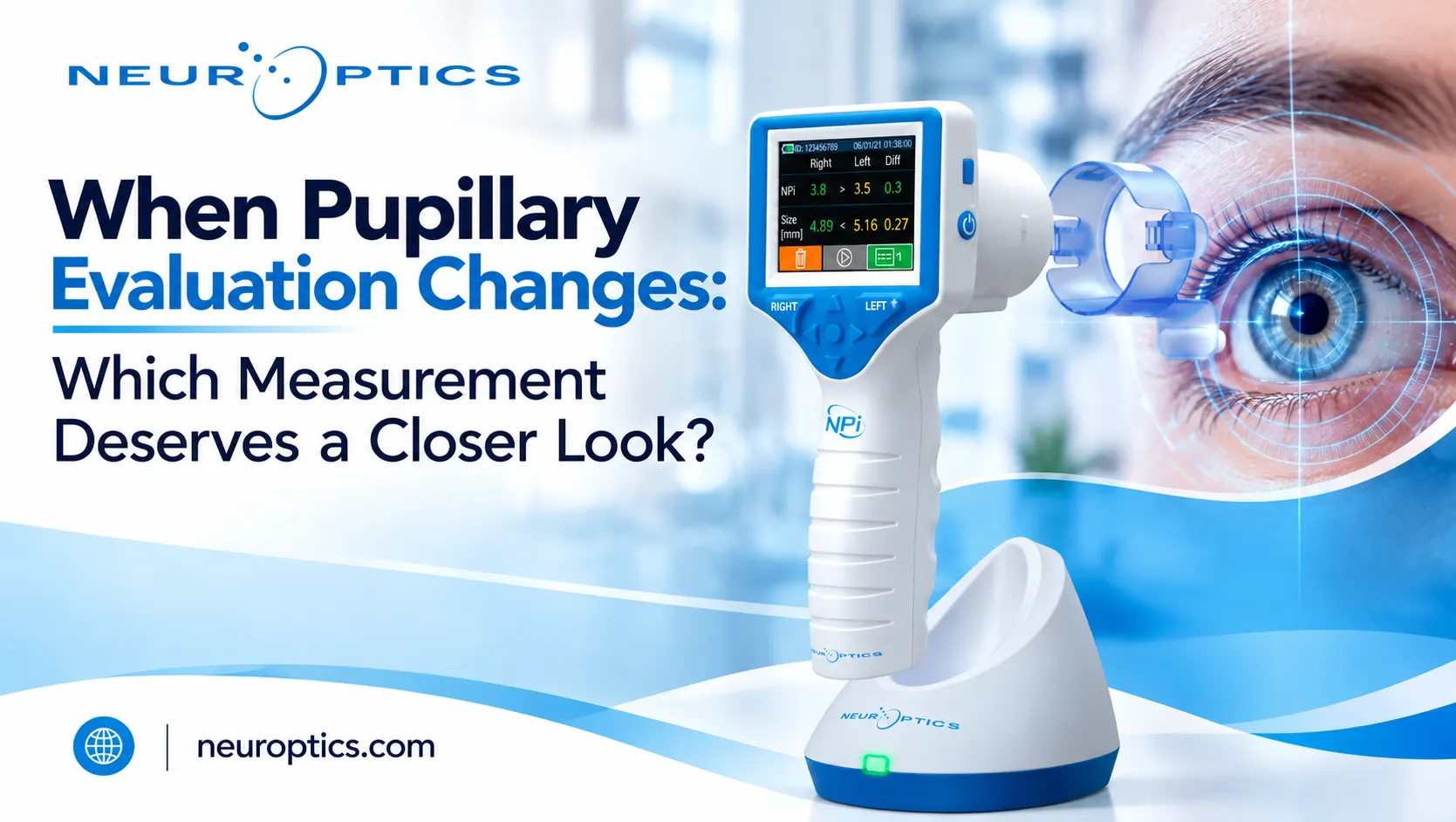
A change in pupil size can immediately draw attention during a neurological assessment. But once a difference is noticed, an important question follows: what exactly has changed, and how should that change be interpreted?
A quantitative pupillary evaluation can provide more detail than a visual description alone. The NPi-300 measures pupil size and reactivity and captures multiple characteristics of the pupillary light reflex (PLR), including percentage change in pupil size.
That makes the measurement more than a simple size check. It becomes one part of a broader picture.
A Change in Pupil Size Is a Starting Point, Not the Whole Answer
Pupil size naturally provides an important measurement during a pupil exam. The NPi-300 defines Size as the maximum pupil diameter before constriction and MIN as the pupil diameter at peak constriction.
These two measurements provide the basis for another value: percent change in pupil size.
The device calculates %CH using the difference between maximum and minimum pupil size relative to the maximum size:
%CH = (Size - MIN) / Size × 100
In practical terms, this shows how much the pupil diameter changes during the measured response.
That can add context that a starting pupil diameter alone cannot provide.
What Does Percent Change in Pupil Size Tell You?
Percent change describes the degree of pupil constriction during the measured PLR. It is therefore different from simply recording whether the pupil appears to react.
But it should not be viewed in isolation.
The NPi-300 also measures latency, constriction velocity, maximum constriction velocity, and dilation velocity. These measurements describe different parts of the pupil's response to the light stimulus.
This creates a more complete quantitative picture.
For example, two measurements may begin with different pupil sizes. Looking only at the initial diameter would not describe how much each pupil changed during the response. The percentage change provides another way to characterize that response.
When Pupil Findings Change, Look at the Response Too
A useful pupillary evaluation goes beyond asking whether the pupil is larger or smaller.
The NPi® provides a numerical expression of pupil reactivity based on the measured variables in the PLR. NeurOptics describes an NPi® from 3.0 to 4.9 as normal, while an NPi® below 3.0 is considered abnormal. An NPi® of 0 may represent a non-reactive, immeasurable, or atypical response.
This means a change in pupil size can be considered alongside quantitative information about the response itself.
For clinical teams, that distinction matters. A pupil's diameter tells you about size. Quantitative PLR measurements provide additional information about what happens when the pupil responds to light.
Why One Measurement Is Better Viewed as Part of a Trend
A single result provides information about one assessment. Repeated measurements provide an opportunity to compare findings over time.
NeurOptics recommends establishing a baseline NPi® and Size measurement and then monitoring trends. The NPi-300 SmartGuard can store up to 168 paired pupil measurements for review and trending.
That changes how teams can approach serial pupil measurement.
Instead of treating every reading as an isolated value, clinicians can review measurements against previous assessments. This can include pupil size, reactivity, and other measured characteristics of the PLR.
The goal is not simply to collect more data. It is to make repeated measurements easier to compare and review.
Where Quantitative Measurement Fits into the Neuro Exam
The neuro exam remains broader than a pupil assessment. Quantitative pupillometry adds objective pupil data to that wider clinical evaluation.
NeurOptics describes the NPi-300 as providing objective pupil size and reactivity data independent of the examiner. Its clinical overview also notes that automated pupillometry can quantify pupil size, symmetry, and reactivity throughout the PLR.
For hospitals considering neurological tools, this distinction is important. The value is not simply having another device at the bedside. It is having measurements that can be documented, compared, and trended as part of an established assessment process.
The Measurement Worth a Closer Look May Not Be Just One Number
When a pupillary evaluation changes, there may be a temptation to focus immediately on the most obvious difference in pupil size.
A quantitative approach allows teams to look more closely.
Pupillary size measurement establishes maximum and minimum diameter. Percent change in pupil size describes the degree of change during the response. Other PLR measurements describe timing, constriction, and recovery. NPi® provides a numerical expression of pupil reactivity.
Taken together, these measurements provide more context than a single visual description.
Conclusion: Put the Change into Context
A changing pupil deserves more than a quick comparison of diameter. The most useful measurement may depend on what part of the pupillary response needs closer examination.
Quantitative pupillometry allows clinicians to examine pupil size, percent change in pupil size, reactivity, and other PLR characteristics within the same assessment. For critical care teams, that creates a more structured way to review pupil findings and follow changes over time.
FAQs
Is percent change in pupil size the same as pupil reactivity?
No. Percent change describes the change between maximum and minimum pupil diameter. NPi® provides a numerical expression of pupil reactivity based on measured PLR variables.
What is the minimum pupil-size measurement threshold for the NPi-300?
The NPi-300 has a pupil-size measurement threshold of 0.80 mm. Pupils smaller than 0.80 mm are not detected for measurement.
What does an NPi® of 0 mean?
According to the NPi-300 IFU, an NPi® of 0 can represent a non-reactive, immeasurable, or atypical response.







Sign in to leave a comment.