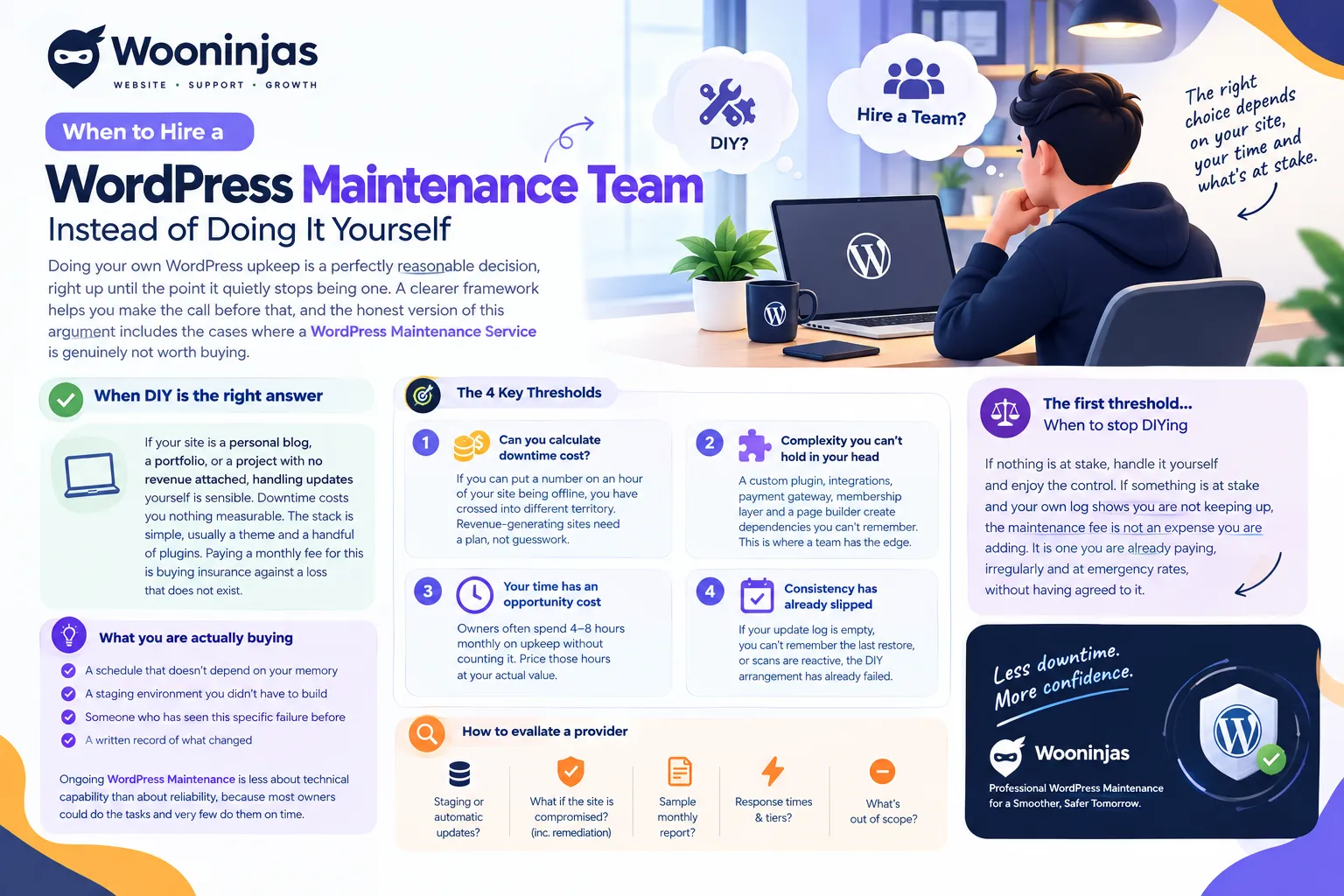


Doing your own WordPress upkeep is a perfectly reasonable decision, right up until the point it quietly stops being one. The switch rarely happens because someone did a cost analysis. It happens after an incident. A clearer framework helps you make the call before that, and the honest version of this argument includes the cases where a WordPress Maintenance Service is genuinely not worth buying.
When DIY is the right answer
If your site is a personal blog, a portfolio, or a project with no revenue attached, handling updates yourself is sensible. Downtime costs you nothing measurable. The stack is simple, usually a theme and a handful of plugins. You can afford to break it and fix it at your leisure. Paying a monthly fee for this is buying insurance against a loss that does not exist.
The first threshold: Can you calculate downtime cost?
If you can put a number on an hour of your site being offline, you have crossed into different territory. A store, a course platform, a membership site or a lead generation site that produces enquiries all have a per hour figure. Once that figure is meaningful, the question changes from whether maintenance is worth paying for to whether your current arrangement is adequate.
The second threshold: Complexity you cannot hold in your head
A site with a custom plugin, three integrations, a payment gateway, a membership layer and a page builder has a dependency map that nobody remembers in full. Updates carry real risk because the interactions are not obvious. This is where testing on staging stops being best practice and starts being necessary, and where a team that works on the site every month has an advantage you cannot replicate occasionally.
The third threshold: Your time has an opportunity cost
Owners routinely spend four to eight hours a month on site upkeep without counting it, because it does not appear as an invoice. Price those hours at whatever your time is actually worth against the work you would otherwise be doing. For most people running a business, this comparison ends the debate on its own.
The fourth threshold: Consistency has already slipped
Look at your update log. Not your intention, your log. If the last plugin update was in April, if you cannot remember the last time you tested a restore, if the security scan is something you do when you feel uneasy rather than on a date, then the DIY arrangement has already failed. That is not a character flaw. It is what happens when maintenance competes with revenue generating work for the same attention.
What you are actually buying
You are buying a schedule that does not depend on your memory, a staging environment you did not have to build, someone who has seen this specific failure before, and a written record of what changed. Ongoing WordPress Maintenance is less about technical capability than about reliability, because most owners could do the tasks and very few do them on time twelve months running.
How to evaluate a provider
Ask whether updates are tested on staging or applied automatically. Ask what happens if the site is compromised while under their care and whether remediation is included or billed separately. Ask to see a sample monthly report. Ask about response times and whether they differ by tier. Ask what is explicitly out of scope, because a provider who answers that clearly is a provider who has thought about it.
The decision in one line
If nothing is at stake, handle it yourself and enjoy the control. If something is at stake and your own log shows you are not keeping up, the maintenance fee is not an expense you are adding. It is one you are already paying, irregularly and at emergency rates, without having agreed to it.

















Sign in to leave a comment.