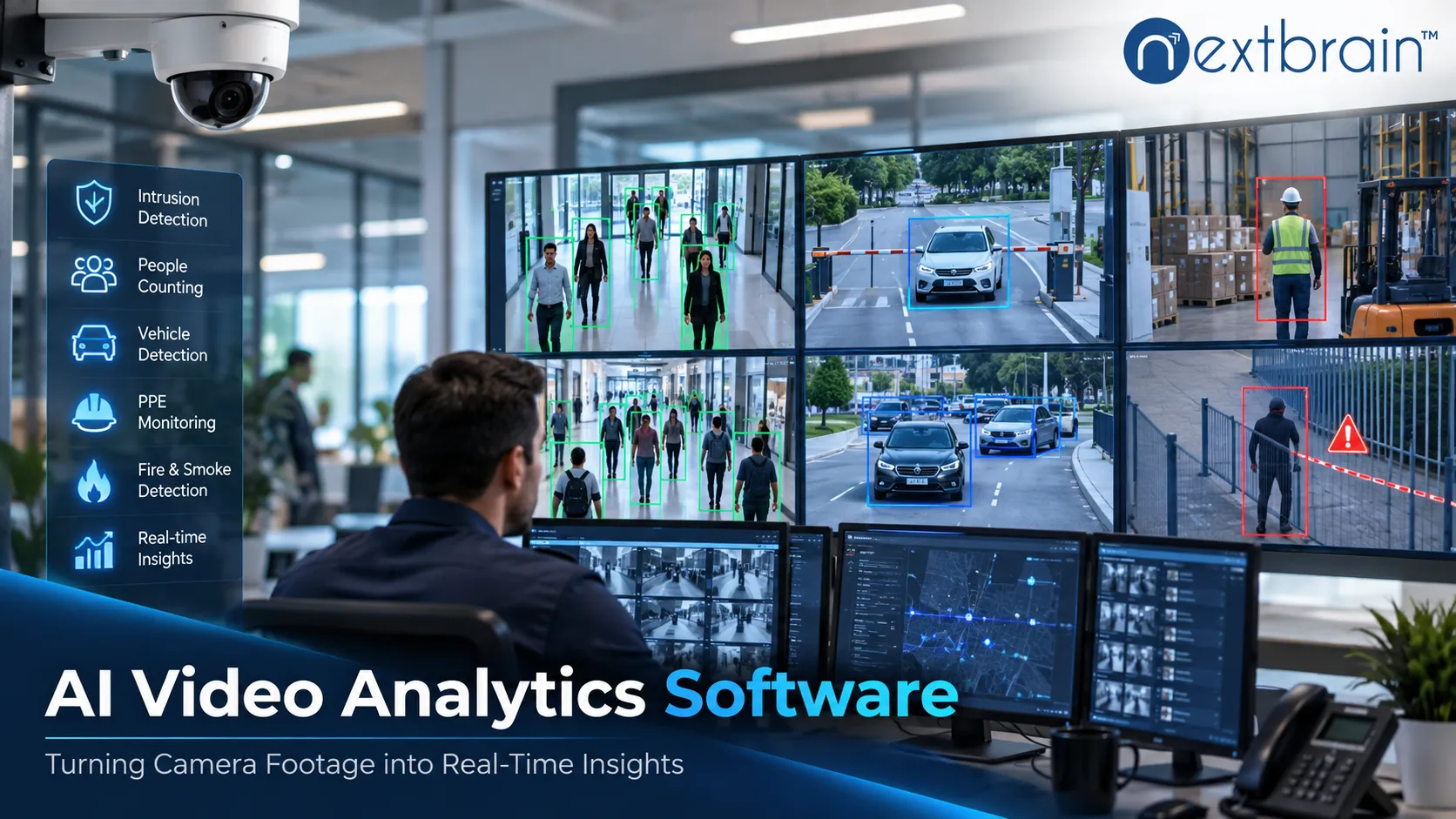

Companies have been using closed circuit television cameras for many years in offices, retail stores, warehouses, factories, and even public places. Although such cameras provide the opportunity to record incidents, the footage captured often stays untouched and unused unless it is being actively monitored by someone. AI video analytics software provides the possibility to use videos as a source of valuable information through the transformation of video streams into structured data.
This technology helps to analyse everything that goes on in real-time, which gives a chance to respond quickly to security issues and other emergencies, as well as get more visibility of business operations.
What Is AI Video Analytics Software?
AI Video Analytics Software uses artificial intelligence and computer vision technologies to perform the analysis of video streams recorded from cameras. It is able to detect people, cars, objects, movement patterns, and predefined events depending on the configuration of the system.
The software analyses video data continuously and is capable of signalling any events that need the attention of users.
Useful Information From Video
Whereas the conventional camera is able to capture images, the AI analytics capability turns the images into data. For instance, instead of capturing individuals who enter a particular building, the analytics system can calculate the number of people entering the building and movements in restricted areas.
This useful data can be displayed as alerts, dashboards, reports, or business intelligence. Hence, the camera system becomes useful not only from a security perspective but also for knowing what is going on in the physical world.
AI’s Role in Day-to-Day Monitoring
One of the best uses of AI in video monitoring involves automation. An organisation can define the events that must be monitored, and the system notifies them in case they happen.
Some of the typical uses include:
Intrusion: Detect any movements in restricted zones.
People counting: Know the number of visitors or the level of occupancy.
Vehicle detection: Detect any movements of vehicles.
PPE monitoring: Detect events related to PPE safety compliance.
Crowd monitoring: Detect increases in occupancy or abnormal crowds.
Fire/smoke detection: Get an early visual warning of potential dangers.
All of these help businesses monitor different things using the same set of cameras.
From Reactive to Rapid Response
Conventional surveillance tends to be reactive. Something happens, it is reported, and the security team reviews recorded footage to figure out what took place.
By using AI for video analysis, pre-defined events can be spotted as they take place. An alert can notify the right team to go to the right camera location to investigate the issue.
AI does not take away the need for human judgment. It enables people to decide which matters most so they can make decisions faster.
Video Analytics Is More Than Security
The utility of video analytics goes far beyond spotting potential threats. Businesses can utilise data generated by video to improve their understanding of the movement, occupancy, traffic patterns, and utilisation of various areas.
For instance, a retailer can analyse footfall and movements of visitors, manufacturers can track activities related to safety, and warehouse owners can have enhanced visibility of restricted areas and vehicle movements.
Responsible application of this information can be beneficial for both security and operations decisions.
Improving Current Cameras
Organisations do not necessarily have to upgrade their complete surveillance system to take advantage of video analytics. Depending on whether the camera is compatible, video quality, network infrastructure, and software needs, the analytics can support either existing CCTV or IP cameras.
In this case, it is possible for organisations to leverage the current investment in cameras by simply adding another layer of intelligence over video monitoring capabilities.
Video-Driven Monitoring in the Future
With the development of artificial intelligence and computer vision technology, video analytics is becoming able to comprehend sophisticated behaviours and environments. Connecting analytics with other security systems such as access control, security management, or business intelligence will make video-based data even more valuable.
Therefore, the future of monitoring is not only about recording video. It is also about making sense out of it.
Conclusion
AI Video Analytics Software turns routine video footage from any camera into valuable data, which will allow you to respond faster and increase safety and awareness. The technology makes it possible not just to observe and record but to interpret the events taking place.
Ready to make your current camera network a smarter one? Give us a call now to see how we can help your company find out about key events, get new insights and be more responsive.
FAQs
1. What is AI video analytics software?
The software analyses camera footage using computer vision and AI technologies to recognise predefined objects, events and actions.
2. Can AI video analytics software work with video in real-time?
Yes, often the software is capable of working with video streams in real-time and triggering alerts based on predetermined events.
3. Does it support current CCTV cameras?
Often yes, although it all depends on some technical aspects.
4. Is video analytics software only used for security purposes?
No, video analytics can also help with people counting, occupancy tracking, traffic monitoring, workplace safety and other purposes.
5. Will AI analytics substitute human monitoring?
Of course not. AI helps analysts to filter out events of interest, but people will still be required.






















Sign in to leave a comment.