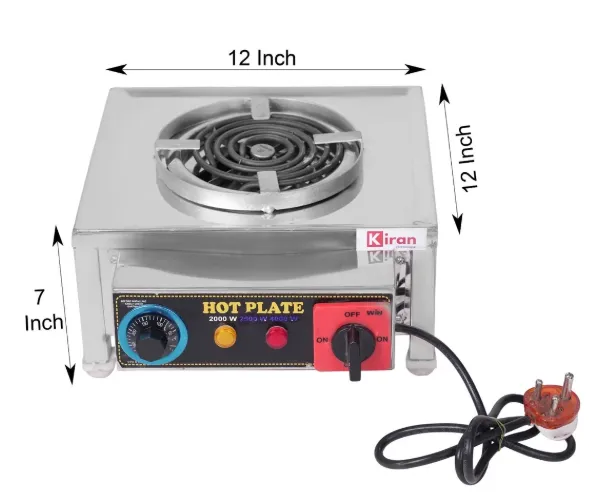

Not every station in a commercial kitchen needs an open flame. Gas has its place on the main line, but there's a growing number of spots in hotel kitchens — back-of-house prep counters, buffet finishing stations, small satellite kitchens, even rooms where gas connections just aren't practical — where a 2000 watt electric stove does the job better, and sometimes safer.
The mistake buyers tend to make with this category is treating it like a downgrade from gas, something you settle for when the "real" setup isn't available. That's not really accurate. For the right application, electric isn't a compromise. It's just a different tool suited to a different kind of task.
Why Electric Fits Certain Stations Better Than Gas
Gas ranges are built for high-heat, fast-response cooking on a main line. But plenty of tasks in a hotel kitchen don't need that — holding a sauce warm, finishing a plated dish, running a small buffet station, or covering prep work in an area without a gas line run to it. In these situations, an electric unit at 2000 watts usually delivers plenty of power without the added infrastructure a gas connection requires.
There's also the layout question. Properties doing renovations or adding satellite kitchens in existing buildings often find that running new gas lines is expensive and sometimes impractical, depending on the building's structure. Electric units sidestep that problem entirely — plug in, and the station is operational.
What "2000 Watt" Actually Means for Kitchen Performance
Wattage is a useful number, but it only tells part of the story. A 2000-watt unit has enough output to boil, sauté, and hold temperature reliably for single-pot or small-batch cooking, which covers a lot of what happens at prep counters, room service stations, or smaller banquet setups. Where it starts to matter more is consistency — how evenly that power gets distributed across the cooking surface, and how quickly the unit responds when temperature needs to change mid-cook.
This is where 2000w induction coil technology tends to outperform standard electric coil or ceramic tops. Induction heats the cookware directly through electromagnetic transfer rather than heating a surface that then heats the pan, which means faster response and less wasted energy sitting in a hot coil after the cook has already moved the pot.
Induction vs Standard Electric: What Actually Changes in Daily Use
Kitchens considering electric equipment often assume all electric stoves behave roughly the same. They don't. A few real differences worth understanding:
- Induction responds almost instantly when the setting is adjusted, much closer to gas in that respect, while standard coil units lag behind by several seconds
Induction surfaces stay cooler to the touch since the heat is generated in the cookware itself, which matters for kitchen safety in tight prep spaces
Standard coils are generally cheaper upfront but use more energy overall since heat is lost to the surrounding air
- Induction requires magnetic cookware, which is worth checking against existing kitchen inventory before switching over
For a busy hotel kitchen weighing energy costs against performance, induction usually wins on efficiency, though it does come with a slightly higher upfront cost and a cookware requirement that's worth planning around.
Where This Fits Into a Broader Equipment Strategy
Electric and induction units aren't meant to replace a main gas line — they're meant to extend cooking capacity into places gas can't easily reach, or where the task doesn't call for gas in the first place. Hotels running multiple outlets, banquet operations, or renovated spaces without existing gas infrastructure tend to get the most value from adding these units strategically rather than trying to force every station onto the same setup.
Durability Still Matters, Even at Smaller Wattage
It's easy to assume smaller electric units need less scrutiny than a full range, but that's a mistake. A poorly built 2000-watt stove with weak internal wiring or a thin heating element will fail faster under repeated commercial use than a well-constructed one, regardless of wattage. Checking build quality, coil material, and manufacturer warranty terms matters just as much here as it does with larger equipment.
Final Thoughts
Electric and induction stoves aren't a backup plan for kitchens that couldn't get gas installed — they're a legitimate equipment choice for specific stations, tasks, and layouts. Matching the right unit to the right application tends to improve both efficiency and long-term reliability across a hotel's broader kitchen setup.
FAQs
Is a 2000 watt electric stove powerful enough for commercial use?
For single-pot cooking, sauces, and smaller-batch prep work, yes. It's generally not meant to replace a full main-line range but works well for supplementary or satellite stations.
What's the difference between induction and standard electric coil stoves?
Induction heats cookware directly and responds almost instantly to setting changes, while standard coils heat a surface first and respond more slowly, using more energy in the process.
Do I need special cookware for a 2000w induction coil stove?
Yes, induction requires magnetic cookware. It's worth checking existing pots and pans against a magnet before switching a station over to induction.
Where does electric cooking equipment make the most sense in a hotel kitchen?
Prep counters, buffet finishing stations, room service kitchens, and satellite kitchens without existing gas lines are common places where electric or induction units perform well.
Is induction more expensive to buy than standard electric?
Usually yes, upfront. But it tends to use less energy over time and responds more precisely, which can offset the higher initial cost in a busy kitchen.

























Sign in to leave a comment.