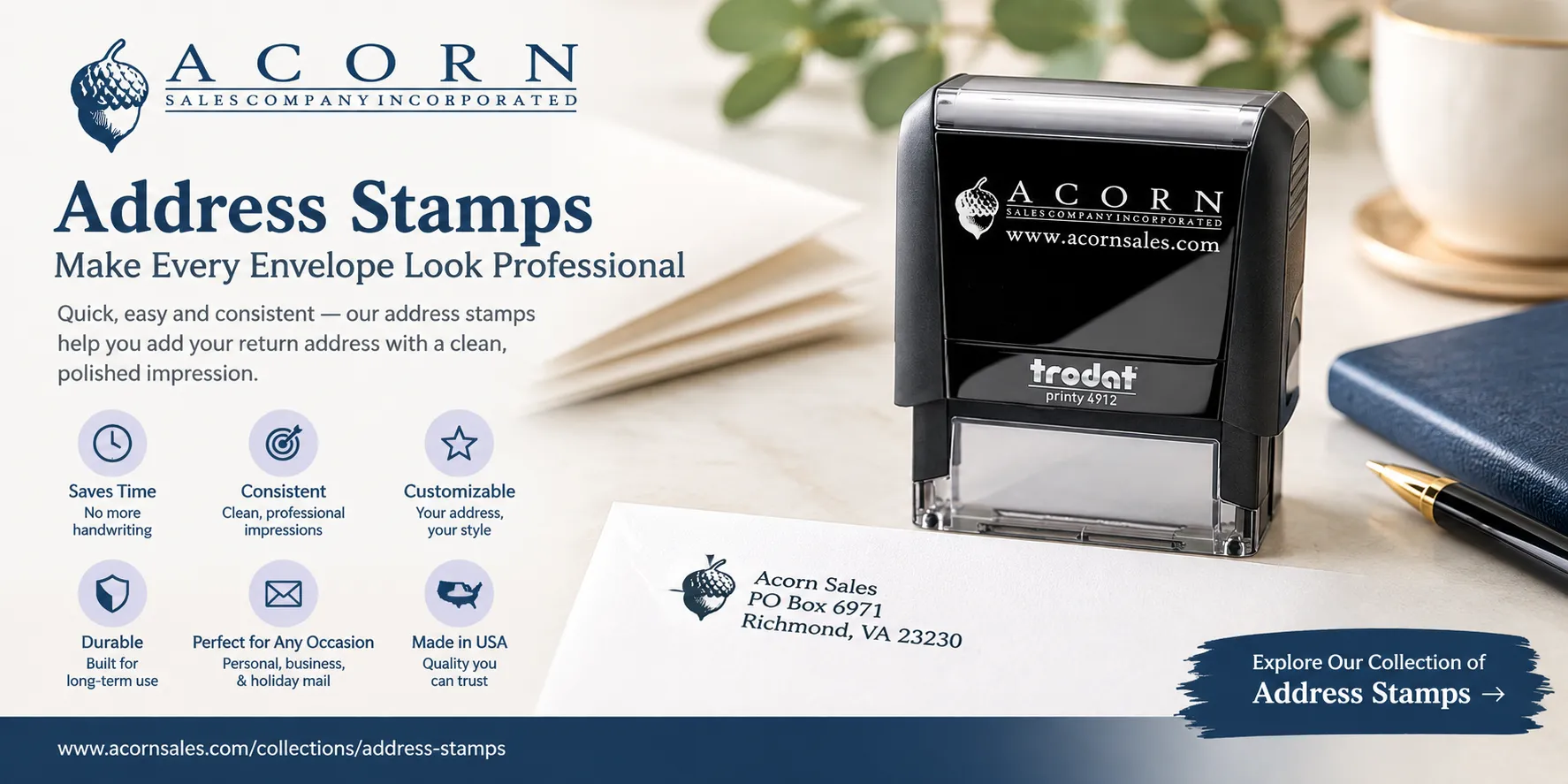

Knowing where to place your return address can make mailing letters, invitations, and business correspondence much easier. For standard U.S. mail, the return address on an envelope is generally placed in the upper-left corner of the front. The recipient's address goes in the center, while postage is placed in the upper-right corner.
For people who mail regularly, address stamps offer a simple way to add return information quickly and consistently. A personalized address stamp can also give envelopes a neat, professional appearance without requiring you to write the same address repeatedly.
Whether you're sending everyday correspondence, wedding invitations, holiday cards, or business mail, understanding proper envelope addressing can help you prepare your mail with confidence.
Where Does the Return Address Go on an Envelope?
So, where does the return address go on an envelope? For a typical U.S. envelope, the return address goes in the upper-left corner on the front side.
A basic envelope layout includes three important areas:
- Upper-left: Sender's return address.
- Center: Recipient's name and mailing address.
- Upper-right: Postage.
Keeping these areas separate makes the envelope easier to read and helps avoid confusion between sender and recipient information.
A return address usually contains the sender's name or business name, street address or P.O. Box, city, state, and ZIP Code.
Where to Put Return Address on an Envelope?
When deciding where to put return address on an envelope, use the upper-left portion of the front of the envelope. Leave enough space around the edges and make sure the text is clear and readable.
For example:
Sender Name
123 Main Street
Richmond, VA 23220
The recipient's information should remain the most prominent address on the envelope. Avoid placing decorative elements, stickers, or other information where they could interfere with the mailing address or postage.
If you frequently send mail, using address stamps can make this process much faster. Instead of handwriting your return information each time, you can create a consistent impression with a personalized stamp.
Why Is Return Address Placement Important?
Correct return address placement helps identify the sender and provides a destination if a mailpiece cannot be delivered. It also makes envelopes look organized and professional.
This can be particularly helpful for businesses that send invoices, customer correspondence, documents, promotional mail, or other materials regularly.
For personal use, an address stamp can save time when sending birthday cards, thank-you notes, holiday cards, or invitations.
The goal is simple: keep the return address clear, readable, and separate from the recipient's mailing information.
How to Address an Envelope Correctly?
Learning how to address an envelope starts with using complete and accurate information. A typical U.S. mailing address includes the recipient's name, street address or P.O. Box, city, state, and ZIP Code.
For example:
Jane Smith
456 Oak Avenue
Atlanta, GA 30303
Your return address follows a similar format:
John Smith
789 Pine Street
Richmond, VA 23220
Double-check spelling, apartment or suite numbers, state abbreviations, and ZIP Codes before mailing. Even a small mistake can make delivery more difficult.
For businesses, include the company name when appropriate. A professional address stamp can help keep your return information consistent across different pieces of correspondence.
When Should You Use a Return Address Stamp?
A return address stamp can be useful whenever you need to add the same sender information to multiple envelopes. Home users can use one for everyday correspondence, greeting cards, invitations, and personal stationery.
Businesses can use custom stamps for customer communications, invoices, thank-you mail, and other routine correspondence.
A custom return address stamp can include a person's name, family name, business name, mailing address, or other selected details. Some designs can also incorporate decorative elements while keeping the address easy to read.
When selecting a stamp, consider the amount of information you need to include, the size of your envelopes, the design style, and whether you prefer a self-inking or traditional stamp.
Where to Put a Return Address on Wedding Invitations?
The return address on wedding invitations requires a little extra attention because couples often want the envelopes to look elegant as well as properly addressed.
For standard mailing, the return address can be placed in the upper-left corner of the envelope. Some wedding stationery designs place the return address on the back flap for aesthetic reasons.
A personalized address stamp can be a practical choice for wedding invitations because the same design can be used across invitation envelopes, RSVP envelopes, thank-you cards, and other wedding stationery.
Choose a simple, readable design that complements your invitation rather than competing with the recipient's address.
How Address Stamps Make Mailing Easier?
Writing your address repeatedly can become tedious, especially when preparing dozens of invitations or business envelopes. Address stamps provide a reusable solution that can make repetitive mailing tasks quicker.
A stamp also helps maintain consistency. Every impression can display the same address in the same basic format, reducing the need to rewrite information manually.
For businesses, this consistency can contribute to a more polished mailing presentation. For families and individuals, a personalized design can add a small personal touch to everyday correspondence.
Acorn Sales offers a variety of address stamps for personal and business mailing needs, including personalized options that can make adding your return information simple and convenient.
Common Envelope Addressing Mistakes to Avoid
Before putting your envelope in the mail, check for these common mistakes:
- Placing the return address where the recipient's address should be.
- Leaving out the ZIP Code.
- Forgetting an apartment, unit, or suite number.
- Writing the address too close to the edge.
- Using ink that is difficult to read.
- Making decorative elements too large or distracting.
- Covering important mailing information with labels or stickers.
- Failing to check the address for spelling errors.
A quick review can help ensure your envelope contains clear and complete information.
Conclusion
Understanding proper return address placement is an important part of preparing mail. For standard U.S. envelopes, the return address generally belongs in the upper-left corner of the front, while the recipient's address is placed in the central area.
If you regularly send letters, invitations, cards, or business correspondence, address stamps can make the process more convenient. A custom return address stamp can provide consistent impressions while adding a personalized touch to your envelopes.
Whether you choose handwriting, printing, or a reusable stamp, the most important thing is to keep the information complete, accurate, and easy to read. With the right addressing method, preparing your everyday mail can be simple and efficient.
Frequently Asked Questions (FAQ)
Where does the return address go on an envelope?
For a standard U.S. envelope, the return address is generally placed in the upper-left corner on the front. The recipient's address is placed in the central area.
Where to put return address on an envelope for mailing?
Place the return address in the upper-left corner of the front of the envelope. Keep it readable and separate from the recipient's mailing address.
What information should be on a return address?
A return address generally includes the sender's name or business name, street address or P.O. Box, city, state, and ZIP Code.
Can I use an address stamp on an envelope?
Yes. An address stamp can be used to apply your sender information to envelopes. It is especially useful when you regularly send letters, cards, invitations, or business correspondence.
What is a return address stamp?
A return address stamp is a reusable stamp customized with your sender information. It can provide a quick and consistent way to add your return address to envelopes.
Are custom return address stamps useful for businesses?
Yes. A custom return address stamp can help businesses apply consistent sender information to routine correspondence, envelopes, and other suitable mailing materials.
























Sign in to leave a comment.