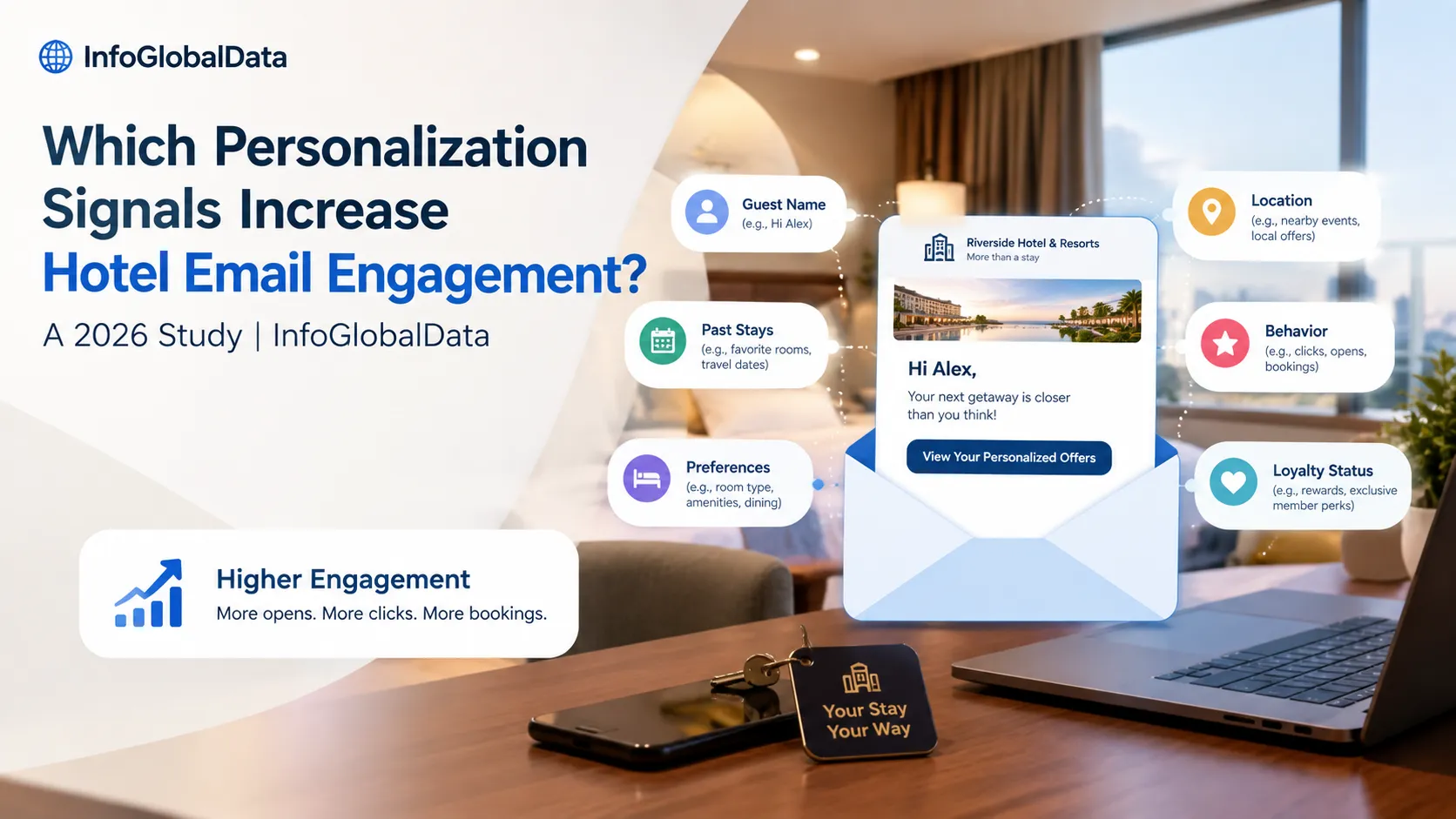

Hotel email engagement is increasingly shaped by contextual personalization rather than basic first-name personalization. Recent hospitality research shows that recurring, behavior-triggered campaigns can substantially outperform broad one-time sends, while traveler surveys indicate strong demand for offers and recommendations based on individual interests. Revinate's 2026 Hospitality Benchmark Report, based on 1.8 billion hotel emails, found average open rates of 56.6% for recurring campaigns versus 32.2% for one-time campaigns, with click-through rates of 15.17% and 2.37%, respectively.
This 2026 analysis examines which personalization signals are most useful for hotel marketers, including stay history, booking behavior, trip purpose, interests, timing, loyalty status, destination preferences, and engagement history. The evidence suggests that the strongest signals are those that help answer a simple question: Why is this particular offer relevant to this guest right now?
Why Personalization Matters More in Hotel Email Marketing
Hotels have an unusual amount of customer context available for personalization. A guest relationship can generate information about previous stays, booking dates, room preferences, booking channel, spending behavior, destination interests, loyalty activity, and interactions with previous emails.
Revinate notes that connected guest data can be used for segmentation, personalization, and automation across the guest journey. Its 2026 benchmark data shows how important the distinction between broad and contextual campaigns can be: recurring campaigns averaged a 56.6% open rate and 15.17% CTR, compared with 32.2% open and 2.37% CTR for one-time campaigns.
That difference should not be interpreted as proof that personalization alone caused the performance gap. Automated campaigns often reach guests at inherently more relevant moments—for example, after an abandoned booking or before an upcoming stay.
Nevertheless, the finding supports a broader principle: relevance and timing should be treated as core personalization signals.
Which Personalization Signals Matter Most?
1. Previous Stay and Booking History
Past behavior is one of the most actionable sources of first-party data.
A hotel can potentially distinguish between:
- First-time and returning guests
- Weekend and weekday travelers
- Frequent and occasional visitors
- Guests who typically book certain room categories
- Previous direct and OTA bookers
- Guests who repeatedly visit a particular destination
Revinate specifically identifies stay history, room preferences, spending patterns, and booking channel as useful hotel guest data for personalization.
This means a Hotel Email List should not be treated as one homogeneous audience. A returning business traveler may respond to a weekday package, while a previous leisure guest may be more interested in a weekend experience.
The signal is valuable because it is based on observed behavior rather than assumptions.
2. Trip Purpose
Business, leisure, family, romantic, group, and event travel can require very different messaging.
For example, a business traveler might respond to:
- Flexible check-in
- Workspace availability
- Business amenities
- Weekday packages
- Airport transportation
A leisure traveler may be more interested in:
- Dining
- Spa services
- Local experiences
- Weekend packages
- Room upgrades
The personalization opportunity is particularly relevant in 2026 because travelers increasingly expect experiences to reflect individual interests.
Booking.com's 2026 Travel Predictions research surveyed 29,733 travelers across 33 countries and territories and found a strong shift toward highly individualized travel experiences. The research was conducted in July and August 2025.
For hotel marketers, this supports using trip-purpose data when it is legitimately available rather than relying exclusively on demographic segmentation.
3. Destination and Interest Signals
Interest-based personalization can make an otherwise generic hotel promotion more useful.
TakeUp's 2025 Voice of the Boutique Travel Guest survey of 350 travelers who regularly stay at independent properties found that 95% said personalized offers or recommendations based on their interests would make them more likely to book a stay. The same study found that 45% were willing to pay more for unique or high-quality experiences, while only 11% prioritized the lowest possible rate.
This is particularly relevant to independent hotels.
Instead of sending:
"Book your next stay with us."
a property could segment guests around interests such as wellness, dining, outdoor activities, family travel, cultural experiences, or local events—provided those preferences are supported by reliable customer data.
The key is to personalize the value proposition, not simply the recipient's name.
4. Booking or Stay Timing
Timing is another personalization signal that can dramatically change the usefulness of an email.
Examples include:
- Pre-arrival upgrade offers
- Abandoned-booking reminders
- Post-stay feedback requests
- Birthday or anniversary campaigns
- Seasonal offers based on previous travel patterns
- Win-back messages after a period of inactivity
Revinate's 2026 data provides strong evidence for behavior-triggered messaging. Recurring automated campaigns averaged 56.6% opens and 15.17% CTR, while one-time campaigns averaged 32.2% opens and 2.37% CTR.
The lesson is not simply "send more automated emails." It is to identify events that create a legitimate reason to contact the recipient.
5. Loyalty and Repeat-Guest Status
Loyalty status can provide another meaningful layer of personalization.
Adyen's 2025 hospitality research reports that guests increasingly want to be recognized and rewarded with tailored promotions and recommendations rather than receiving generic rewards. It also found that hospitality businesses are moving toward more personalized, data-driven loyalty strategies.
A loyalty member's email can therefore acknowledge an existing relationship instead of treating the recipient like a new prospect.
Examples include:
- Early-access offers
- Relevant upgrades
- Personalized rewards
- Destination-specific recommendations
- Recognition of repeat visits
However, loyalty status should not automatically mean "discount." Personalization can also involve convenience, recognition, access, or recommendations.
Does Smaller Segmentation Improve Hotel Email Engagement?
Available hotel marketing data suggests that smaller, more focused segments can improve engagement, although marketers should avoid assuming that smaller is always better.
Revinate reports that applying sufficient segment filters to reduce audiences to 5,000 recipients or fewer can increase open rates by about 15% in its data.
This finding is particularly useful for teams managing a large Hotel Email Database.
Instead of creating one massive campaign, marketers can build segments such as:
| Signal | Example Segment | Possible Message |
|---|---|---|
| Stay history | Repeat guests | Exclusive return-stay offer |
| Booking behavior | Weekend visitors | Weekend package |
| Trip purpose | Business travelers | Weekday/business amenities |
| Interest | Spa users | Wellness package |
| Loyalty | High-frequency guests | Early access or recognition |
| Engagement | Recent clickers | Follow-up offer |
| Booking stage | Abandoned booking | Booking recovery message |
The objective is not maximum segmentation. It is useful segmentation.
Too many small segments can create operational complexity and insufficient sample sizes for reliable testing.
Why Behavioral Signals Usually Beat Basic Demographics
Demographic information can help establish broad audience groups, but behavioral signals often provide stronger context for a hotel campaign.
Consider two guests of the same age and location. One has stayed at the property three times for business; the other stayed once for a family vacation.
Their demographic profile may be similar, but their likely hotel needs are different.
Behavioral information—such as previous booking type, stay frequency, room preference, engagement, and purchase history—can therefore provide a more direct connection between the message and the customer's demonstrated interests.
Booking.com's 2026 research reinforces the wider movement toward individualized travel: the company describes 2026 travelers as seeking trips aligned with their individual passions, goals, and interests, based on its survey of nearly 30,000 travelers.
For a Hotel Mailing List, this means the value of segmentation increasingly depends on the quality and depth of available first-party data.
Why Engagement Should Be Measured Beyond Open Rate
Open rates remain useful as a directional metric, but they should not be treated as the final measure of personalization success.
Revinate's benchmark data demonstrates the difference between opens and deeper engagement. Recurring campaigns averaged a 15.17% CTR compared with 2.37% for one-time campaigns.
Hotel marketers should therefore monitor:
- Delivery rate
- Click-through rate
- Click-to-open rate
- Booking starts
- Completed bookings
- Revenue per recipient
- Upgrade or ancillary purchases
- Unsubscribe rate
- Repeat bookings
- Direct-booking share
This makes it possible to determine whether personalization produces commercially meaningful engagement, rather than merely more opens.
What Personalization Signals Should Hotels Test First?
A practical testing hierarchy can start with signals that are both useful and relatively easy to validate.
Test 1: Recent behavior
Compare messages based on recent clicks, bookings, searches, or abandoned bookings.
Test 2: Stay history
Test returning guests against first-time or inactive guests.
Test 3: Trip purpose
Where reliable data exists, separate business, leisure, group, and other travel contexts.
Test 4: Interest or experience
Test relevant dining, wellness, local attractions, family, or activity recommendations.
Test 5: Timing
Compare generic scheduled campaigns with messages triggered by booking, arrival, checkout, or inactivity events.
This approach creates measurable experiments rather than assuming that every available customer attribute should be used.
How a Hotel Email Database Supports Personalization
Personalization depends on the quality of the underlying records.
A Hotel Email Database can help marketers identify and organize hotel-related contacts for B2B campaigns involving hospitality vendors, technology providers, travel services, suppliers, and other hotel-industry offers. But a database should be combined with segmentation, enrichment, verification, and appropriate compliance practices.
For teams using InfoGlobalData, structured hotel contact data can serve as one input into account targeting and audience development. The performance advantage comes from combining accurate contact information with relevant segmentation and a clear reason for outreach—not from treating a database as a substitute for campaign strategy.
5 Practical Takeaways for Hotel Marketers
1. Start with behavior, not just names
First-name personalization is easy to implement but provides limited context. Prioritize signals such as previous stays, booking behavior, interests, and engagement.
2. Build lifecycle campaigns
Use booking, pre-arrival, post-stay, abandonment, and win-back events to create legitimate reasons for contacting guests.
3. Keep segments actionable
Use enough filters to make the message meaningfully different, but avoid creating dozens of tiny audiences that cannot produce statistically useful tests.
4. Connect data sources
PMS, CRM, loyalty, booking-engine, and engagement data become more useful when they can contribute to a unified customer profile. Revinate emphasizes connected guest data as a foundation for personalization.
5. Measure bookings and revenue
Compare personalized campaigns with control groups where possible and track downstream outcomes—not only opens and clicks.
Conclusion: The Most Valuable Signal Is Context
The latest hospitality evidence points toward a shift from superficial personalization to contextual relevance. Travelers increasingly express interest in individualized experiences, while hotel email benchmarks show that automated and behavior-triggered campaigns can generate substantially stronger engagement than broad one-time sends.
For marketers managing a Hotel Email List, the most useful signals are therefore those that explain the guest's likely need: previous stay behavior, booking stage, trip purpose, interests, loyalty relationship, and recent engagement. No single signal guarantees higher performance, and survey preferences should not be confused with measured email causality.
The next step is systematic testing. Build reliable segments, connect first-party data, personalize around genuine context, and measure clicks, bookings, revenue, and repeat behavior. As hotel marketing becomes increasingly data-driven, the competitive advantage will come less from sending more personalized emails and more from knowing which personalization is genuinely useful to each guest.
Frequently Asked Questions
1. What personalization signals work best for hotel email marketing?
Useful signals include previous stay history, booking behavior, trip purpose, interests, loyalty status, booking stage, and recent email engagement. Current hotel benchmark evidence particularly supports behavior-triggered and segmented campaigns, although results vary by audience and property.
2. Does personalization increase hotel email open rates?
Personalization can improve relevance, but there is no universal percentage increase attributable to personalization alone. Revinate's 2026 benchmark found recurring hotel campaigns averaged a 56.6% open rate versus 32.2% for one-time campaigns, but the difference reflects multiple factors, including timing, automation, and audience intent.
3. How should hotels segment a Hotel Email List?
Hotels can segment by stay history, booking behavior, trip purpose, interests, loyalty status, geography, engagement, and lifecycle stage. The best segments are those where the message or offer changes meaningfully based on the selected signal.
4. What is the difference between a Hotel Email List and a Hotel Email Database?
The terms are often used interchangeably, but a Hotel Email Database generally implies a broader structured dataset containing contact and company attributes that can support segmentation and enrichment. A list may simply refer to the subset of contacts used for a particular campaign.
5. How can hotels personalize emails without overcomplicating campaigns?
Start with a small number of high-value signals—such as previous booking behavior, lifecycle stage, and trip purpose—and create a few clearly differentiated campaigns. Expand segmentation only when campaign data shows that the additional distinction changes engagement or revenue.
6. Should hotels personalize subject lines or email content?
Both can be tested, but content relevance is especially important because an attractive subject line does not guarantee a booking or click. Hotel marketers should compare engagement and downstream booking behavior rather than optimizing open rate alone.
7. Why is first-party data important for hotel personalization?
First-party data comes directly from interactions between guests and the property, such as bookings, stays, preferences, and engagement. It gives hotels context that can be used to create relevant lifecycle and behavioral segments, provided the data is collected and used appropriately.
8. Can a Hotel Mailing List be used for personalized B2B hotel outreach?
Yes, when the list contains relevant business contacts and appropriate segmentation fields. For B2B campaigns, marketers can segment hotel contacts by role, property type, company size, geography, or business need and then tailor the message to the recipient's professional context.




























Sign in to leave a comment.