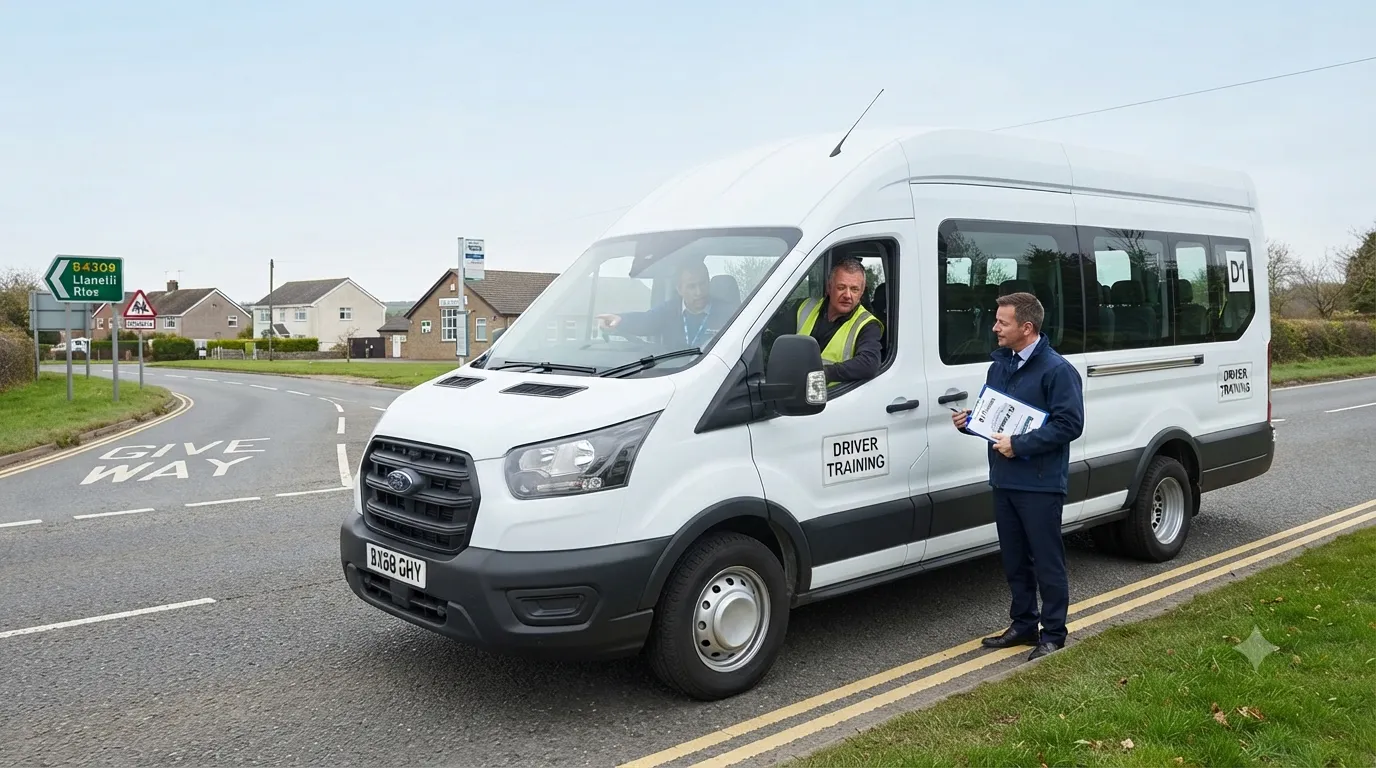

A minibus can be useful for schools, care organisations, community groups, sports clubs, hotels, transport companies and other organisations that need to carry several passengers. However, the licence you need to drive one depends on the vehicle, how it is being used and the conditions attached to your driving licence.
For many drivers, the relevant licence category is D1.
A Category D1 licence allows you to drive a minibus with up to 16 passenger seats, a maximum length of 8 metres and a trailer up to 750kg.
But not everyone who drives a minibus automatically needs to complete D1 training. There are specific circumstances where a driver may be able to drive a minibus using a car licence.
So, who needs a D1 minibus licence in the UK?

What Is a D1 Minibus Licence?
A Category D1 licence is a passenger vehicle licence category for minibuses.
Under the current UK driving licence categories, D1 covers vehicles with:
- No more than 16 passenger seats
- A maximum length of 8 metres
- A trailer up to 750kg
If you need to tow a trailer over 750kg with a D1 vehicle, you generally need D1E rather than D1.
D1 is therefore different from Category D, which covers larger buses with more than 8 passenger seats.
Who Usually Needs a D1 Licence?
You may need a D1 licence if you want to drive a minibus that falls within the D1 category and you do not have another entitlement that allows you to drive it.
This can include people who drive minibuses for work or professional purposes, such as:
- Minibus drivers
- School transport drivers
- Care organisation drivers
- Community transport drivers
- Hotel and leisure transport drivers
- Airport or passenger shuttle drivers
- Sports club transport drivers
- Passenger transport workers
- Drivers working for organisations that provide minibus services
The exact requirements depend on how the minibus is being used.
Do You Need a D1 Licence to Drive a Minibus?
Not necessarily.
GOV.UK explains that some people may be able to drive a minibus with a Category B car licence if specific conditions are met. These conditions include the minibus not being used for hire or reward and other restrictions relating to the driver, organisation, vehicle weight and use.
For example, someone aged 21 or over who has held a car licence for at least two years may be able to drive a minibus in the UK for a non-commercial organisation on a voluntary basis, provided the other conditions are met.
The minibus must also meet the relevant weight limits and the driver must not tow a trailer under this particular exemption.
Therefore, it is important to check your individual licence and the circumstances in which the vehicle will be used before assuming that D1 training is or is not required.
Who Needs D1 Training for Professional Minibus Driving?
If you want to drive a D1-category minibus commercially or the available car-licence exemptions do not apply, you may need to obtain the appropriate D1 provisional entitlement and complete the required training and testing.
This can apply to drivers who are employed to transport passengers in a minibus.
For example, a person employed to drive a minibus for a passenger transport business may need the relevant PCV entitlement rather than relying on the limited car-licence exemptions.
GOV.UK states that if you want to drive a minibus commercially, or the relevant non-commercial conditions do not apply, you need to apply for a minibus provisional entitlement and a PSV operator licence applies to the operator where required.
What Does D1 Allow You to Drive?
A standard D1 entitlement allows you to drive a minibus with:
Up to 16 passenger seats
The vehicle can have no more than 16 passenger seats in addition to the driver.
Maximum length of 8 metres
The D1 category applies to minibuses with a maximum length of 8 metres.
Trailer up to 750kg
A D1 vehicle can tow a trailer with a maximum authorised mass of up to 750kg.
If you need to tow a heavier trailer, you may need D1E.
What Is the Difference Between D1 and D1E?
The main difference is the trailer entitlement.
D1
D1 allows you to drive a qualifying minibus with a trailer up to 750kg.
D1E
D1E allows you to drive a D1-category minibus with a trailer over 750kg, subject to the applicable combined weight restrictions.
If your intended job involves towing a larger trailer, such as equipment or specialist transport equipment, it is important to check whether D1E is required.
Can You Drive a Minibus with a Car Licence?
In certain circumstances, yes.
Some drivers can drive a minibus with a Category B licence without obtaining a full D1 entitlement.
For example, GOV.UK states that you may be able to drive a minibus in the UK if:
- You are 21 or older
- You have held your driving licence for at least two years
- You meet the relevant medical requirements if applicable
- You drive on a voluntary basis
- The minibus is used by a non-commercial organisation for social purposes
- You are not driving for hire or reward
- The minibus meets the relevant MAM limit
- You are not towing a trailer
These conditions apply to a specific exemption, so they should not be treated as a general replacement for D1 entitlement.
What Does "Hire or Reward" Mean?
Hire or reward generally relates to carrying passengers in return for payment or other consideration.
This is important because some of the exemptions available to car licence holders apply only when the minibus is not being used for hire or reward.
If you are being employed specifically to drive passengers commercially, you should check the relevant licensing requirements rather than assuming that your Category B licence is sufficient.
Do School Minibus Drivers Need a D1 Licence?
It depends on the circumstances.
Schools and other educational organisations may use minibuses to transport pupils and staff. Some drivers may qualify under specific exemptions, while others may need a D1 entitlement.
GOV.UK guidance for school minibuses confirms that drivers with a full D1 or D PCV entitlement can drive minibuses for hire or reward. It also describes circumstances in which certain Category B licence holders can drive minibuses for non-commercial purposes.
Therefore, schools should check both the driver's licence entitlement and how the minibus service is being operated.
Do Community Transport Drivers Need D1?
Community transport is another area where the rules can vary.
A volunteer driving a minibus for a qualifying community organisation may be able to use a car licence if all the relevant exemption conditions are met.
For example, GOV.UK states that a minibus permit can apply where a vehicle carries between 9 and 16 passengers, is operated by a voluntary organisation benefiting the community, is available to members of that organisation and charges only cover running costs rather than generating a profit.
If the conditions are not met, the driver may need the appropriate PCV entitlement.
Do You Need D1 for a Hotel or Airport Shuttle?
It depends on how the service operates.
Hotels, airports and other businesses may use minibuses to transport customers or passengers. If the vehicle is being operated commercially and the applicable exemption does not apply, the driver may need the relevant passenger-carrying vehicle entitlement.
Before starting a job, it is worth checking:
- The number of passenger seats
- Vehicle length
- Vehicle weight
- Whether passengers are paying
- Whether the service is operated commercially
- Whether the driver is employed specifically to drive passengers
- Whether any licence restrictions apply
What Are the Requirements for D1 Training?
If you need to obtain D1 entitlement, you will need to follow the appropriate licensing and testing process.
This can include:
- Applying for the relevant provisional entitlement
- Meeting the medical requirements
- Completing the required theory tests
- Taking professional D1 driving lessons
- Practising vehicle control and manoeuvring
- Completing the practical driving test
- Completing any additional professional qualification requirements that apply to your intended work
The exact process can depend on whether you are seeking D1 for professional driving and whether you already hold other vocational driving entitlements.
What Skills Do You Learn During D1 Minibus Training?
Driving a minibus requires different skills from driving a standard car.
D1 training can help learners develop skills such as:
Vehicle Control
You need to understand how a larger passenger vehicle responds to steering, braking and acceleration.
Mirror Use
A minibus has different visibility requirements from a car. Effective mirror checks are an important part of safe driving.
Road Positioning
The increased size and length of the vehicle need to be considered when positioning on the road.
Manoeuvring
Drivers need to practise manoeuvring in confined areas and understand the vehicle's turning characteristics.
Passenger Safety
A minibus driver has responsibility for the safety and comfort of passengers throughout the journey.
Hazard Awareness
Drivers need to identify hazards early and make safe decisions based on traffic, road conditions and the vehicle's size.
Do D1 Drivers Need Driver CPC?
If you drive a minibus professionally and fall within the Driver CPC requirements, you may need the relevant professional qualification in addition to your driving licence.
Driver CPC requirements depend on the type of driving you do and the circumstances in which the vehicle is operated.
Drivers should therefore check the current requirements before starting professional passenger transport work.
What Jobs Can You Do with a D1 Licence?
A D1 licence can be relevant to a range of passenger transport roles.
Potential areas include:
- School minibus driving
- Community transport
- Care organisation transport
- Hotel shuttle services
- Passenger transfer services
- Sports club transport
- Private passenger services
- Specialist minibus operations
The exact job requirements can vary between employers.
Some roles may also require additional qualifications, experience or checks depending on the passengers being transported.
What Is the Difference Between D1 and Category D?
D1 and D are both passenger vehicle licence categories, but they cover different vehicle sizes.
D1 is for minibuses with no more than 16 passenger seats and a maximum length of 8 metres.
D covers buses with more than 8 passenger seats and is the category used for larger buses and coaches.
If you plan to drive a standard minibus, D1 may be the relevant category. If you want to drive a larger bus or coach, you may need Category D instead.
Why Is D1 Training Important?
D1 training helps learners understand how to safely operate a larger passenger vehicle.
A minibus carries multiple passengers, so drivers need to consider more than their own position and safety.
Good training can help you develop:
- Better vehicle control
- Safer road positioning
- Effective mirror use
- Improved manoeuvring skills
- Better hazard awareness
- Passenger safety awareness
- Test preparation
- Confidence with larger vehicles
Professional training can also help learners identify areas that need more practice before taking the practical test.
Why Choose GS Driver Training?
Choosing a suitable training provider can help you prepare for D1 driving in a structured way.
GS Driver Training provides professional driver training for people looking to develop their minibus driving skills.
Training can focus on:
- D1 minibus driving
- Vehicle control
- Mirror use
- Road positioning
- Manoeuvring
- Hazard awareness
- Practical test preparation
- Safe passenger transport
Whether you are starting a new driving career or need D1 entitlement for a specific role, structured training can help you prepare for the practical requirements of minibus driving.
Final Thoughts
A D1 minibus licence is generally used for driving minibuses with up to 16 passenger seats, a maximum length of 8 metres and a trailer up to 750kg.
However, not everyone who drives a minibus automatically needs a full D1 entitlement. Certain drivers can use a Category B licence under specific conditions, particularly for qualifying voluntary and non-commercial minibus use.
If you plan to drive a minibus commercially, work as a professional passenger transport driver, or do not meet one of the available exemptions, you should check whether you need D1 training and the appropriate PCV entitlement.
Understanding the licence requirements before starting training can help you choose the right course for your intended driving role.























Sign in to leave a comment.