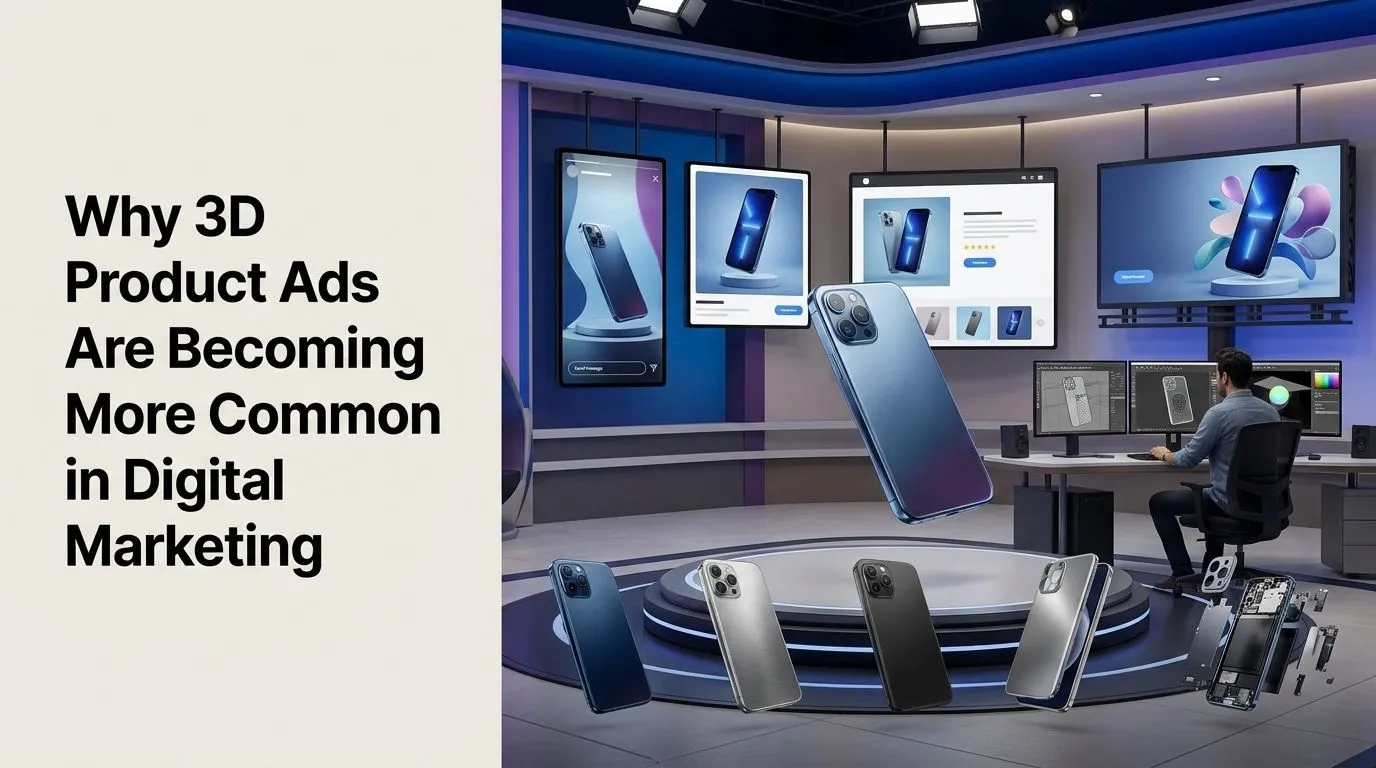

Open Instagram, TikTok, or a shopping app right now and you will likely see a product spinning in place, a lid popping open in slow motion, or a shoe exploding into its individual parts. None of that was filmed. These are 3D product ads, and they are showing up more often because they let brands do things photography and live video cannot: change color, angle, or setting in minutes, and show a product working from the inside before it ever exists in real life.
This piece looks at what is actually driving the shift toward 3D product ads, where they work best, what they cost compared to traditional shoots, and how to decide if your next campaign should use one.
Table of contents
- What is a 3D product ad?
- Why are 3D product ads becoming more common?
- Where do 3D product ads work best?
- How does a 3D product ad compare to a traditional photo or video shoot?
- What are the different styles of 3D product ads?
- How is a 3D product ad made?
- What mistakes should you avoid?
- Best practices for a 3D product ad campaign
- How to choose a studio for 3D product ads
- Frequently asked questions
- Conclusion
What is a 3D product ad?
A 3D product ad is an advertisement built from a computer-generated 3D model of a product instead of a photograph or filmed footage. The model can be lit, colored, rotated, and animated in any way the campaign needs, and the same model can be reused across many ads without a new shoot.
This covers a range of formats, all built from the same underlying idea:
- Short looping animations for social feeds, showing a product rotating or a lid opening.
- Exploded views that separate a product into its parts to show what is inside.
- Photorealistic still renders used in place of studio photography.
- Interactive 3D or AR ads that let a shopper rotate or place a product themselves.
- Larger-scale 3D formats, such as digital billboards, used for brand campaigns.
Why are 3D product ads becoming more common?
3D product ads are becoming more common because they solve practical problems that photography cannot: cost, speed, flexibility, and the ability to show a product before it physically exists. Several forces are pushing brands toward them at the same time.
The same 3D model can produce unlimited variations
Once a product is modeled in 3D, changing its color, material, or background takes minutes, not a new photo shoot. A brand selling a product in ten colorways used to need ten photo setups, or ten items shipped to a studio. With a 3D model, the same file produces all ten, along with any new colors added later.
Products can be advertised before they exist
Consumer brands increasingly launch marketing before manufacturing is finished. A 3D model can be built directly from the same design files used in product development, so a company can build hype, collect pre-orders, or test messaging before a single physical unit comes off the line.
Feeds reward motion and novelty
A still photo competes for attention with everything else in a feed. A product that rotates, transforms, or reveals its interior tends to hold attention longer, simply because it behaves differently from the static posts around it. This is one reason short looping 3D clips have become common on TikTok and Instagram specifically, formats built around scroll-stopping motion.
3D and AR content is converting better for some brands
According to a 2026 digital marketing trends analysis published by DesignRush, All Things Media co-founder Robert Spierenburg has reported that products featuring 3D or AR content convert significantly higher than products shown without it. Results vary by product category and audience, but the direction is consistent with what many e-commerce brands report anecdotally: shoppers who can see a product from more angles, or interact with it directly, return items less often because they know more clearly what they are buying.
Rendering has gotten faster and cheaper
Improvements in rendering software and hardware have shortened the time between building a 3D model and producing a finished ad. Work that once needed a specialized studio with expensive equipment can now be done by a smaller team, which has widened the pool of brands that can afford to use 3D regularly instead of only for occasional flagship campaigns.
Where do 3D product ads work best?
3D product ads tend to work best in specific situations rather than as a blanket replacement for photography. They are strongest when:
- The product has moving parts, layers, or an interior mechanism worth showing.
- The product comes in many colors, materials, or configurations that would be expensive to photograph individually.
- The product is fragile, oversized, hazardous, or otherwise hard to shoot safely or practically.
- The campaign needs the same asset resized and reformatted for many platforms, from a square social post to a widescreen banner.
- The brand wants an interactive or AR experience, such as letting a shopper preview furniture in their own room.
For everyday lifestyle shots, a person actually holding, wearing, or using a product, traditional photography and video generally still do the job better. Many brands mix both: photography for lifestyle context, 3D for the product itself.
How does a 3D product ad compare to a traditional photo or video shoot?
A traditional shoot pays for a location, equipment, a crew, and the product's physical presence, all on one day. A 3D ad shifts that cost toward building an accurate model once, which can then be reused indefinitely.
The practical differences usually come down to a few points:
- Reshoots. A photo shoot mistake often means booking another day. A 3D model can usually be corrected and re-rendered without rebooking anything.
- New variations. A new colorway or seasonal version needs a new photo shoot, but only a quick update to an existing 3D model.
- Timing. A 3D ad can be finished before the physical product exists. A photo shoot needs a real, finished sample in hand.
- Format flexibility. The same 3D scene can be re-rendered at a different angle, aspect ratio, or resolution for each platform, without restaging anything physically.
- Upfront cost. Building an accurate 3D model has a real upfront cost, and for a single simple product used once, a photo shoot can still be the cheaper option.
The trade-off is not that one method is always better. It is that a 3D model behaves like a reusable asset, while a photo shoot produces a fixed set of images tied to that one session.
What are the different styles of 3D product ads?
Photorealistic renders
These aim to be indistinguishable from photography. They are common in e-commerce, where a brand needs a clean, consistent product shot across every colorway and angle.
Stylized or exaggerated animation
Some brands lean into an obviously animated, sometimes cartoonish look, useful for a playful tone or for products aimed at a younger audience.
Exploded and cutaway views
These separate a product into its components or reveal its interior, common for electronics, appliances, and anything sold on technical merit rather than appearance alone.
Interactive and AR ads
These let the viewer rotate, customize, or place the product themselves, usually inside a shopping app or a dedicated AR ad unit.
3D character and mascot-led ads
Some brands build a 3D character, a mascot or spokes-character, into their product ads rather than showing the product alone. A recurring animated character gives a brand a consistent face across many ads and platforms, and studios that offer 3D character animation services can build one character that then appears, reused, across an entire campaign rather than being redesigned for each ad.
How is a 3D product ad made?
- Gather references. This includes the product's CAD files if they exist, or detailed photos and measurements if they do not.
- Build the 3D model. The model is built to match the real product's proportions, materials, and any moving parts.
- Set materials and lighting. Surfaces are given realistic properties, such as how glossy, matte, or reflective they are, and the scene is lit to match the campaign's mood.
- Animate or pose the scene. This might be a slow rotation, a transformation, an exploded view, or a still pose, depending on the ad format.
- Render. The computer calculates the final images or video frames from the model, materials, lighting, and animation.
- Composite and finish. Final color correction, text, and branding are added, and the ad is exported in the sizes each platform requires.
Because the model itself is reusable, steps two and three are usually the only ones that need to happen once. Later ads built from the same product often start at step four.
What mistakes should you avoid?
- Skipping reference photos or CAD files, which forces the studio to guess at proportions and often produces a model that looks slightly wrong to anyone familiar with the real product.
- Chasing photorealism when a simpler, faster style would communicate the message just as well.
- Building one static render and calling the project finished, instead of planning for the multiple sizes and formats each platform actually needs.
- Ignoring how materials look in motion. A material that reads correctly in a still image can look wrong once it is rotating or catching light from a different angle.
- Treating the 3D model as disposable after one campaign, instead of keeping the source file to reuse for future ads, packaging updates, or new colorways.
Best practices for a 3D product ad campaign
- Build the model once, at a quality level that will hold up across every format you plan to use, from a small mobile ad to a larger website banner.
- Decide the platforms and aspect ratios you need before rendering, so you are not re-rendering scenes later for a format nobody planned for.
- Keep source files and project files after delivery, so updates and new variations do not require starting over.
- Match the ad's style, photorealistic or stylized, to where your audience actually spends time and what your brand already looks like elsewhere.
- Test a short, simple version before investing in a longer, more complex one, since attention on social platforms is won or lost in the first few seconds.
How to choose a studio for 3D product ads
The studios and freelancers offering this work range widely in size, price, and specialty, so it helps to know what to ask before committing to a project.
- Have you built 3D product ads for a brand in our category before, and can I see the finished ads, not only the raw renders?
- Can you work from our existing CAD files or product photos, and which do you need from us?
- What formats and aspect ratios are included in the price, and what costs extra?
- Do we keep the 3D model and source files after the project, so future ads do not start from zero?
- How many rounds of revisions are included, and at which stage?
If your brand also needs a recurring animated mascot alongside product renders, ask specifically about that experience, since building a consistent character that holds up across many future ads is a different skill from rendering a single product. A 3D animation services company that handles both product and character work can usually keep the two visually consistent, since the same team is building both.
Frequently asked questions
Are 3D product ads more expensive than a photo shoot?
It depends on how many variations and formats you need. A single simple product shown once can be cheaper to photograph. A product shown in many colors, angles, or platforms is usually cheaper over time as a 3D model, since the same file produces every version.
Do I need CAD files to make a 3D product ad?
No, but they help and usually lower the cost. Without CAD files, the studio builds the model from detailed photos and measurements, which takes more time to get accurate.
Can a 3D product ad look exactly like a photograph?
Yes, when photorealism is the goal and the model and lighting are built carefully. Many 3D product ads in e-commerce are made specifically to be indistinguishable from photography.
What is the difference between a 3D product ad and an AR ad?
A 3D product ad is a fixed video or image rendered from a 3D model. An AR ad places that same kind of 3D model into the viewer's own camera view, letting them move around it or see it in their own space in real time.
Can the same 3D model be used for ads and for the product page on my website?
Yes. The same model can produce ad creative, product page images, 360-degree views, and AR previews, which is one of the main reasons brands find the upfront modeling cost worthwhile.
Conclusion
3D product ads are becoming more common because they solve problems that photography and film cannot solve as easily: producing many variations from one asset, advertising a product before it exists, and holding attention in a feed built around motion. They are not a full replacement for traditional photography, but for products with color options, moving parts, or a story to tell about what is happening inside them, a 3D model is often the more practical long-term choice.
If you are planning a campaign and want to know whether a 3D product ad makes sense for your product, Pixel Studios INC can review your product and goals and recommend a format. Use the contact page on the Pixel Studios INC website to share your product details and get started.
























Sign in to leave a comment.