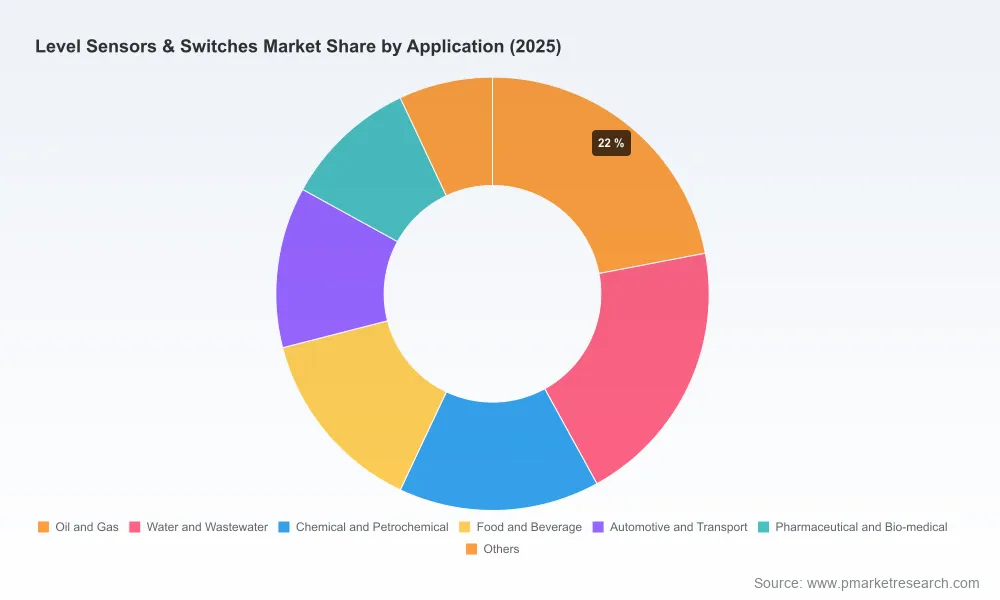

Navigating the Strategic Upside in the Global Level Sensors & Switches Market
The global market for level sensors and switches is entering a phase of structural expansion, driven by a convergence of industrial automation, stringent safety regulations, and the operational demands of complex fluid and solids handling environments. Valued at approximately USD 6.4 billion in 2025, the market has sustained a steady recovery and acceleration trajectory since 2020. Forward projections indicate the sector will surpass USD 10.3 billion by 2032, underpinned by a compound annual growth rate of 7.15 percent over the forecast period. This growth is neither uniform nor accidental. It reflects a maturing industrial ecosystem where precise level measurement has transitioned from a peripheral utility to a core component of process safety, operational efficiency, and digital integration.
For executives and strategic planners, the market’s trajectory signals more than steady demand. It points to a shifting competitive landscape where technology differentiation, regulatory alignment, and supply chain resilience will dictate market share. The following analysis unpacks the structural dynamics shaping this space, highlights the forces accelerating growth, examines how incumbent and emerging players are positioning themselves, and maps the strategic opportunities that will separate market leaders from the rest over the next three to five years.
Market Landscape and Core Challenges
The worldwide level sensors and switches market has built momentum through a combination of industrial modernization, water infrastructure investment, and the gradual replacement of legacy mechanical gauges with intelligent, connected instrumentation. The revenue expansion from 2023 through 2025 reflects robust end-user capital expenditure across process industries and municipal utilities, while the projected runway through 2032 suggests that adoption curves are lengthening rather than peaking. This is a market where volume growth is being reinforced by value migration: buyers are increasingly willing to pay for reliability, diagnostic capability, and integration readiness rather than opting for the lowest upfront cost.
Float Level Switch Market
Yet the environment is not without friction. Several structural challenges and inflection points are reshaping how companies design, source, and commercialize level measurement solutions.
Material Cost Volatility and Component Availability
One of the most immediate pressures stems from raw material and semiconductor inputs. Stainless steel prices for sensor housings have climbed year over year, driven by supply chain constraints and sustained demand from multiple industrial sectors. At the same time, silicon wafer prices for ultrasonic transducers have risen amid intermittent semiconductor shortages. These cost movements compress margins for manufacturers that rely on commodity-grade materials or single-source suppliers, while simultaneously raising the barrier to entry for new product lines that depend on precise transducer fabrication.
For buyers, the implication is a pragmatic shift in evaluation criteria. Total cost of ownership, lead-time reliability, and supply continuity are gaining weight against sticker price. For manufacturers, the response increasingly involves dual-sourcing strategies, material optimization without compromising corrosion resistance, and redesign efforts that reduce dependency on constrained semiconductor components where alternative measurement principles can deliver comparable performance.
Regulatory Tightening and Safety-Critical Certification
A second major inflection point is the enforcement of higher safety and certification standards in process environments. Industry standards such as IEC 61508 SIL 3 are increasingly required for safety-critical level sensors in hazardous or high-consequence applications. Concurrently, regional directives governing explosion-proof equipment for Zone 0 and Zone 20 areas have been updated, raising the compliance bar for level switches deployed in volatile atmospheres.
Compliance is no longer a checkbox exercise; it is becoming a design philosophy and a commercial differentiator. Manufacturers that embed safety certification into their product architecture from the outset can address high-value oil and gas, chemical, and pharmaceutical applications with greater speed and credibility. Those that treat certification as a retrofit process face longer time-to-market and higher validation costs. For end users, the trend reinforces a preference for vendors with proven certification track records and clear documentation of safety integrity levels across product families.
Wastewater Level Sensors Market
Trade Policy and Regional Supply Chain Realignment
A third challenge is the recalibration of trade flows and sourcing strategies. Tariff actions on certain imported radar sensors from China have altered cost structures and prompted procurement teams to reassess supplier geography. These shifts do not necessarily reduce overall demand, but they do reshape where value is captured and how quickly products can be delivered to specific markets. Companies with flexible manufacturing footprints, regionally balanced supplier networks, and clear customs-classification strategies are better positioned to navigate the resulting complexity.
Together, these challenges create a market environment where resilience, certification readiness, and cost discipline are as important as technical performance. The firms that navigate them effectively are building a foundation for durable share gains rather than transient pricing wins.
Key Drivers of Market Evolution
The market’s growth trajectory is being propelled by several reinforcing drivers. These forces do not operate in isolation; they interact to change how level sensing is specified, deployed, and maintained.
Technological Innovation in Measurement Physics and Signal Processing
Advancements in radar, guided wave radar, ultrasonic, and capacitive measurement principles continue to expand the envelope of where and how level sensors can be deployed. Narrower beam profiles, improved handling of vapor and agitation, better performance in high-temperature and high-pressure conditions, and more robust signal processing all contribute to expanding application scope. High-temperature radar variants, for example, have opened new use cases in steam-heavy or thermally challenging environments that previously required more invasive or maintenance-intensive solutions.
Equally important is the integration of intelligent diagnostics. Modern level instruments increasingly provide condition monitoring, drift alerts, and performance trending that help operations teams move from reactive maintenance to predictive intervention. This shift raises the strategic value of level sensors from point measurement devices to nodes in a broader reliability and asset management program. In practical terms, it means that procurement decisions are increasingly influenced by the instrument’s ability to reduce unplanned downtime and support remote monitoring, not solely by measurement accuracy in ideal conditions.
Policy, Standards, and Infrastructure Investment
Regulatory and standards environments are acting as both a constraint and an accelerator. Where safety certification mandates raise the performance bar, they also consolidate demand around suppliers that can reliably meet those requirements. This dynamic benefits manufacturers with established testing frameworks, documented safety cases, and global compliance support. In parallel, public and private investment in water and wastewater infrastructure, chemical plant modernization, and process automation continues to create a steady demand base for both continuous level measurement and point-level switching.
The policy context also affects regional growth patterns. As industries in emerging manufacturing hubs upgrade facilities to meet international quality and safety expectations, they adopt instrumentation that aligns with global standards. This creates a bridge between local capacity expansion and the technology roadmaps of established multinational suppliers, often resulting in partnership, licensing, or localized assembly arrangements.
Demand-Side Shifts Toward Integration, Hygiene, and Precision
End-user behavior is changing in ways that influence product specifications. In food, beverage, pharmaceutical, and bio-medical applications, there is sustained emphasis on hygienic design, cleanability, and materials compatibility, alongside the need for high-precision detection. In automotive and transport logistics, level sensing requirements are shaped by fluid management, fueling systems, and increasingly by electrification-related coolant and battery-related fluid monitoring. In bulk solids handling, the push for inventory visibility and silo-level accuracy is driving interest in multi-point and 3D scanning approaches that reduce guesswork in material management.
These demand-side shifts have a common thread: users want instruments that fit cleanly into operational and compliance workflows, not just into tanks and vessels. The value proposition increasingly includes ease of integration with control systems, clarity of output signals, and the ability to operate reliably in environments where fouling, vibration, or chemical exposure would have defeated earlier generations of equipment.
PW Consulting
Supply Chain and Cost Structure Realignment
Cost structures across the value chain are being rebalanced by input price movements, logistics complexity, and regional sourcing preferences. Manufacturers are responding with more disciplined Bill of Materials management, greater emphasis on configurable platforms that can serve multiple applications without linear cost increases, and strategic decisions about where to manufacture versus assemble. At the same time, distributors and system integrators are recalibrating inventory strategies to reduce exposure to long lead times while preserving service levels for critical customers.
The net effect is a market in which value is increasingly captured by players that can align product architecture with supply chain realities, rather than by those that simply offer the widest catalog. This is especially visible in the pressure on ultrasonic transducer supply and stainless steel housing costs, where proactive material and component strategy now functions as a competitive moat.
Competitive Landscape and Strategic Positioning
The competitive field in level sensors and switches is defined by a mix of large multinational instrumentation groups, specialized sensor manufacturers, and regional players with strong application focus. Market concentration levels indicate that while leading firms hold meaningful share, the environment remains open enough for differentiation through technology, application expertise, and service model design.
Differentiation Through Technology Families and Application Coverage
Several companies have built recognizable positions by anchoring their portfolios in specific measurement technologies and extending them across liquids, solids, and hazardous-area applications. Firms with strong radar and guided wave radar offerings emphasize continuous level measurement in challenging process conditions, often pairing hardware with configuration software and diagnostic features that simplify commissioning. Others have leaned into ultrasonic and vibrating fork technologies, targeting water treatment, HVAC, food and beverage, and bulk solids applications where cost-effectiveness, hygienic design, or solids handling matters more than extended range in heavy process environments.
A distinct sub-group has focused on safety certification, explosion-proof design, and compliance documentation as a core part of their value proposition. In sectors where level measurement interfaces directly with safety instrumented functions, the ability to provide SIL-capable devices with clear certification pathways becomes a decisive factor in vendor selection. These companies often compete not only on measurement performance, but on the reduced integration risk and validation burden they offer to end users.
Strategic Moves in Product Launches, Certifications, and Showcase Events
Recent developments illustrate how incumbents and focused manufacturers are refining their positions. Updated radar level transmitters have been showcased to emphasize improved robustness, easier setup, and better performance in demanding environments. IIoT-enabled smart systems have been introduced to connect level sensors more seamlessly into remote monitoring and data-driven maintenance workflows. New threaded radar sensor variants and high-temperature radar devices point to an ongoing push to expand the addressable range of installation scenarios, from retrofit constraints to thermally intense process points.
Alongside product actions, certification and standards alignment continue to serve as strategic levers. Updated certification coverage and compliance reassurance allow suppliers to unlock or defend positions in safety-sensitive applications. Exhibit presence and trade show activity remain important as well, not merely for visibility, but for demonstrating live configuration, proof-of-performance, and application engineering support that shortens the path from specification to deployment.
Market Structure Evolution: Integration, Segmentation, and New Entrants
The market is evolving along multiple structural lines. Consolidation is visible where larger instrumentation groups absorb specialized capabilities or broaden their portfolios to address adjacent measurement and control functions, creating more seamless offerings for end users who prefer fewer vendors and integrated support. At the same time, segmentation continues as companies double down on specific applications such as solids measurement, hygienic processing, or hazardous-area switching, where deep domain expertise can offset the advantage of broader portfolios.
New entrants and niche manufacturers contribute to this dynamic by targeting underserved installation constraints, compact form factors, or OEM-integrated solutions. Their influence is often disproportionate in specific verticals, especially where they can pair a focused technology with strong application engineering and fast customization. For incumbent players, the strategic response increasingly involves balancing scale advantages in core product lines with agility in application-specific designs and partnership models that extend reach without bloating internal complexity.
Forward-Looking Trends for the Next 3 to 5 Years
Looking ahead, several interrelated trends are likely to shape how the market grows and where profit pools emerge.
First, Intelligent Level Instrumentation as a Reliability Platform
Level sensors and switches are increasingly being specified as part of reliability and condition-monitoring strategies rather than as isolated measurement points. Instruments with diagnostics, trend data, and remote visibility will see continued adoption in applications where downtime cost is high or where access for manual inspection is constrained. This trend creates opportunities for suppliers that bundle hardware with configuration, connectivity, and service-oriented software, and for buyers that can institutionalize predictive maintenance around level measurement data.
The commercial implication is a shift from transactional product sales toward solutions that justify themselves through operational savings and risk reduction. Manufacturers that can quantify and communicate these value streams will have stronger positioning in competitive bids, especially in oil and gas, chemicals, pharmaceuticals, and water infrastructure.
Second, Compliance-Led Consolidation in Safety-Critical Applications
As standards and directives continue to elevate the bar for safety-related level instrumentation, demand in high-consequence applications is likely to concentrate around suppliers with robust certification portfolios and clear documentation practices. This will favor vendors that treat safety integrity as a product-line attribute rather than a project-by-project exercise. It also creates a barrier that rewards preparedness: companies that have already aligned design, testing, and support around SIL and explosion-proof requirements will be able to respond faster to specification changes and regulatory updates.
For investors, this trend points to the value of assessing certification readiness and compliance support as part of competitive evaluation, not just product specifications. For manufacturers, it underscores the importance of investing in standards alignment before demand surges, rather than reacting after procurement teams have already narrowed their shortlists.
Third, Regional Realignment and Application-Led Growth in Emerging Industrial Hubs
Growth is expected to remain geographically diverse, with particular strength in regions where industrial capacity, water management investment, and process automation adoption are all advancing. As facilities in these markets modernize, they often adopt instruments and standards that align with global best practices, creating demand for solutions that combine measurement performance with compliance, service, and integration support. Regional supply chain flexibility will be an enabler: companies that can serve these markets with appropriate lead times, localization, and clear regulatory positioning will capture share more readily than those reliant on a single sourcing or manufacturing model.
A related opportunity lies in application-specific innovation. Solids measurement, hygienic processing, high-temperature services, and hazardous-area switching each present distinct design constraints. Products that solve these constraints comprehensively, rather than partially, are well positioned to command stronger margins and more loyal end-user relationships.
Risks and Uncertainties to Monitor
Several uncertainties could alter the pace or shape of growth. Continued volatility in raw material and semiconductor inputs may pressure margins and extend lead times if not managed through design flexibility and sourcing diversification. Trade policy changes can shift cost structures and supplier preferences quickly, particularly for technology-intensive sensor categories with concentrated import dependencies. Certification and directive updates may raise compliance costs in the near term, even as they create longer-term segmentation advantages for prepared suppliers. Finally, if macroeconomic conditions slow capital expenditure in certain process industries, replacement cycles may lengthen, shifting growth toward replacement and upgrade demand rather than greenfield expansion.
Strategic Actions for Decision Makers
The prevailing dynamics suggest clear, actionable priorities for different audiences within the market.
For Manufacturers and Product Leaders
- Strengthen platform-based design strategies that allow a common architecture to serve multiple applications while reducing exposure to constrained components and costly material choices.
- Treat safety certification and explosion-proof compliance as product-line capabilities, embedding them early in development so that high-value applications can be addressed without prolonged validation cycles.
- Expand application engineering and configuration support, since buyers increasingly weigh ease of integration, diagnostics, and maintenance workflow compatibility alongside raw measurement performance.
- Build sourcing resilience through dual-supplier arrangements, material substitution where feasible, and regional manufacturing or assembly options that reduce lead-time risk and tariff exposure.
For Investors and Strategic Buyers
- Evaluate companies not only on current share, but on certification readiness, technology breadth across liquid and solids applications, and the ability to combine hardware with connectivity and service-oriented offerings.
- Watch for consolidation patterns where larger instrumentation groups acquire specialized capabilities, as well as for focused niche players that gain disproportionate share in high-value verticals such as hygienic processing, hazardous-area switching, or bulk solids measurement.
- Consider exposure to input cost volatility and trade policy risk when assessing margin durability, and favor businesses with clear strategies for material, component, and geographic diversification.
For Procurement and Operations Leaders
- Shift evaluation criteria toward total cost of ownership, including lead-time reliability, diagnostic value, integration effort, and safety certification completeness, rather than focusing narrowly on unit price.
- Prioritize suppliers with documented compliance support and clear product roadmaps that align with your operational constraints, especially for safety-critical or hygienic applications.
- Plan for supply continuity by qualifying alternative technologies or vendors for critical points, and by aligning specification practices with realistic lead times and regional sourcing options.
The level sensors and switches market is not simply expanding; it is re-composing around technology intelligence, safety compliance, and supply chain resilience. Companies that recognize this re-composition early can align product strategy, sourcing, and commercial positioning to capture durable advantage. For those seeking a more granular view of segment dynamics, regional trajectories, and company-level benchmarks, the full research report provides detailed breakdowns and customized guidance to support specification, investment, and sourcing decisions with greater precision.
For detailed analysis of this topic, please visit the official page: Worldwide Level Sensors & Switches Market
Lacy Lee
Senior Marketing Manager
[email protected]
PW Consulting: www.pmarketresearch.com























Sign in to leave a comment.