

The modern real estate market is awash in developer marketing that heavily prioritizes superficial luxury. Billboards across major urban corridors advertise infinity pools, imported Italian marble, smart-home automation, and private concierge services. While these opulent amenities undoubtedly elevate the immediate, physical experience of living within the four walls of an apartment, they frequently mask a critical structural deficiency: geographic isolation.
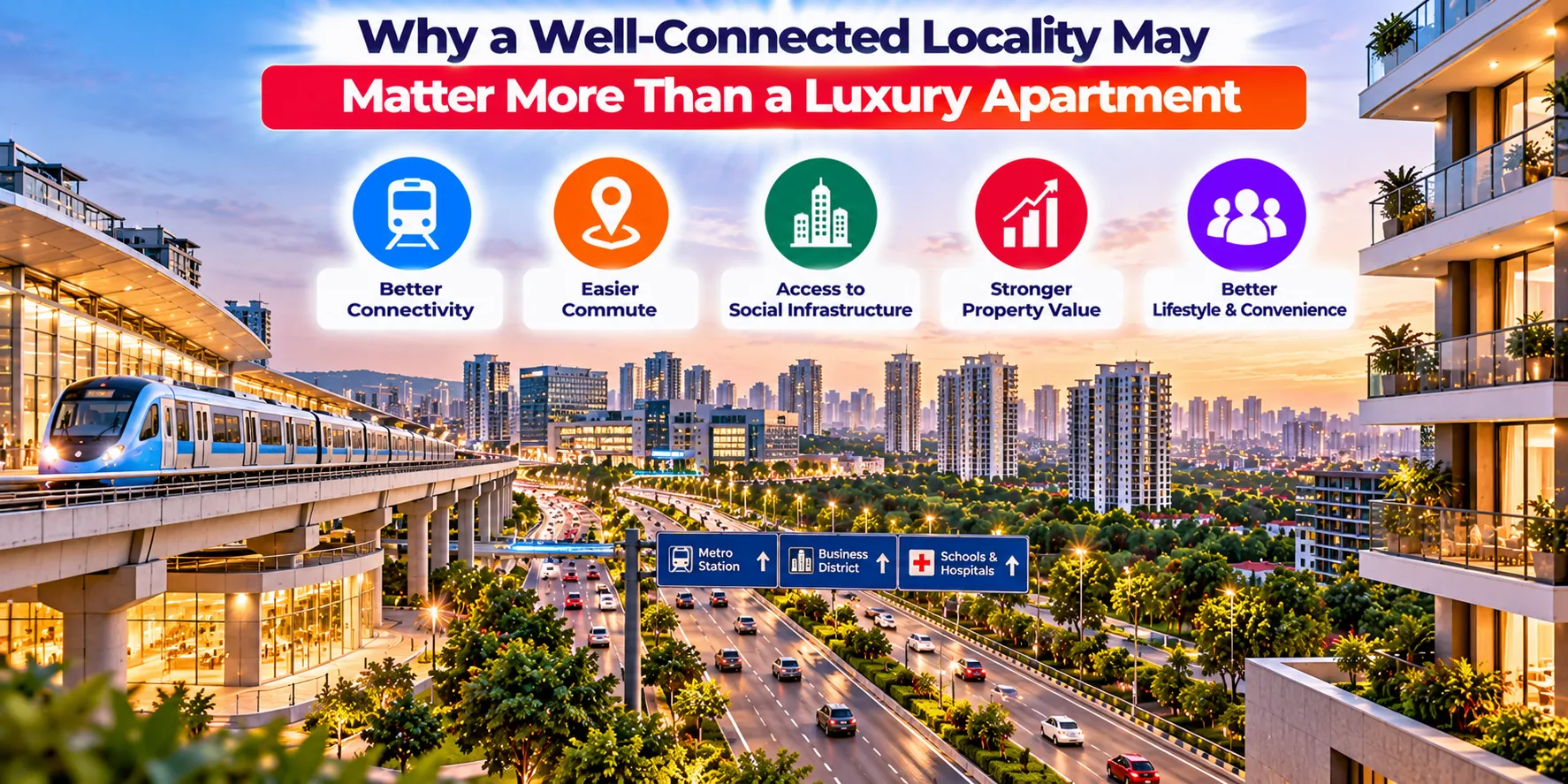
When forced to choose between a sprawling, ultra-luxury apartment situated in a disconnected, peripheral suburb and a slightly older, standard apartment located in a highly connected, mature urban center, many buyers are seduced by the sheer square footage of the former. However, separating the emotional appeal of luxury from the functional reality of daily life reveals a stark truth. For the overwhelming majority of urban professionals and families, a well-connected locality structurally matters more—and delivers a higher quality of life—than the isolated luxury of a premium apartment.
The Mathematical Supremacy of Time over Space
The fundamental argument for prioritizing connectivity over localized luxury is rooted in the mathematics of time management. In congested megacities like Bengaluru, Mumbai, or the National Capital Region (NCR), time is the ultimate, non-renewable luxury.
The Commute Penalty: A massive, 3,500-square-foot luxury apartment loses its functional value if it forces you into a grueling, two-hour daily commute to reach the central business district. Spending ten to twelve hours a week trapped in gridlocked traffic actively destroys physical health, induces chronic stress, and cannibalizes the time that could be spent actually enjoying the apartment's luxury amenities.
- The Frictionless Reality: Conversely, a smaller, standard apartment situated just a ten-minute walk from a major metro station or directly adjacent to a commercial hub effectively grants you an additional ten hours of free time every week. This seamless connectivity transforms daily logistics from a source of profound exhaustion into an afterthought. A well-connected locality effectively expands your usable day, which is a far more profound luxury than a larger living room.
The Ecosystem of Predictability and Resilience
Luxury inside an apartment cannot compensate for the failure of the infrastructure immediately outside its gates. Well-connected, mature localities offer a level of civic resilience that developing, peripheral luxury townships simply cannot match for several years, if not decades.
- Civic Maturity: An established, connected neighborhood is already integrated into the municipal grid. It benefits from mature stormwater drainage systems, reliable piped water, and upgraded electrical sub-stations. In contrast, massive luxury enclaves built on cheap, peripheral land often rely on temporary, highly volatile infrastructure. They frequently depend on daily private water tankers, suffer from frequent grid power failures that necessitate expensive diesel generator backups, and endure flooded approach roads during the monsoon season.
- Medical and Academic Anchors: True family security is defined by what is accessible within a five-kilometer radius. A connected locality guarantees rapid, high-speed access to multi-specialty trauma centers and established K-12 schools. An isolated luxury township might feature an in-house clinic or a nascent branch of a school, but during a severe medical emergency or when seeking competitive academic environments, isolation becomes a severe, undeniable liability.
The Micro-Economy of Daily Convenience
The marketing brochures for peripheral luxury apartments often tout the concept of a "self-contained township," promising that residents will never need to leave the gates. While appealing in theory, the reality of human behavior dictates otherwise.

The Illusion of Self-Containment: No matter how many retail shops a developer builds into the podium of a luxury complex, it cannot replicate the organic, robust micro-economy of a connected urban center. Residents inevitably need diverse services—specialized diagnostic labs, specific banking branches, diverse culinary options, or simply the ability to walk to a neighborhood tailor or hardware store.
- The 15-Minute City: A well-connected locality adheres to the urban planning concept of the "15-minute city," where every conceivable daily requirement is accessible within a short, friction-free walk or a brief drive. This localized density of services drastically reduces the cognitive load of running a household. In an isolated luxury complex, a simple errand to repair a laptop or buy a specific pharmaceutical requires a planned, multi-hour vehicular expedition.
Financial Resilience and Secondary Market Liquidity
When analyzing the trade-off through a purely financial lens, the well-connected property consistently outperforms the isolated luxury asset, particularly regarding risk mitigation and liquidity.
- The Liquidity Advantage: Real estate is inherently illiquid, but isolated luxury properties suffer from extreme illiquidity. The buyer pool for a ₹5 Crore apartment located forty kilometers outside the city center is microscopically small. If you face a sudden financial crisis and need to liquidate the asset, you will likely wait months or years, often forced to accept a massive pricing haircut. A standard apartment in a prime, highly connected locality is the most liquid asset in the real estate market. The demand from migrating professionals and young families ensures that you can sell the property rapidly, preserving your capital in an emergency.
- Unbreakable Rental Velocity: Connected localities are heavily insulated against macroeconomic downturns. Because they are anchored near employment hubs and transit nodes, they guarantee a perpetual pipeline of high-quality corporate tenants. An isolated luxury property frequently sits vacant for months because the tenant demographic willing to pay premium rent usually prioritizes commute times above all else.
- Appreciation Floor: In a market correction, peripheral luxury properties are the first to crash in value because their pricing was heavily speculative, based on future infrastructure that may never arrive. Connected properties maintain a high valuation "floor" because the underlying utility of the location remains in constant, undeniable demand.
Conclusion
The pursuit of a luxury apartment is a valid aspiration, but it becomes a strategic error when it requires sacrificing fundamental geographic connectivity. True luxury is not defined merely by the quality of the floor tiles or the size of the clubhouse; it is defined by the absolute absence of daily friction.
A well-connected locality insulates you from the exhausting realities of urban gridlock, guarantees immediate access to vital social infrastructure, and ensures your financial capital remains highly liquid and secure. While developers can replicate a swimming pool or a smart-home system anywhere, they cannot artificially manufacture the intrinsic value of a prime location. Ultimately, buying into a connected neighborhood is an investment in your time, your health, and your uncompromised peace of mind—a return on investment that no isolated luxury amenity can ever match.


















Sign in to leave a comment.