

An AI agent demo built for a large Dubai real estate or hospitality conglomerate usually looks great. Clean test data, a couple of well-behaved API integrations, a scripted scenario that highlights exactly what the agent does well. Everyone in the room is impressed. Then the pilot moves toward actual production deployment, and the agent needs to touch the company's real property management system, a separate CRM acquired through a merger three years ago, a legacy accounting platform nobody's fully documented, and a newer logistics tool the operations team adopted independently last year. Suddenly the clean demo scenario is fighting five different authentication schemes, three incompatible data formats, and at least one system with an API that technically exists but hasn't been meaningfully maintained since the vendor got acquired.
This gap between demo and production isn't unique to Dubai. It shows up with particular sharpness here, though, because a lot of the region's largest enterprises, conglomerates spanning real estate, hospitality, retail, and logistics under one corporate umbrella, have grown through acquisition and diversification in ways that leave behind exactly this kind of fragmented, multi-vendor technical landscape.

Where the Demo-to-Production Gap Actually Lives
A pilot AI agent typically gets built and tested against a carefully selected slice of a company's actual systems, chosen specifically because they have clean, well-documented APIs and cooperative data formats. This is a reasonable way to prove a concept quickly. It's also, by design, avoiding exactly the systems that will cause the most trouble in a full production deployment, the ones with undocumented quirks, inconsistent authentication, or business logic embedded in ways that aren't visible from the API surface alone.
A large Dubai hospitality group running multiple hotel brands under one corporate structure, each acquired at a different time with its own booking and property management system, presents this problem in a particularly concentrated form. An AI agent meant to handle guest service requests across the portfolio needs to work with several genuinely different underlying systems, each with different data models for something as basic as a guest profile or a room booking, and reconciling those differences well enough for the agent to operate reliably across all of them is a substantially harder engineering problem than the clean single-system pilot suggested.
Authentication and permission models compound this. A pilot often runs with elevated, broadly scoped access to a single test system, because it's faster to set up and nobody's worried about security implications for a limited proof of concept. Production deployment across five real vendor systems means navigating five different, genuinely incompatible authentication and permission models, some modern OAuth-based, some relying on older API key schemes with far less granular access control, and building an agent that respects the actual security boundaries of each system correctly is meaningfully more work than the pilot's simplified access model ever had to account for.
Data Consistency Problems Nobody Notices Until Scale
A pilot working with a small, curated dataset rarely surfaces data quality problems that become obvious at real scale. A property management system with inconsistent address formatting, a CRM with duplicate customer records from a data migration that was never fully cleaned up, a legacy accounting system that represents currency amounts inconsistently across different modules, none of these show up as problems in a small pilot deployment with hand-picked test data. They become very real, very visible problems the moment an agent is operating against the full, messy, real dataset across a genuinely large enterprise's accumulated systems.
Where People Get This Wrong
The recurring mistake, and it happens in vendor pitches constantly, is treating a successful pilot as strong evidence that production deployment will go smoothly, with maybe some minor additional integration work required. That's usually a significant underestimate of the actual gap. A pilot proves the AI agent's core reasoning and task logic work well under favorable conditions. It says very little about whether that same agent can handle the genuine mess of a real, decade-accumulated enterprise IT environment with multiple vendor systems that were never designed to work together in the first place.
A more honest, and more useful, way to scope this work treats the pilot's success as a necessary but far from sufficient signal, and budgets real, separate time and engineering effort specifically for the systems integration challenge, distinct from the AI reasoning work itself. Companies that skip this distinction tend to discover the real cost of production deployment well after a pilot's initial success has already set expectations for a much faster, cheaper rollout than the actual integration complexity supports.
The Dubai Angle: Conglomerate Structures Make This Especially Common
An AI app development company in Dubai working with the region's larger conglomerate-structured enterprises needs to scope projects with this reality built in from the start, rather than discovering the true integration complexity partway through a project that was budgeted based on pilot-stage assumptions. Dubai's business landscape includes a meaningful number of large groups spanning multiple sectors under one ownership structure, each subsidiary often having grown or been acquired with its own independent technology stack, and an AI agent meant to operate meaningfully across that structure needs an integration strategy that accounts for this fragmentation explicitly, not as an unwelcome discovery made during production rollout.
Teams with direct experience in this environment tend to run a genuine systems audit before finalizing project scope and budget, mapping out exactly which systems the agent will need to touch in production, what authentication and data format challenges each one presents, and building that complexity into the project timeline from the start rather than treating it as scope creep discovered after the pilot's success has already created expectations the actual integration work can't realistically meet on the original timeline.
What Actually Needs to Change in How These Projects Get Scoped
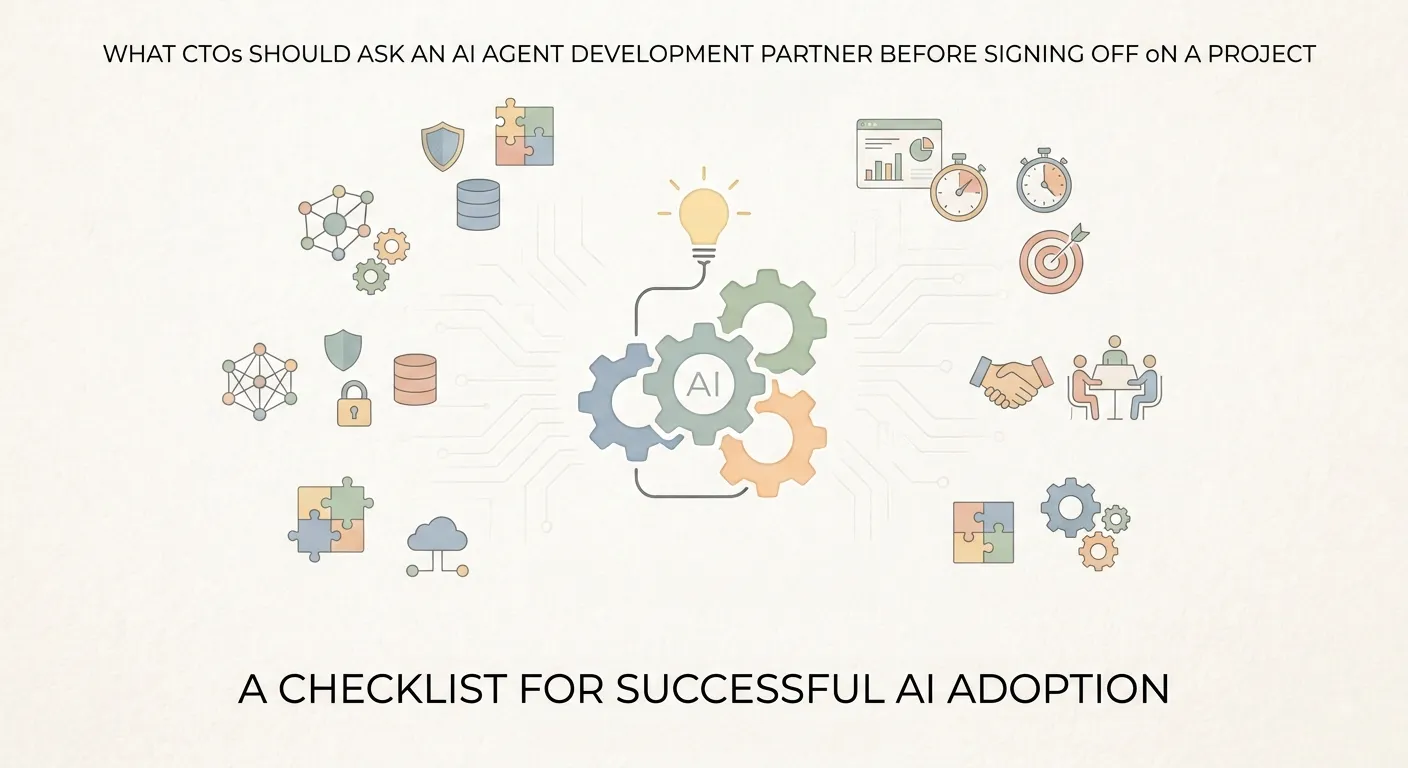
Run a genuine systems audit covering the full production integration surface before finalizing a project timeline, not just the systems selected for a favorable pilot demonstration. Budget real, distinct engineering time for authentication and data consistency work across every system the agent will actually need to touch in production, treating this as a separate, substantial workstream rather than an assumed minor extension of the pilot's integration work. And set expectations honestly with stakeholders about the real gap between a successful pilot and a production-ready deployment across a genuinely fragmented multi-vendor environment, rather than letting pilot success create timeline expectations the actual integration complexity can't support.
FAQ
Why do AI agent pilots often succeed while production deployment struggles?
Pilots are typically built against a curated set of systems chosen for clean APIs and cooperative data formats, deliberately avoiding the messier, undocumented, or legacy systems that create the real integration challenges in a full production environment.
What makes multi-vendor enterprise environments particularly hard for AI agent deployment?
Different systems often use incompatible authentication methods, inconsistent data formats, and varying levels of API documentation and maintenance, especially in organizations that have grown through mergers or acquisitions over time.
How should companies scope an AI agent project to avoid this gap?
By running a genuine systems audit covering all production systems the agent will need to touch before finalizing budget and timeline, rather than assuming a successful pilot means production integration will require only minor additional work.
Why is this challenge especially common in Dubai's business environment?
A meaningful number of large Dubai-based conglomerates span multiple sectors under one ownership structure, often with subsidiaries that grew or were acquired independently, each carrying its own separate technology stack that an AI agent needs to navigate in a full deployment.






















Sign in to leave a comment.