

The demo went perfectly. Leadership nodded, the budget got approved, and six months later the project is parked in a notebook nobody opens. That is not bad luck. Why AI prototypes never reach production almost always comes down to what the demo hides, not what the model can do.
The numbers back it up. A 2024 RAND Corporation report, built on interviews with 65 experienced data scientists and engineers, cites estimates that more than 80 percent of AI projects fail, roughly double the rate of regular IT projects [1]. Gartner's 2024 survey of 644 organizations found that on average only 48 percent of AI projects make it into production, and the move from prototype to production takes about eight months [2]. You may also have seen an 87 percent figure floating around, but it traces back to an unsourced blog post [3], so I stick with the research above.
A prototype exists to answer one question quickly. I walk through the rapid prototyping process for AI products in a separate guide, but the short version is to build thin, test on real data, and expect to throw it away. Trouble starts when the throwaway quietly becomes the foundation. DenebrixAI builds with that handoff in mind, and the rest of this article shows what to plan for.
Prototype vs Production: What Actually Changes
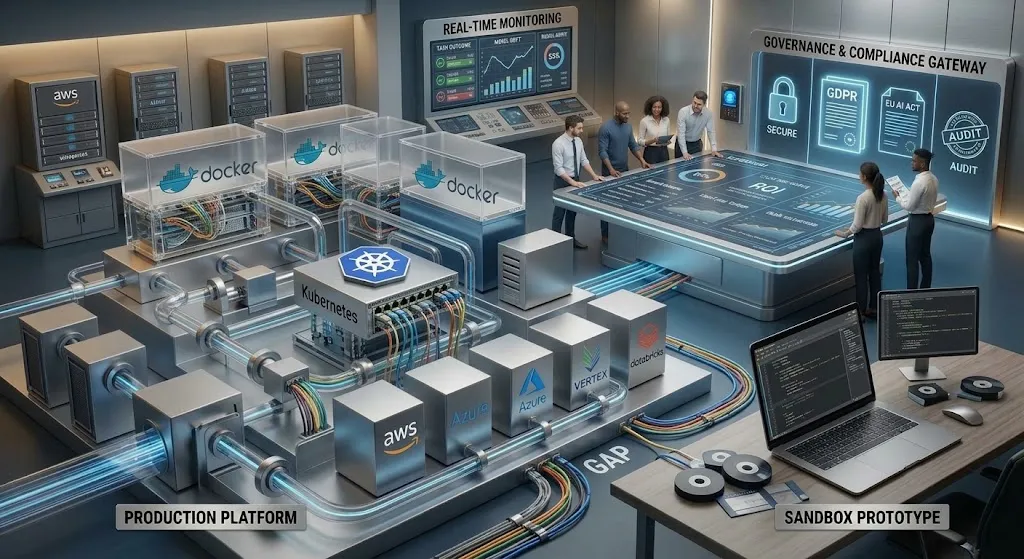
Four things shift the moment real users show up. When nobody plans for them, they explain why AI prototypes never reach production.
- Data: a clean sample turns into messy, late, constantly changing input.
- Load: one tester becomes thousands of requests, with real latency and real cost.
- Risk: a wrong answer in a demo is funny. A wrong answer in front of a customer is a ticket, or a compliance problem.
- Ownership: the builder moves on, and someone else inherits the system.
An AI agent MVP raises the stakes further. A chatbot only talks, while an agent calls tools and writes to other systems, so every failure has a bigger blast radius than a plain chatbot or a single AI feature.
Why AI Prototypes Never Reach Production: 5 Root Causes
- Data pipeline issues. Prototypes run on curated files. Production needs automated pipelines, validation, and often a feature store so training and serving use the same inputs. Skip that and the model degrades quietly [1][4].
- The model deployment gap. Data scientists hand over notebooks while ops teams need running services. Without MLOps (or LLMOps for language models), a CI/CD pipeline, and experiment tracking with a tool like MLflow, nobody can update the system safely, and model drift does the rest [1].
- Infrastructure complexity. A quick API call becomes containers in Docker, orchestration on Kubernetes, a RAG layer, and cloud setup on AWS with Amazon Bedrock, Azure, or Google Cloud Vertex AI. For a sense of what an enterprise-grade stack involves, this explainer on OpenShift architecture shows the moving parts. Teams burn months on plumbing instead of business logic [4].
- The governance gap. Security reviews, data lineage, audit trails, GDPR, and the EU AI Act usually arrive after the demo instead of before it [4]. That is where plenty of projects stall.
- No business alignment. If success was never defined beyond accuracy, nobody can defend the budget when the bill arrives [1].
How to Move AI from Prototype to Production
If you're wondering why AI prototypes never reach production on your own team, this is the sequence I'd follow for any AI pilot-to-production move.
- Scope one task. Pick a single job with a number attached, like tickets resolved without a human. Narrow scope is what makes an AI MVP-to-production jump realistic.
- Pick models and tools for reliability, not novelty. Start with managed models, add retrieval (RAG) only if the task needs your own data, and choose tools your ops team can run. If you're weighing low-code against custom builds, this comparison of no-code vs AI coding platforms for startups is a useful starting point.
- Design for failure. Add retries, timeouts, confidence thresholds, and a clean human handoff for when the system is unsure.
- Test with imperfect inputs. Typos, mixed languages, missing fields, hostile prompts. Real users supply all of them in week one.
- Launch to a small group. Start with ten to fifty real users and logging switched on. Expand only when results hold. For the deployment basics behind this step, see this guide to building and deploying an intelligent AI model.
- Track reliability metrics. Watch task success rate, escalation rate, latency, cost per request, and drift alerts, and set a retraining schedule.
Quick readiness check: Is the pipeline automated? Is there a named owner? Is monitoring live? Has security signed off? Do you know the cost per request at full traffic? Can you roll back in minutes? Any "no" means you're not ready yet.
Common Mistakes

Treating the proof of concept as the product. Leaving security for the end. Measuring model accuracy instead of business outcomes. Assuming launch day finishes the job, when monitoring and retraining never stop.
Final Thoughts
Why AI prototypes never reach production stops being a mystery once you look past the model. Plan for data, operations, and governance from the first week, scope small, and give someone clear ownership. That alone puts you ahead of most teams.
If you want engineers to review a stalled prototype before the next sprint, SoftBrixAI's team can help you work out what stands between the demo and go-live.
FAQs
Why do AI prototypes never reach production? Because prototypes skip the unglamorous parts: data pipelines, monitoring, security review, and ownership. The model usually works fine. The system around it simply doesn't exist yet.
What is the AI project failure rate? RAND's 2024 report cites estimates that more than 80 percent of AI projects fail, about twice the rate of non-AI IT projects [1]. Gartner's 2024 survey found that on average 48 percent of AI projects reach production [2].
How long does it take to move AI from prototype to production? Gartner puts the average at around eight months [2]. A tightly scoped MVP running on infrastructure you already have can move noticeably faster.
What does production-ready AI mean? It means the system runs reliably on live data, with monitoring, rollback, security approval, a named owner, and a known cost per request.
What is the difference between a PoC and an MVP? A proof of concept shows the idea is technically possible. An MVP serves real users with a minimal feature set and has to survive real conditions.
Resources
- The Root Causes of Failure for Artificial Intelligence Projects and How They Can Succeed: RAND Corporation, August 2024. [https://www.rand.org/pubs/research_reports/RRA2680-1.html]
- Gartner survey on generative AI adoption barriers: CIO Dive coverage of Gartner's 2024 survey of 644 organizations, including the 48 percent and eight-month figures. [https://www.ciodive.com/news/generative-ai-adoption-barrier-project-value/716504/]
- Why Most AI Projects Die Before Production: Towards AI, February 2026. Explains where the 87 percent claim came from. [https://pub.towardsai.net/why-most-ai-projects-die-before-production-and-its-not-a-tech-problem-630e595e39b9]
- Why Most AI Projects Fail: It's Infrastructure and People: The New Stack. Covers data infrastructure, security, and reliability gaps. [https://thenewstack.io/why-most-ai-projects-fail-its-infrastructure-and-people/]




















Sign in to leave a comment.