

Key Takeaways
- Construction site banners can provide branding, project information, advertising, or visual communication around active building sites.
- Mesh materials are often considered for temporary fencing because their perforated structure allows some airflow through the banner.
- Banner size, material, artwork, finishing, installation, and weather exposure should be assessed before use.
- Construction site banners can serve different purposes, so their design should match the needs of workers, visitors, contractors, and the public.
- Proper installation and regular inspection remain important, particularly where banners are exposed to wind and changing outdoor conditions.
Introduction
Construction site banners are popular because they provide a practical way to display branding, project information, advertising, and other visual messages around temporary fencing and construction areas. Mesh versions are particularly relevant to outdoor sites because their perforated structure allows some air to pass through the material.
Construction environments present different challenges from indoor advertising spaces. Sites may remain exposed to wind, rain, dust, sunlight, equipment movement, and changing site layouts. Choosing suitable construction site banners therefore involves more than selecting an attractive design. Material, size, installation, visibility, and environmental conditions all need to be considered.
What Are Construction Site Banners?
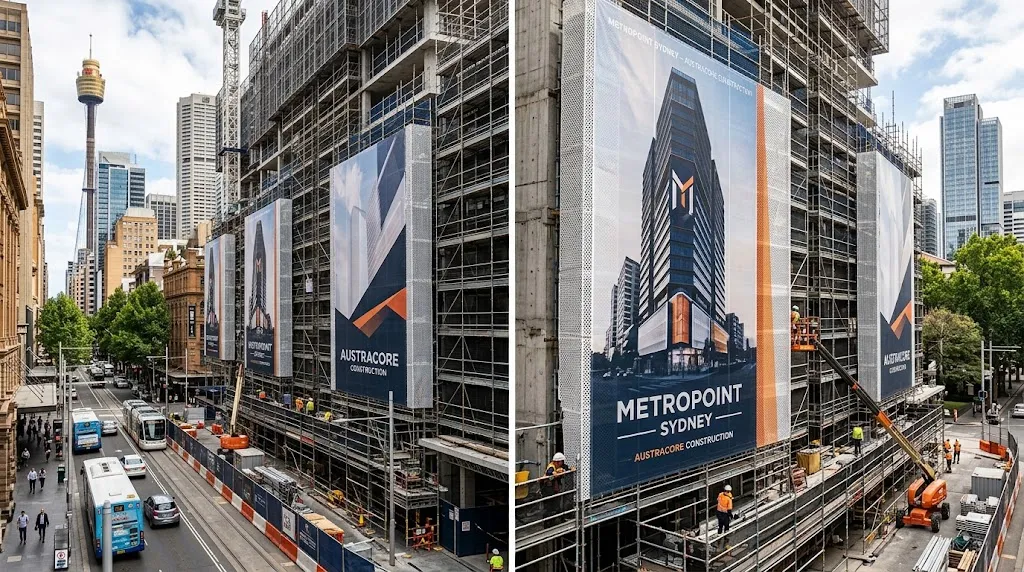
Construction site banners are large-format printed displays used around building, renovation, infrastructure, and development projects.
They can be attached to temporary fencing, site boundaries, scaffolding, hoardings, or other suitable structures, depending on the application.
The content can include a company logo, project name, development information, contact details, safety-related information, directional messages, or other approved site communication.
What Is a Mesh Construction Banner?
A mesh construction banner is made from a perforated material rather than a completely solid banner substrate.
The openings in the material allow some airflow through the surface. This characteristic can be relevant when a banner is installed outdoors, particularly on temporary fencing or other exposed structures.
However, mesh does not eliminate wind forces. Large construction site banners can still be affected by strong weather conditions, and installation should be assessed according to the specific site.
Why Are Mesh Banners Used on Construction Sites?
There are several practical reasons mesh banners are considered for construction environments.
They Provide Large-Format Visibility
Construction projects often have large boundaries that need to be covered with visual information or branding.
A construction site banner can use this available space for project identification, company branding, development information, or approved advertising content.
Large-format printing can make messages visible from surrounding roads, footpaths, neighbouring properties, or other viewing areas, depending on the banner's size and location.
They Can Be Used on Temporary Fencing
Temporary fencing is common on active construction sites because it helps establish a defined boundary around the work area.
A mesh banner can be attached to suitable temporary fencing to display approved graphics or information.
Before installation, the fence should be assessed for stability and condition. The attachment method should also be appropriate for the banner dimensions and the supporting structure.
They Allow Some Airflow
One of the main characteristics of mesh is its perforated construction.
Instead of presenting a completely solid surface, mesh contains openings through which air can pass. This is one reason mesh may be considered for certain outdoor construction site banners.
The amount of airflow depends on the material's design and open area. Site conditions, banner size, installation height, and wind exposure also influence how the finished installation behaves.
How Can Construction Site Banners Be Used?
A construction site can have several audiences, including workers, contractors, visitors, pedestrians, nearby residents, and potential customers.
The purpose of the banner should therefore be established before the design is created.
Project Branding
Developers and builders may use construction site banners to identify the company responsible for a project or communicate the identity of a development.
Branding can include logos, colours, project names, and other approved visual elements.
The design should remain readable at the expected viewing distance and should not interfere with required site information.
Project Information
Banners can also be used to communicate information about a development or construction project.
Depending on the project, this could include development names, project descriptions, architectural imagery, project stages, or information intended for members of the public.
Any regulatory or project-specific information should be reviewed by the appropriate party before printing.
Advertising and Promotion
Construction boundaries can sometimes provide space for approved advertising or development marketing.
A construction site banner may display information about properties, businesses, contractors, suppliers, or other relevant organisations.
The content should be appropriate for its location and comply with any applicable site, council, property, or advertising requirements.
What Should You Consider When Choosing Construction Site Banners?
The right banner depends on the application rather than a single universal specification.
Material
Material selection is one of the first considerations.
Mesh can be appropriate where airflow is relevant, while the exact mesh construction should be selected according to the intended application.
The material should also be suitable for the expected outdoor exposure, printing requirements, and installation method.
Size
The size of construction site banners should correspond to the available installation area and intended viewing distance.
A banner that is too small may not provide enough space for readable information, while a very large banner may require more careful installation planning.
Measurements should be confirmed before production to reduce the risk of sizing errors.
Artwork
Construction banner artwork should be designed for the physical dimensions of the finished product.
Text, logos, photographs, and other graphics should be large enough to remain understandable at the expected viewing distance.
Because mesh contains openings, very small details may require additional consideration during the design stage.
How Should Construction Site Banners Be Installed?
Installation is an important part of using construction site banners safely and effectively.
Choose Appropriate Attachment Points
Mesh banners may include eyelets or other finishing features that provide attachment points.
The spacing and position of these attachment points should work with the supporting fence or structure.
The supporting structure itself should also be suitable for the intended installation.
Consider Wind Exposure
Wind conditions can change throughout the day and during different weather events.
Although mesh allows some air to pass through, a large construction site banner can still experience movement and loading in windy conditions.
Sites should follow appropriate installation practices and any relevant safety requirements. Temporary signage should also be inspected after severe weather or when there are visible changes to the supporting structure.
Avoid Interference With Site Operations
Banners should not obstruct required access points, emergency routes, visibility areas, safety signage, equipment, or other essential site functions.
Their placement should be coordinated with the site's overall layout and safety procedures.
What Are the Limitations of Construction Site Banners?
While construction site banners can be useful, they are not suitable for every situation.
Mesh materials have openings, which means they do not provide the same continuous printed surface as solid banner materials.
This can influence the appearance of small text, fine graphics, and detailed images.
Wind exposure also remains a consideration. Mesh should not be described as completely windproof, and a banner's suitability depends on factors such as its dimensions, installation method, supporting structure, and local conditions.
There may also be local requirements governing advertising, signage, temporary structures, construction sites, or public-facing displays. These requirements should be checked before installation.
How Can Construction Site Banners Be Maintained?
Regular inspection can help identify visible issues before they become more significant.
The banner should be checked for damaged edges, loose attachment points, tears, excessive dirt, or changes in the supporting structure.
If a construction site banner becomes damaged, it should be assessed before continued use.
Cleaning requirements depend on the specific material and printing process. Gentle cleaning methods recommended by the manufacturer are generally preferable to abrasive tools or harsh chemicals.
When a banner is removed for storage or reuse, it should be handled carefully and kept in suitable conditions.
What Makes a Construction Banner Effective?
An effective construction site banner should communicate its intended message clearly while remaining appropriate for the environment in which it is installed.
The design should consider viewing distance, available space, lighting, colour contrast, text size, and the amount of information being presented.
For example, a banner viewed by passing motorists may require a simpler design than one positioned close to a pedestrian area.
The physical installation should also complement the design. A well-prepared graphic may become difficult to read if the banner is poorly positioned, stretched unevenly, or partially obstructed.
Conclusion
Construction site banners provide a flexible way to display branding, project information, advertising, and other visual messages around building and development sites.
Mesh versions can be useful for selected outdoor applications because their perforated structure allows some airflow through the material. However, this does not remove the need to consider wind exposure, supporting structures, installation methods, and local site conditions.
Choosing appropriate construction site banners involves evaluating material, size, artwork, finishing, installation, maintenance, and intended viewing distance. Businesses and project teams should also check relevant site and signage requirements before installation.
Taking these factors into account allows construction teams to make decisions based on the actual conditions of their project rather than assuming that one banner specification is suitable for every site.
Book a Strategy or Discovery Call
If you are planning construction site banners and need to clarify material, dimensions, artwork, finishing, or installation considerations, a strategy or discovery call can provide an opportunity to discuss the practical requirements of the project.
The discussion is informational and focused on helping you understand the available considerations before making a decision. There is no pressure and no guarantee of a particular outcome.
Planning construction site banners? Book a no-pressure discovery call to discuss your project requirements, banner specifications, artwork, and installation considerations.
Frequently Asked Questions
1. Why are mesh banners used on construction sites?
Mesh banners are used for purposes such as project branding, development information, advertising, and visual communication. Their perforated construction can also allow some airflow through the material.
2. Are construction site banners suitable for temporary fencing?
They can be suitable when the banner, attachment method, and temporary fencing are appropriate for the application. The fence condition, banner dimensions, wind exposure, and installation method should be assessed beforehand.
3. Are mesh construction banners windproof?
No. Mesh allows some air to pass through its openings, but it is not completely unaffected by wind. Large banners can still experience wind forces depending on their size, location, and installation.
4. What information can be displayed on construction site banners?
Depending on the project, banners may display company branding, project names, development information, architectural images, contact information, advertising, or other approved messages.
5. How large should a construction site banner be?
There is no universal size. The appropriate dimensions depend on the available installation area, viewing distance, supporting structure, design requirements, and intended purpose.
6. Do construction site banners need eyelets?
Eyelets are one common finishing option because they can provide attachment points. Whether they are appropriate depends on the installation method and supporting structure.
7. How should construction site banners be maintained?
Banners should be inspected periodically for damage, loose attachments, dirt, and changes in the supporting structure. Cleaning and storage methods should follow the requirements of the specific material.
























Sign in to leave a comment.