Why Are Overseas Bedding Brands Switching Supply Chains to India’s largest exporter of blankets?


A bedding brand does not usually change its supply chain because another manufacturer offers a slightly lower price.
The decision is bigger than that.
A buyer has to think about fabric, blanket weight, colours, sizes, packaging, production capacity, and delivery schedules. Then there is the question that becomes important after the first successful order: Can the supplier make the same product again?
That is where Indian blanket manufacturing has become interesting to overseas buyers.
India already has a large textile manufacturing base, and its blanket exporters serve markets across the Middle East, Asia, Europe, America, and other regions. JTI, for example, presents itself as India’s largest exporter of blankets, with a product portfolio covering blankets as well as other textile categories.
For an overseas bedding brand, however, the attraction is not simply the size of the exporter. It is the manufacturing system behind the order.
The buyer is looking for more than a factory price
Imagine a bedding company preparing its winter collection.
It needs 30,000 blankets in three sizes, four colours and two different weights. The products will carry its own labels and packaging. The first shipment needs to arrive before the retail season begins.
At this point, the purchasing team is not asking only, “What is your price per blanket?”
They are asking:
- Can you produce this quantity?
- Can you match the approved sample?
- Can you keep colours consistent?
- Can you repeat the order later?
- Can you manage private-label packaging?
- How much notice do you need?
- What happens if the order increases?
These questions explain why blanket exporters in India are increasingly being considered by international sourcing teams.
The wider Indian textile industry already has an established export infrastructure, while recent industry discussions show overseas distributors looking at India as an additional sourcing base rather than relying entirely on one Asian manufacturing market.
That is a very different reason to switch suppliers than simply chasing a cheaper quotation.
Why are overseas buyers looking at India now?
Supply chains have become more cautious.
A brand that depends heavily on one manufacturing location can be exposed when production capacity becomes tight, shipping conditions change, or demand suddenly increases.
Adding another country to the sourcing mix can give the buyer some breathing room.
This does not mean overseas brands are abandoning China, Vietnam or other established textile-producing countries. India is increasingly being considered alongside them.
The Indian textile sector gives buyers access to a broad manufacturing ecosystem covering yarns, fabrics, home textiles and finished products. For a blanket company, that matters because the finished product is only one part of the supply chain.
JTI (Jindal Textile), for instance, operates across several textile categories and highlights manufacturing and export operations connected with Panipat and other locations. Its product portfolio includes blankets, recycled wool, recycled cashmere, yarn, comforters, quilts, and other textile products.
For a bedding brand, that broader textile background can make conversations about materials and product development easier.
It starts with the product, not the country.
One mistake buyers can make is choosing a manufacturing country before defining the product.
A blanket for a discount retailer is not the same product as one developed for a premium bedding label.
The buyer may need:
- lightweight polyester
- heavier winter constructions
- wool or wool blends
- specific GSM
- particular dimensions
- printed designs
- solid colours
- private labels
- retail-ready packaging
This is where blanket manufacturers in India can become relevant to different types of international buyers. The country has manufacturers working across varied fibres, constructions and price segments.
But buyers still need to check individual capabilities.
A supplier that makes excellent mink blankets may not be the right partner for a recycled-wool programme. Another factory may be better suited to high-volume institutional orders than a small premium collection.
So the real question is not, “Is India good for blankets?”
It is:
Can this particular manufacturer make the product my customers want, at the volume and consistency my business needs?
That is a much more useful sourcing question.
The sample tells the buyer more than a catalogue
A website can show hundreds of products.
A physical sample tells you much more.
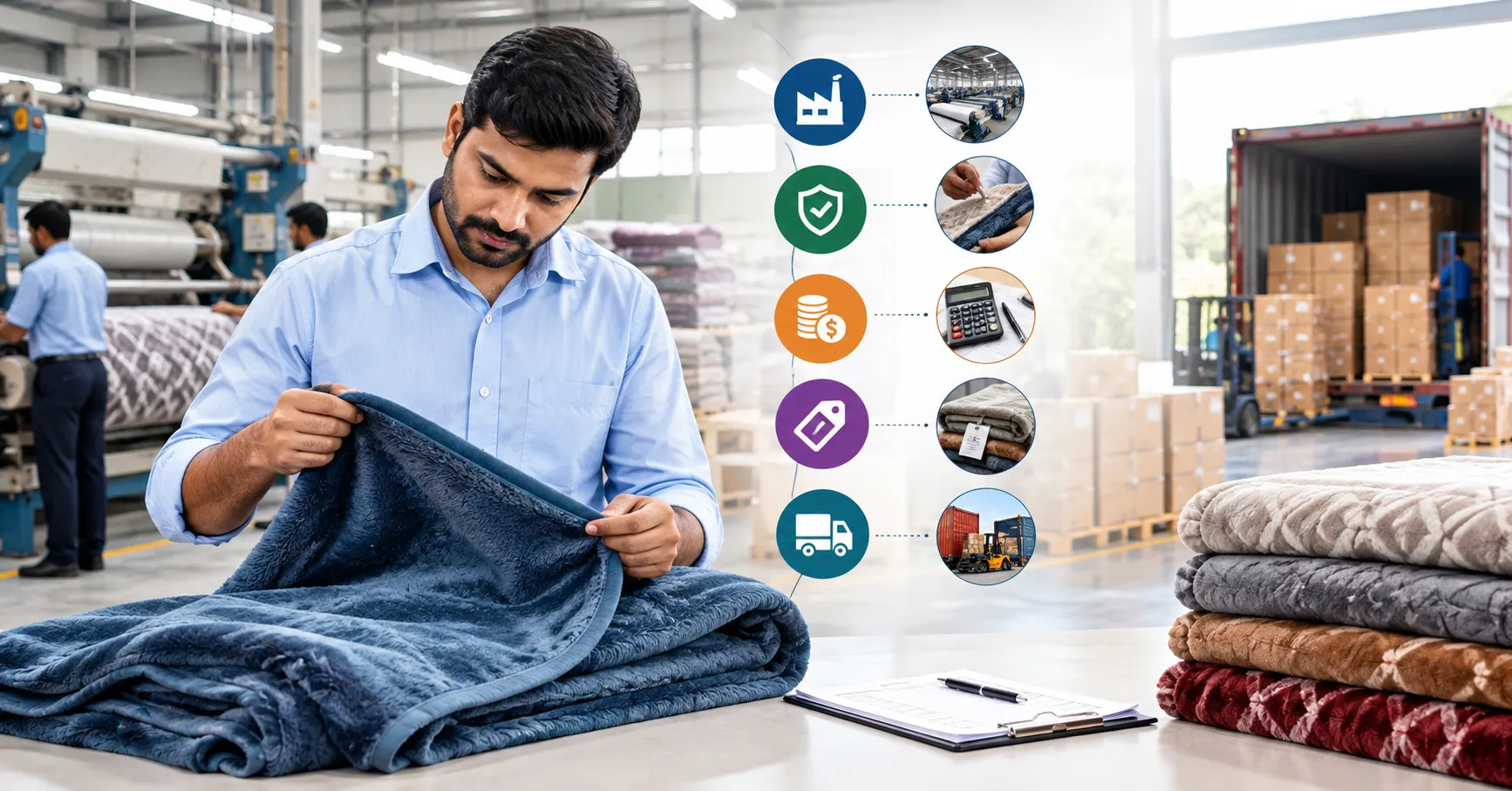
Experienced procurement teams look closely at the hand feel, weight, dimensions, stitching, edges, print quality, and overall finishing. They may wash or handle the sample before approving it, depending on the product and intended market.
This is especially important when the blanket will later be produced in thousands of pieces.
The approved sample becomes a reference point.
That reference helps both sides avoid confusion when the bulk order begins.
It also gives the manufacturer something concrete to work against instead of relying on a long email containing specifications that can be interpreted differently.
For blanket suppliers in India, this part of the process can make the difference between a smooth production run and repeated revisions.
Why repeat orders matter more than the first order
The first shipment can look impressive.
The second shipment is where a supplier starts proving itself.
Suppose a retailer orders 15,000 blankets for one winter season. Sales are strong, and the buyer wants another 10,000 pieces three months later.
The buyer expects the new batch to look and feel like the previous one.
That sounds obvious, but maintaining consistency across production batches requires proper specifications and process control.
The manufacturer needs to know what was approved previously. Colour references, dimensions, material composition, weight, finishing and packaging cannot simply be guessed from memory.
This is one of the practical reasons blanket exports from India are being considered by buyers who want a longer-term sourcing relationship rather than a one-off shipment.
A supplier's ability to repeat an approved product can be more valuable than a small difference in the initial quotation.
The hidden value of a mature textile cluster
Panipat is an important part of this conversation.
The city has developed a deep textile ecosystem around blankets, home furnishings, weaving, processing, and recycled textiles. That means manufacturers operate alongside a network of supporting businesses, workers, and textile capabilities.
For an international buyer, this can matter when an order changes.
Maybe the buyer wants a different colour.
Maybe the GSM needs adjusting.
Maybe the packaging needs to be changed for a retail chain.
Maybe the customer wants another blanket construction added to the range.
A mature manufacturing environment can make those conversations more practical.
This is one reason the Indian blanket export market is not simply about finished products leaving a factory. It is connected to a much larger textile production network.
Overseas brands are also buying flexibility.
There is another change happening in procurement.
Retailers increasingly want collections rather than one standard product.
A bedding company might sell three blanket weights under the same brand. A hotel group might need a standard product for guest rooms and a different one for premium properties. A distributor may want different designs for different countries.
The supplier therefore needs to be comfortable with variation.
This is where international blanket suppliers compete on more than production volume.
A good sourcing relationship gives the buyer room to develop products, test samples, adjust specifications, and then scale the approved version.
That flexibility can be particularly useful for private-label businesses.
What does “switching supply chains” actually mean?
It does not always mean completely leaving an existing supplier.
Often, it means adding another source.
For example, a European bedding company may continue buying part of its range from an existing Asian supplier while testing a new Indian manufacturer for selected blanket collections.
If the Indian supplier performs well, the relationship can grow.
This approach reduces the risk of moving an entire product category overnight.
It also gives the purchasing team real information about production quality, communication, packaging, and delivery instead of making the decision based entirely on quotations and presentations.
For many businesses, this is a more sensible way to evaluate blanket sourcing from India.
Start with a product that fits the manufacturer's strengths. Approve a sample. Run a manageable order. Measure the result.
Then decide whether to expand.
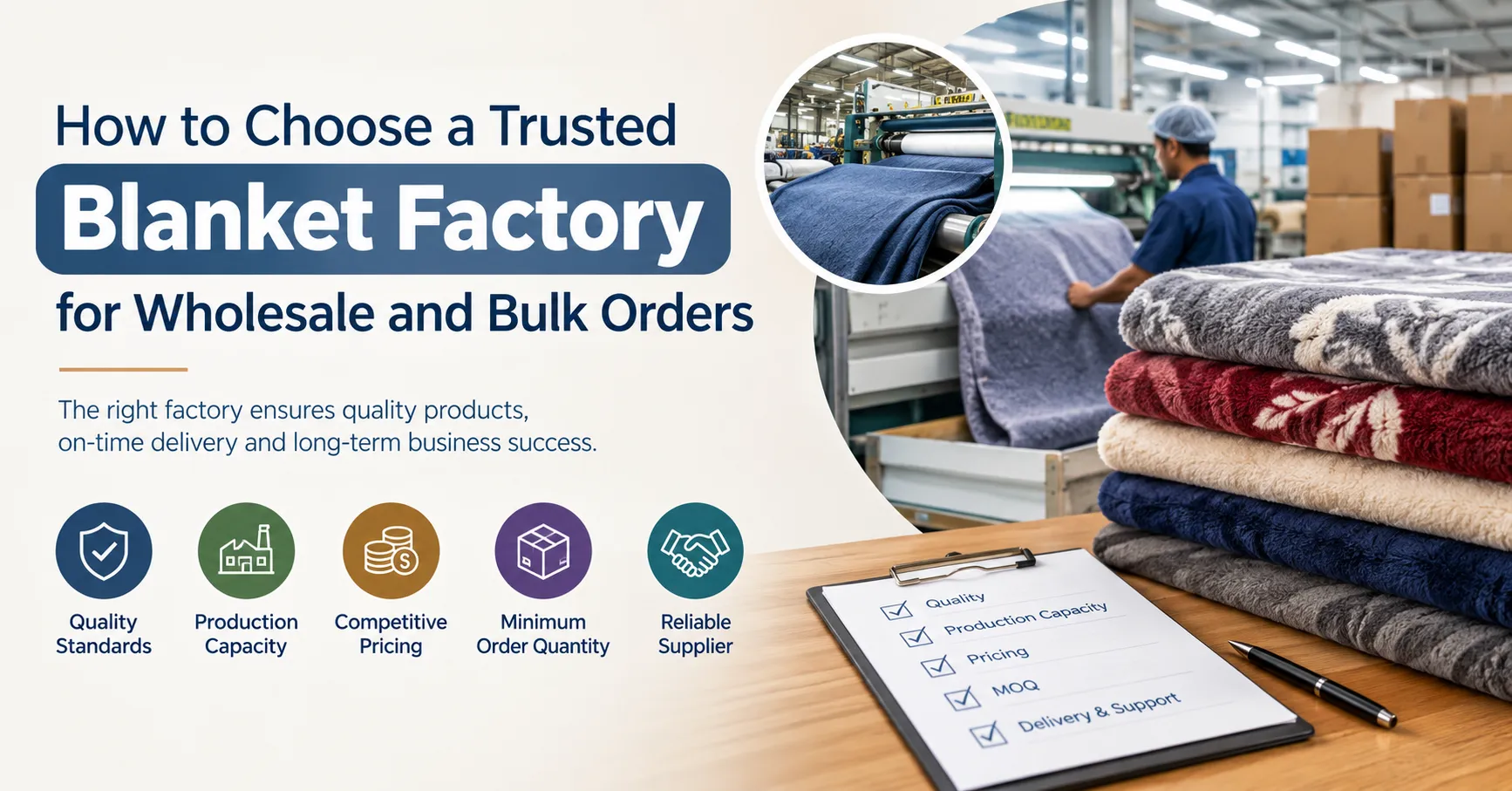
What should an overseas buyer check before moving an order?
A buyer considering India should look at the complete commercial picture.
Product capability:
Does the manufacturer actually make the construction, material, and finish required?
Production capacity:
Can the factory handle the planned quantity without compromising the production schedule?
Sample consistency:
Will the bulk product match the approved reference?
Customization:
Can the supplier work with the buyer's colours, dimensions, designs, labels, and packaging?
Quality control:
What checks happen during production, rather than only after everything is finished?
Export experience:
Has the manufacturer handled international orders and the documentation and logistics that accompany them?
Repeat orders:
Can the same product be reproduced months later?
These questions are more useful than asking which country has the cheapest factory price.
Price still matters, but landed cost matters more.
A low factory price can look attractive until the rest of the calculation is added.
The buyer needs to consider packaging, freight, order quantity, lead time, inspection, and other commercial costs.
Then there is the cost of mistakes.
If a shipment arrives late for a seasonal collection, the retailer may lose valuable selling time. If the colour differs from the approved sample, the buyer may face returns or rework. If packaging is wrong, products may need to be repacked before entering distribution.
That is why experienced procurement teams look at total sourcing cost rather than simply comparing the factory quotation.
For overseas businesses evaluating blanket sourcing from India, this distinction is important.
The cheapest supplier on paper may not be the cheapest supplier after the complete order is delivered.
Where JTI fits into the discussion
JTI (Jindal Textile Industries LTD) positions its blanket business around large-scale manufacturing and international supply. Its export-focused material discusses supply for wholesalers, distributors, retailers, hospitality businesses, and institutional buyers, with options including mink, woolen, flannel, and thermal polyester blankets.
The company also highlights customization involving dimensions, fabric or GSM, colours, patterns, private labeling, and export packaging.
For an overseas bedding brand, these capabilities are relevant because the sourcing requirement rarely ends with “send us blankets.”
The actual brief can be much more specific.
The buyer may have an existing product to match, a target retail price, a packaging format, a seasonal deadline, and a forecast for repeat orders.
A manufacturer has to understand that entire requirement.
So, why are brands considering India?
The answer is fairly practical.
India gives overseas bedding companies another established textile manufacturing base. It offers access to different blanket categories, production capabilities, and export experience. The country also has the wider textile ecosystem needed to support product development and large-scale manufacturing.
But there is no automatic advantage simply because a supplier is Indian.
The right manufacturer still needs to prove itself through samples, specifications, production consistency, quality checks, and successful shipments.
That is especially important when a company is researching India’s largest exporter of blankets. A large export position can attract attention, but procurement decisions should still be based on the supplier's ability to meet the specific order.
The bigger shift is about control.
Overseas bedding brands are becoming more deliberate about where and how they source.
They want fewer surprises.
They want to know where the product is made, how specifications are controlled, how repeat batches are handled, and whether the supplier can grow with the business.
That makes supply-chain diversification less about finding a replacement country and more about finding another dependable manufacturing relationship.
India is increasingly part of that conversation.
For brands comparing suppliers, the best starting point is not a country ranking or a bold claim about who is biggest. It is the product itself.
Define the requirement. Review the sample. Understand the factory's capabilities. Test a commercial order. Then judge the supplier on what actually arrives.
That is how a sourcing decision becomes a long-term supply-chain decision.
FAQs
1. Why do overseas buyers source blankets from India?
Overseas buyers source blankets from India because the country offers a large textile manufacturing base, different product options, and established export experience. For bedding companies, the attraction can include flexible product development, bulk production, and customization. The supplier still needs to be assessed on quality, capacity, pricing, and repeat-order performance.
2. Why do bedding brands choose Indian blanket manufacturers?
Bedding brands choose Indian blanket manufacturers when they need a combination of product variety, manufacturing capacity, and sourcing flexibility. Indian factories can serve retail, wholesale, and institutional requirements, although capabilities differ considerably between manufacturers. A sample and production trial are better indicators than a supplier profile alone.
3. Why source blankets from India?
The question “why source blankets from India” usually comes down to supply-chain choice rather than one single advantage. India offers an established textile ecosystem and international export connections. It can also provide another manufacturing base for companies that want to reduce dependence on a single sourcing country.
4. What are the advantages of sourcing blankets from India?
The advantages of sourcing blankets from India can include product diversity, established textile clusters, customization, and access to manufacturers experienced in international orders. For a serious buyer, however, those advantages only matter when the selected factory can meet the required specifications, quantities, quality standards, and delivery schedule.
5. How do overseas brands source blankets from India?
How overseas brands source blankets from India generally begins with a product brief or reference sample. The buyer identifies suitable manufacturers, requests samples, compares commercial terms, approves the specification, and places an initial order. Successful suppliers can then move into larger or repeat programmes.
6. What should buyers look for in blanket exporters in India?
When comparing blanket exporters in India, buyers should look beyond the catalogue. Production capacity, sample accuracy, quality checks, customization, packaging, lead time, and export experience all deserve attention. It is also worth asking how the manufacturer records approved specifications for future repeat orders.
7. How can buyers compare blanket manufacturers in India?
The best way to compare blanket manufacturers in India is to evaluate them against the same product brief. Request comparable samples, production details, MOQs, lead times, and packaging information. Then compare quality and total landed cost rather than choosing the lowest factory quotation automatically.
8. What makes international blanket suppliers reliable?
Reliable international blanket suppliers tend to have clear production processes, realistic lead times, and experience handling export requirements. They should be able to explain how a sample becomes a bulk order and how the approved specification is maintained across future production runs.
9. Is blanket sourcing from India suitable for private-label bedding brands?
Yes, provided the selected manufacturer can handle the required customization. Blanket sourcing from India can suit private-label businesses that need specific dimensions, materials, colours, patterns, labels, or packaging. Buyers should confirm MOQ, sampling, production capacity, and private-label requirements before placing a commercial order.
10. How does JTI (Jindal Textile) support overseas blanket buyers?
JTI (Jindal Textile) presents its business around blanket manufacturing and international supply for wholesalers, distributors, retailers, hospitality, and institutional buyers. Its export materials list customization options and several blanket categories. Buyers should confirm the current product specifications, MOQ, lead time, and commercial terms for their particular requirements.





Sign in to leave a comment.