

A lot of it is normal. Citrus naturally sheds a large share of its blossoms and young fruit, while an apple tree may need only about one flower in twenty to set in order to carry a full crop. The more useful question is not why is fruit dropping but when in the season is it dropping, because the timing narrows down the cause.
Finding a scatter of tiny fruit under a plant looks like a harvest failing. Often it is the plant doing arithmetic: it set more fruit than it can carry, and it is correcting.
The way to tell a normal correction from an actual problem is to stop counting the fruit on the ground and start noting the calendar.
Fruit Drop Comes in Waves
Research on citrus at UF/IFAS describes three distinct drop periods across a season. Similar timing-based diagnosis is useful for many tree fruits, although the exact stages and timing differ by species, so treat this as a framework rather than a fixed schedule.

Wave 1: Right after bloom. Very small fruit falls in the weeks immediately after the petals drop. These are largely flowers that were never properly pollinated. UC Cooperative Extension notes that in apples this phase often follows petal fall and may last two to three weeks, and the very small dropping fruits are the ones that were not pollinated Premature Fruit Drop Is Common in Many Fruit Tree Species.
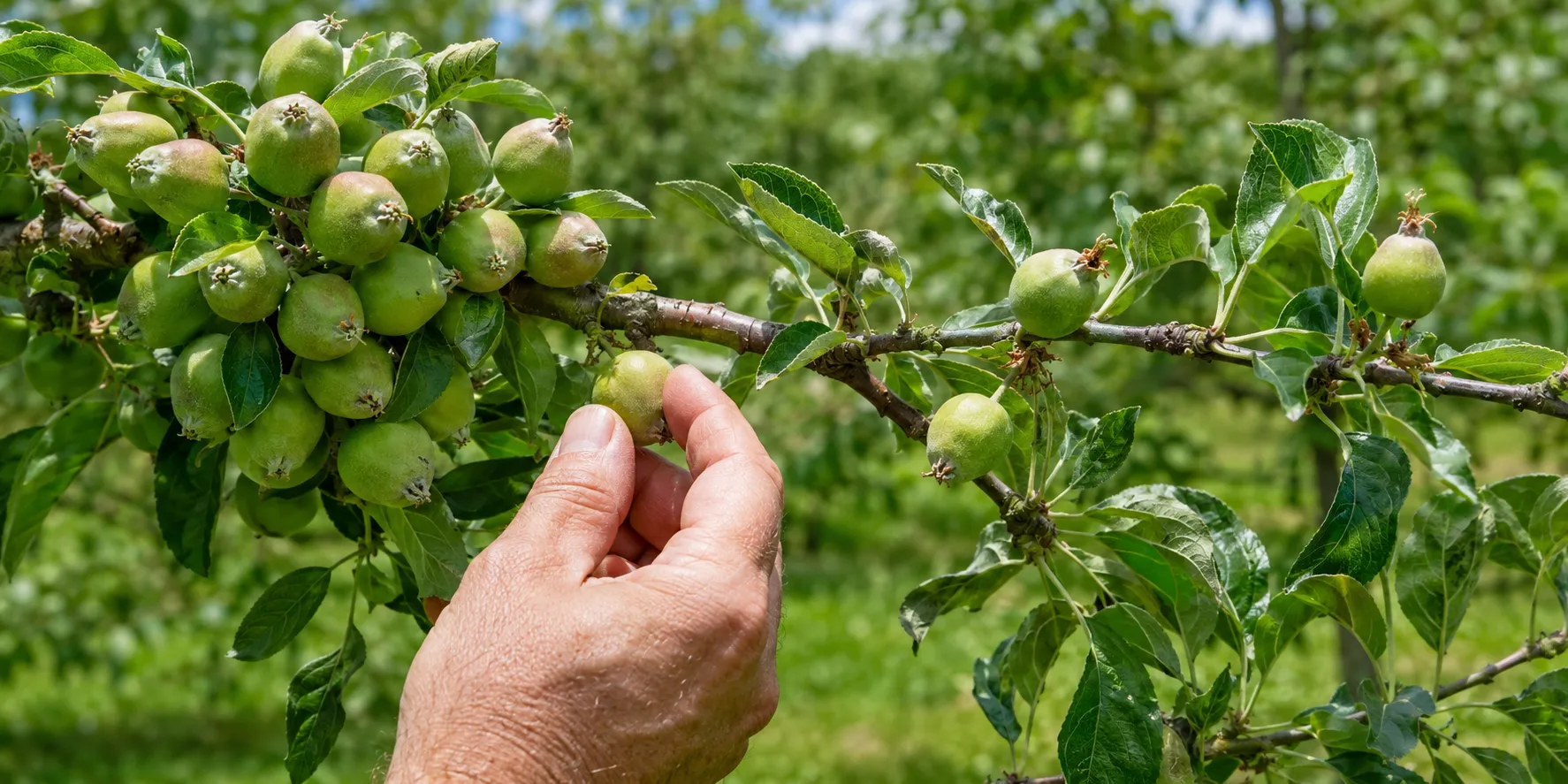
Wave 2: June drop. Roughly one to two months after bloom, the tree sheds young fruit it cannot support. This is driven largely by competition between developing fruits for carbohydrates, at a point when the leaves have not yet fully expanded to supply them. RHS describes this as a natural loss of surplus fruit combined with competition for limited carbohydrate resources RHS: June drop in apples. Despite the name, it can happen in May in warmer regions.
Wave 3: Pre-harvest drop. Mature or near-mature fruit falls in the period before harvest. University of Minnesota Extension notes that some late-season drop is normal, that some varieties are more prone to it, and that it can indicate too much fruit was left on the tree.
Which wave you are in changes what to check. Wave 1 points toward pollination. Wave 2 points toward crop load and resources. Wave 3 points toward stress, variety, or ripeness.
There is even a physical clue on the fruit itself. UF/IFAS notes that citrus dropping during June drop tends to separate at the stem end, leaving the stalk attached to the fruit, while pre-harvest drop separates at the calyx "button." Pick one up and look at where it broke.
How Much Loss Is Normal
This is what people actually want to know, and it varies a lot by crop.
• Citrus: UC IPM describes extensive drop of small citrus fruit as normal. Citrus typically drops many small fruit beginning shortly after the blossoms fall and continuing for about a month, and small fruit can keep dropping until the remaining fruit reaches around half an inch in diameter UC IPM: Fruit Drop of Citrus. Published drop percentages vary widely by variety and conditions, so treat any single figure as an example rather than a benchmark.
• Apples: RHS notes that because apples are large fruit, about one flower in twenty setting can constitute a full crop, or as much as the tree can support.
• Cherries and other small fruits: the opposite situation. Because each fruit is small, a much higher proportion has to set, so losing the same share is far more significant.
That last point matters. The same drop rate can mean very different things on different crops.
Natural drop is worth investigating when nearly all fruit is lost, when larger fruit starts falling later in the season, or when the plant shows other stress symptoms alongside it.
What If Tomatoes, Peppers or Squash Drop Young Fruit?
Fruit trees are the usual culprits, but vegetable growers see this too, and the pattern is a little different. If a tomato, pepper, squash or cucumber has already set a small fruit that then yellows and drops, the flower was pollinated well enough to start, so the question is what stopped it from holding.
The common causes are incomplete pollination, where too few seeds set to sustain the fruit; a heat spell around fruit set; and water stress, whether from a sudden dry spell or from sharp swings between dry and saturated soil. Container vegetables are especially prone to the last one, since a pot dries far faster than a bed. If the plant is flowering heavily but never forms a fruit at all, that is a different problem, covered in our guide to plants that flower but do not fruit. Here we are specifically talking about tiny fruit that formed and then let go.
The Cause Many Home Growers Miss: No Pollination Partner
If you have a single apple tree and it drops nearly all its tiny fruit every year, check this before anything else.
Many apple varieties are self-unfruitful. They cannot set a proper crop with their own pollen and need pollen from a different apple cultivar, or a crabapple, growing near enough for bees to travel between them. MSU Extension identifies this as a leading reason home fruit trees drop small fruit June drop of fruit in fruit trees.

What it looks like: the tree flowers beautifully every spring, sets pea-sized fruit, then loses almost all of it within a few weeks. Year after year, with no disease symptoms and no obvious stress.
What to do: find out whether your variety is self-fertile. If it is not, plant a compatible pollination partner that flowers at the same time, or graft a compatible branch onto the existing tree. A neighbor's tree within bee range may already be doing the job, which is part of why the same variety performs differently in different gardens.
Incomplete Pollination Produces Fruit That Cannot Hold
Pollination is not always all-or-nothing. A flower can receive some pollen, begin swelling, and still fail, because seed development drives fruit development in many crops.
Clues:
• tiny fruit forms but stops enlarging
• fruit is lopsided or misshapen
• drop happens soon after flowering
• pollinator activity was low during bloom
• weather during bloom was cold, wet, very hot, or windy
That last point is easy to forget. Conditions during the flowering period can determine what happens weeks later. If it rained through bloom week and bees never flew, you may see the consequence in June.
Heat and Water Amplify Everything Else
Sudden heat around fruit set is stressful. UC IPM notes that while citrus normally sheds many small fruit, excessive drop can occur under stressful growing conditions such as sudden high temperatures around fruit set. Heat raises water demand and disrupts the balance between leaves, roots and developing fruit, and a plant carrying a heavy crop may respond by dropping the youngest fruit first.
Irregular watering does similar damage. A cycle of severe dryness followed by heavy watering can stress a plant even when the total water over the month looks adequate. Developing fruit needs a steady supply, not an average. RHS notes that insufficient soil moisture may contribute to fruit fall, and that watering followed by mulching in dry spring weather may help.
Containers are the most vulnerable, since the root zone swings from wet to dry far faster than garden soil.
The practical approach is consistency, checked at root depth rather than judged from the surface. Because the stress behind fruit drop is usually a pattern over weeks rather than one bad day, what helps most is seeing how the root zone behaves over time. A soil tester that records readings to an app makes that pattern easier to see, since a single reading tells you what is happening now while saved readings show what is changing.
Aim for consistent moisture with good drainage. Permanently saturated soil creates a different problem, since waterlogged roots are also a route to fruit drop.
Crop Load: When the Plant Is Carrying Too Much
A heavy fruit set is exciting and is often the reason for the drop.
Every developing fruit competes for the carbohydrates the leaves produce. Above a certain load the plant sheds the surplus. This is the mechanism behind June drop, and it is also why thinning works.
Thinning improves the size and quality of what remains, reduces limb breakage, and helps prevent biennial bearing, the two-year cycle where a tree over-crops one year and produces little the next.
Timing and spacing are species-specific. UC Cooperative Extension gives concrete figures:
Crop Spacing to leave
Apples One fruit every 6 inches, or one per spur
Plums One fruit every 4 to 6 inches, thinned when fruit is about ¾ inch long
Asian pears One fruit per spur
On timing: for home growers, planned hand thinning is commonly done just after the natural June drop, which avoids removing fruit the tree was about to shed anyway. Commercial thinning programs may begin earlier, since earlier thinning is generally more effective at breaking a biennial bearing cycle. If your tree has a history of alternating heavy and light years, thinning on the earlier side is worth considering.
Nutrition: Where More Is Not Better
Poor nutrition can contribute to fruit drop, but so can over-fertilizing.
Excess nitrogen drives vigorous shoot growth that competes with developing fruit. Fertilizer salts can stress roots when applied heavily. UC IPM's guidance for citrus is adequate but not excessive nitrogen.
If drop begins suddenly, avoid feeding as a reflex. Work through watering consistency, recent heat or cold, pollination during bloom, crop load, recent pruning, and visible damage first, then assess nutrition in that context.
Nutrient problems do leave visible clues on the foliage. On citrus, nitrogen shortage tends to show as yellowing of older leaves first, while zinc shortage produces abnormally small young leaves with yellow blotching between the veins. Read the leaves before reaching for a bag.
Pests, Disease and Physical Damage
Natural thinning drops small fruit that otherwise looks normal. Dropped fruit with visible damage is a different conversation.
Look at what fell for:
• holes or punctures
• rot or sunken lesions
• mold
• distorted shape
• insect feeding damage
• damaged or discolored stalks
Some insects abort fruit without obvious external signs. Lygus bugs, for example, can inject a toxin into buds and small fruit that causes them to drop within days, and the damage may show only as small discolored spots.
Identify before you spray. The relevant pest depends on the crop and region, and a crop-specific extension diagnostic guide will get you there faster than a broad-spectrum product.
Physical factors add up too. Strong wind increases drop, especially on fruit already stressed by heat or drought. Heavy summer pruning reduces the leaf area available to feed the crop. UC IPM advises against excessive pruning of citrus for this reason, and recommends pruning shortly before or after blossoming so the tree can balance the fruit it retains against its remaining foliage.
Normal or Not: A Quick Reference
What you see How concerned to be
Some tiny fruit drops, plenty remains, leaves look fine Likely normal thinning
Heavy drop one to two months after bloom Likely June drop, a normal crop load adjustment
Nearly all tiny fruit drops, every year, single tree Check for a pollination partner
Drop follows a heat wave or a dry spell Water and temperature stress
Larger, nearly mature fruit falling repeatedly Pre-harvest drop, worth closer diagnosis
Dropped fruit has rot, holes or lesions Investigate pests and disease
Leaves also wilting, yellowing or scorching Broader plant stress, diagnose the plant first
Huge crop one year, almost none the next Biennial bearing, thin harder in the heavy year
Take a photo when the drop starts, and note the weather and watering from the previous one to two weeks. A repeated pattern at the same stage each season is far easier to solve than a single isolated event.
What to Do Before the Next Fruit Set
You cannot prevent every fruit from falling, and you should not try. Aim instead at helping the plant carry a realistic crop.
1. Confirm your variety has a compatible pollination partner nearby.
2. Keep watering consistent through flowering and early fruit development.
3. Mulch garden plants to slow surface drying.
4. Encourage pollinators, and avoid covering flowers during bloom where pest management allows.
5. Thin using the spacing recommended for that species, timed to your situation.
6. Avoid excess nitrogen.
7. Avoid heavy pruning during the growing season.
8. Inspect dropped fruit for damage rather than assuming.
9. Record when the drop happens each year.
Frequently Asked Questions
Why are tiny fruits falling off my plant?
Natural thinning, incomplete pollination, no pollination partner, heat, water stress, excessive crop load, nutrition problems, or pests.
Is it normal for fruit trees to drop small fruit?
Yes, and often in large quantities. UC IPM describes extensive drop of small citrus fruit as normal, and RHS notes that apples may need only about one flower in twenty to set for a full crop.
What is June drop?
The wave of young fruit that trees shed roughly one to two months after bloom, when developing fruits compete for limited carbohydrates. It is normal.
Can lack of water make unripe fruit fall?
Yes. Drought stress can increase fruit drop, particularly during hot weather and early fruit development.
Can too much water cause fruit drop?
Yes. Prolonged waterlogging damages roots and stresses the plant. The target is consistent moisture with good drainage.
Why does fruit start growing and then fall off?
Often incomplete pollination, where the fruit begins to swell but lacks enough developing seed to sustain it. Heat, water stress and crop load can also cause the plant to abort it later.
Should I thin my fruit tree?
For apples, plums and pears it generally helps. It improves fruit size, reduces limb breakage, and can prevent a two-year bearing cycle. Home growers commonly thin just after the natural June drop.























Sign in to leave a comment.