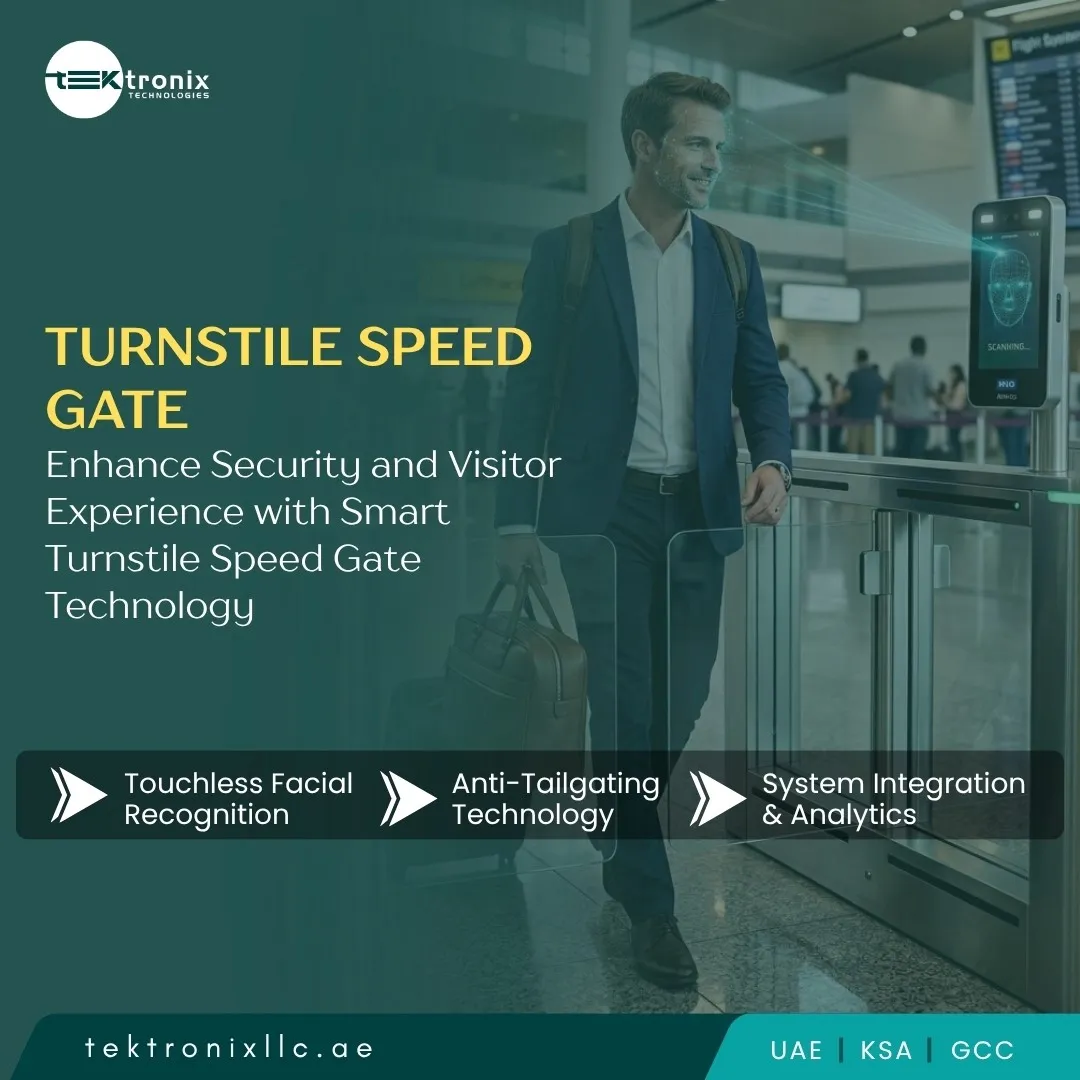

Turnstile Speed Gates are rapidly becoming the access control standard of choice for businesses across the UAE, and for good reason. As commercial developments grow denser, workforce populations expand, and security threats evolve, organisations from JAFZA-based logistics operators to DIFC financial institutions are replacing legacy barriers with intelligent, high-throughput pedestrian control systems that combine speed, safety, and deep integration with modern security ecosystems. This article examines the driving forces behind that adoption, the technology options available, and the strategic advantages that make biometric-ready speed gates a sound long-term investment for UAE enterprises.
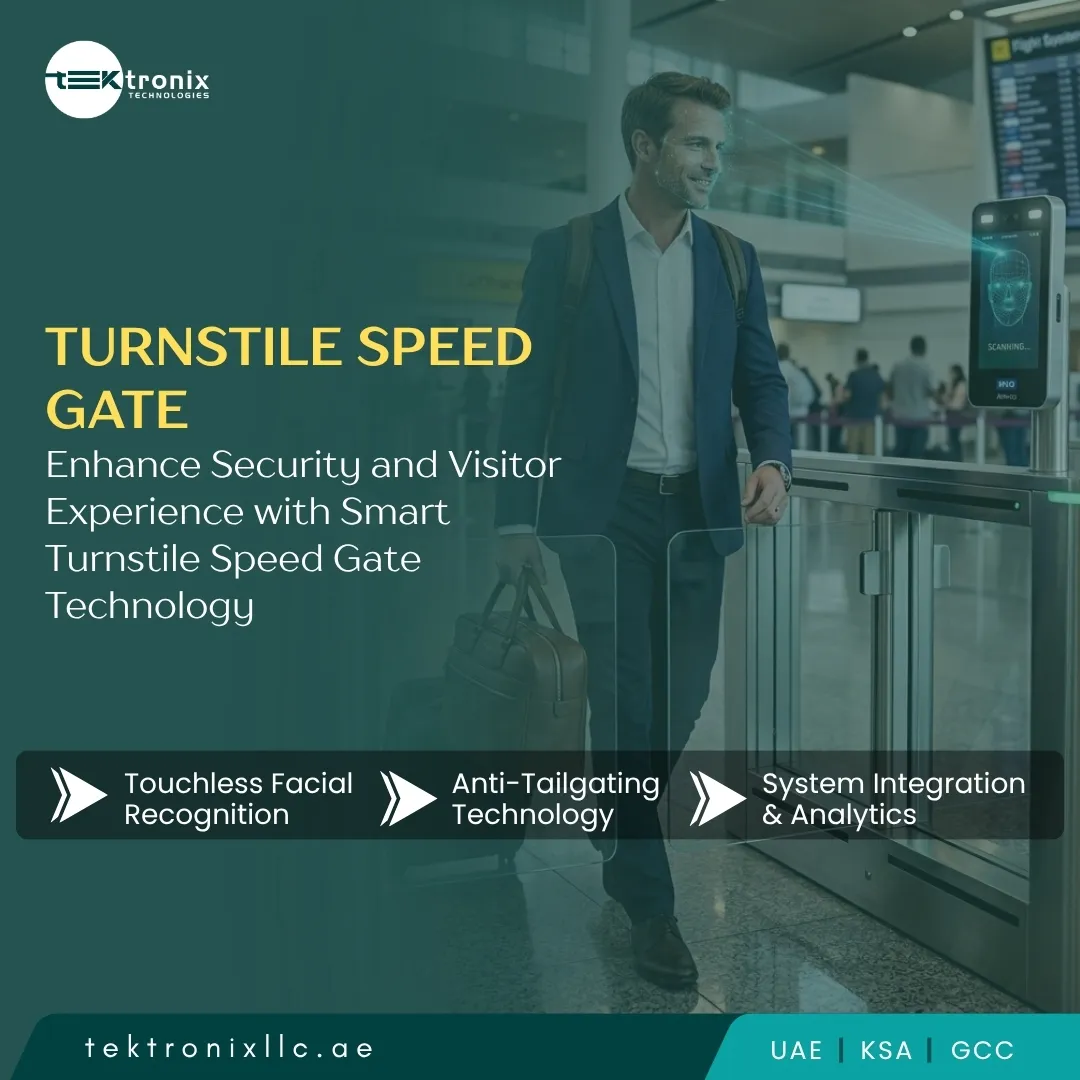
The UAE Business Landscape and the Demand for Advanced Pedestrian Access Control
The United Arab Emirates is home to more than 595,000 active commercial licences, dozens of world-class free zones, and a workforce that spans over 200 nationalities. Managing the daily flow of employees, contractors, visitors, and delivery personnel across high-density facilities is a logistical and security challenge that manual guarding alone cannot solve at scale. UAE Vision 2031 and the Smart Dubai initiative have created a regulatory and cultural climate that actively rewards the adoption of intelligent building technologies, making automated pedestrian access control not merely a convenience but an operational imperative.
Against this backdrop, purpose-engineered Turnstile Access Control systems have emerged as the backbone of perimeter security for everything from corporate headquarters and government ministries to warehouses, hospitals, and mixed-use retail developments. They enforce authorisation at the point of entry, generate tamper-proof audit trails, and integrate natively with facial recognition, RFID, and mobile credential platforms, capabilities that no human guard station can replicate consistently at scale.
A Complete Guide to Turnstile Gate Types and Their Ideal Use Cases
Not all pedestrian barriers are engineered for the same environment. Understanding the mechanical and operational differences between gate categories is essential for specifying the correct solution for each facility type.
Swing Barrier Turnstile Gates
Swing Barrier Turnstile Gates feature wide, motorised panels that retract laterally on authorisation, creating a broad passageway suitable for wheelchair users, trolleys, and luggage. Their ADA and DDA compliance make them the default choice for corporate reception lobbies, airports, and healthcare facilities in the UAE where inclusive design is a building code requirement. Panel open-and-close cycles complete in under one second, maintaining throughput rates of up to 35 persons per minute per lane.
Full Height Turnstile Gates
Full Height Turnstile Gates deliver the highest mechanical security of any pedestrian barrier category. Floor-to-ceiling rotating frames physically prevent climbing, crawling, or forced passage, making them the preferred solution for critical infrastructure sites, data centres, server rooms, power utilities, and construction site perimeters across the UAE. They function effectively as standalone barriers that do not require a secondary security guard presence to enforce compliance.
Flap Barrier Turnstile Gates
Flap Barrier Turnstile Gates use retractable horizontal wings that fold away rapidly on valid credential presentation. Their low-profile, glass-and-steel aesthetic integrates seamlessly into premium commercial interiors, making them a favourite in DIFC office towers, five-star hotel service corridors, and financial services headquarters where both security and architectural elegance are priorities. Anti-tailgating infrared sensors detect and alarm on dual-occupancy attempts without interrupting the flow of authorised personnel.
Tripod Turnstile Gates
Tripod Turnstile Gates are the most cost-effective entry-level barrier solution, deploying a rotating three-arm mechanism that controls single-file pedestrian flow. They are widely specified for staff canteens, time-and-attendance checkpoints in manufacturing and logistics facilities, and temporary event access control across Dubai’s exhibition and hospitality venues. Their compact footprint and straightforward installation make them an agile choice for environments where rapid deployment or reconfiguration is needed.
Optical Turnstile Gates
Optical Turnstile Gates are the most technologically advanced category, using arrays of infrared beams to detect and track individual pedestrians through an open lane without physical barrier arms. On an unauthorised credential, an alarm is triggered and barrier panels deploy within milliseconds. This contactless architecture delivers the fastest throughput in the category, up to 60 persons per minute, and is specified for high-volume transit hubs, smart government buildings, and premier co-working campuses where user experience and throughput take precedence over maximum physical deterrence.
Key Reasons UAE Businesses Are Accelerating Turnstile Deployments
1. Eliminating Tailgating and Piggybacking
Tailgating, an unauthorised person following an authorised individual through a controlled entry, is the most exploited vulnerability in physical access control. Multi-beam infrared detection embedded in modern speed gates identifies dual-occupancy within a single access cycle and triggers instant alarms, a capability that cannot be reliably replicated by card-reader-only systems or manual checking.
2. Scalable Workforce Attendance Management
Integrated time-and-attendance modules within speed gate controllers log every entry and exit event with a microsecond-accurate timestamp. These records synchronise directly with HRM platforms such as SAP SuccessFactors and Oracle HCM, automating payroll calculation, overtime validation, and compliance reporting, eliminating the buddy-punching fraud that costs UAE employers an estimated billions of dirhams annually in payroll leakage.
3. Smart City and Building Automation Integration
Dubai’s Unified Building Intelligence standards increasingly expect access control infrastructure to communicate with HVAC, elevator dispatch, lighting, and CCTV platforms via open protocols such as OSDP, Wiegand, and BACnet. Modern speed gate controllers support all three, enabling scenarios such as automatic elevator pre-call on gate authorisation and HVAC zone activation based on real-time occupancy data derived from gate traffic counts.
4. Visitor and Contractor Management
Pre-registered visitor credentials, issued as QR codes, mobile NFC tokens, or temporary RFID cards, are validated at the gate against a visitor management system, granting time-bounded and zone-specific access without requiring a reception agent to physically escort every guest. This architecture dramatically reduces lobby congestion during peak arrival hours and provides a complete, auditable visitor record for post-incident investigation.
5. Regulatory Compliance and Insurance Requirements
UAE Federal Law No. 37 of 2021 on Combating Cybercrimes, DIFC Data Protection Law 2020, and sector-specific mandates from the Dubai Health Authority and Critical Infrastructure and Coastal Protection Authority (CICPA) all require demonstrable access event logging with defined retention periods. Speed gate audit trails satisfy these requirements natively, and certified deployments have been shown to reduce facility insurance premiums by reducing the measurable probability of unauthorised access events.
Turnstile Speed Gates UAE: Compliance, Climate, and Construction Considerations
Specifying Turnstile Speed Gates UAE-wide requires attention to environmental, regulatory, and construction factors that differ materially from European or North American deployments.
- Ambient Temperature Tolerance: UAE outdoor and semi-outdoor installations, car park barriers, logistics yard entry points, and construction site gates, require units rated to operate reliably at sustained ambient temperatures of 55–60°C. IP54 or higher ingress protection ratings guard against the fine-particulate dust events that are a routine feature of the Gulf climate.
- Power Resilience: Fail-safe and fail-secure modes must be configured in accordance with UAE Civil Defence evacuation requirements. In the event of a power failure, fail-safe units default to open (evacuation mode), while fail-secure units default to locked, the correct mode is site-specific and must be confirmed with the UAE Civil Defence authority during design review.
- Aesthetic Integration: Premium free-zone and mixed-use developments specify brushed stainless steel or powder-coated aluminium housings consistent with LEED and Estidama Pearl Rating System interior design standards.
- Data Residency: Biometric and access event data generated by gate-integrated readers must be stored within UAE data-residency boundaries under Federal Decree-Law No. 45 of 2021 (UAE PDPL). On-premise edge processing or UAE-hosted cloud deployments satisfy this requirement.
Turnstile Speed Gates Dubai: Sector-Specific Deployment Highlights
As the UAE’s most commercially dense city, Dubai hosts a disproportionately high concentration of Turnstile Speed Gates Dubai deployments across the following sectors:
- Financial Services (DIFC & Business Bay): Flap barrier lanes with integrated facial recognition and anti-tailgating sensors secure trading floors, server rooms, and executive suites.
- Logistics & Free Zones (JAFZA, DWC, Dubai Industrial City): Full height rotating gates and tripod units manage shift-worker access across 24-hour warehouse and manufacturing operations, feeding directly into SAP time-and-attendance modules.
- Hospitality & Mixed-Use (Downtown Dubai, Palm Jumeirah): Swing barrier lanes with wide-format glass panels maintain five-star aesthetic standards at hotel back-of-house and amenity zone entry points.
- Healthcare (DHA-Regulated Facilities): Optical lanes with visitor pre-registration integration restrict pharmaceutical storage, ICU corridors, and operating theatre suites to credentialled staff, satisfying Dubai Health Authority access control guidelines.
- Government & Semi-Government Buildings: Multi-lane optical and flap barrier installations linked to UAE PASS national identity verification provide ministerial offices with the highest attainable combination of throughput and security assurance.
Deployment Methodology: From Site Survey to Go-Live
A structured implementation process is the difference between a speed gate installation that performs at specification for a decade and one that generates support tickets from week one. Tektronix LLC follows a six-stage methodology proven across UAE enterprise deployments:
- Site Survey & Security Audit: Pedestrian flow analysis, peak-hour throughput modelling, existing infrastructure audit, and Civil Defence egress route confirmation.
- System Design & Specification: Gate category selection, lane-count determination, credential technology specification (RFID, facial recognition, QR, mobile NFC), and protocol integration design.
- Supply & Logistics: UAE-cleared hardware procurement with lead-time management, pre-delivery factory acceptance testing, and site-readiness pre-checks.
- Installation & Commissioning: Certified mechanical and electrical installation, controller configuration, third-party system integration testing, and Civil Defence fire-mode validation.
- User Acceptance Testing: Throughput benchmarking, anti-tailgating sensitivity calibration, credential read-rate validation, and edge-case scenario testing.
- Training & Handover: Administrator and end-user training, documentation handover, and activation of SLA-backed maintenance contract.
ROI Analysis: The Business Case for Speed Gate Investment
Organisations that replace manual guard-and-barrier configurations with automated speed gate systems consistently report a return on investment within 18 to 24 months. The primary value drivers are: a 40 to 60 percent reduction in manned guarding costs at controlled entry points; elimination of payroll fraud through automated, tamper-proof attendance logging; reduction of insurance premiums linked to verifiable perimeter security upgrades; and avoidance of regulatory penalties tied to inadequate access event documentation.
Beyond direct cost recovery, the operational data generated by speed gate systems, peak entry times, lane utilisation rates, and anomaly frequency, provides facilities managers with actionable intelligence to optimise staffing, energy consumption, and security posture on an ongoing basis.
Why Tektronix LLC Is the UAE’s Trusted Speed Gate Specialist
Tektronix LLC has designed, supplied, and commissioned turnstile and speed gate solutions across Dubai and the wider UAE for over a decade, building a portfolio that spans DIFC-regulated financial institutions, Dubai Municipality-approved facilities, free-zone logistics operators, and ISO 27001-certified data centres. Our engineering team holds OEM-certified competencies from leading global manufacturers, and every project is delivered with a full UAE Civil Defence compliance package.
We provide end-to-end project ownership from initial site survey and system design through certified installation, third-party integration, staff training, and 24/7 post-deployment support under an SLA-backed maintenance contract. Our clients benefit from proactive firmware management, annual performance audits, and direct access to a UAE-based technical team that responds to critical faults within four hours.
Conclusion
The accelerating adoption of Turnstile Speed Gates across UAE commercial, industrial, and government facilities reflects a broader strategic shift: organisations are moving from reactive, guard-dependent security models to proactive, data-driven access control architectures that simultaneously strengthen perimeter integrity, reduce operational costs, and generate the compliance-ready audit trails that modern UAE regulation demands.
Whether your requirement is a single swing barrier lane in a boutique DIFC office, a bank of optical lanes in a government ministry, or a full-height perimeter gate network at a JAFZA logistics campus, the right specification starts with a thorough site assessment and an integrator with proven UAE deployment experience. Investing in the correct system today means a secure, efficient, and fully compliant access control infrastructure that will serve your business for the next decade and beyond.
FAQs
1. What is the difference between a Swing Barrier and an Optical Turnstile Gate?
A Swing Barrier uses physical motorised panels that retract to create a wide passageway, making it ADA-compliant and suitable for users with mobility aids or luggage. An Optical Turnstile Gate, by contrast, uses infrared beam arrays to monitor passage through an open lane with no physical arm, triggering an alarm and deploying barrier wings only on unauthorised entry. Optical lanes deliver higher throughput, up to 60 persons per minute, while swing barriers offer the broadest passive lane width, typically 900mm or more.
2. Are speed gates suitable for outdoor UAE installations given the extreme heat?
Yes, provided the correct specifications are chosen. Outdoor and semi-covered UAE installations should specify units rated for sustained ambient operation at 55–60°C, with IP54 or IP65 ingress protection against the fine dust and humidity that characterise Gulf climate conditions. Stainless steel housings with UV-resistant powder-coat finishes are strongly recommended for direct-sun exposure. Your integrator should validate operating temperature ratings against the specific microclimate of the installation site during the design phase.
3. Can Turnstile Access Control systems integrate with biometric readers and HRM platforms?
Yes. Modern speed gate controllers support Wiegand, OSDP, and RS-485 protocols, enabling plug-in integration with facial recognition cameras, fingerprint readers, RFID card readers, and QR code scanners. On the software side, RESTful APIs and pre-built connectors allow access event data to synchronise in real time with HRM and payroll platforms including SAP SuccessFactors, Oracle HCM, and Microsoft Dynamics 365, automating attendance logging, overtime calculation, and compliance reporting without manual data entry.
4. How many lanes do I need for my UAE office or facility?
The standard industry rule of thumb is one lane per 500 to 600 peak-hour pedestrians, but the correct answer depends on your specific peak-hour flow rate, acceptable queue wait time, and the credential technology you are deploying. Facial recognition credentials are faster to process than PIN entry, which reduces per-person cycle time and therefore the lane count required for a given throughput target. Tektronix LLC conducts a complimentary pedestrian flow analysis during the site survey to produce a data-backed lane-count recommendation specific to your facility.
5. What maintenance is required for Flap Barrier and Tripod Turnstile Gates in a UAE environment?
Preventive maintenance schedules for UAE deployments typically include quarterly mechanical inspections covering barrier arm alignment, motor and gear assembly lubrication, and sensor calibration; bi-annual electrical inspections covering controller board health, cable integrity, and power supply condition; and annual full-system performance audits benchmarking throughput and false-rejection rates against original commissioning data. Gulf dust ingress makes more frequent sensor cleaning necessary than in temperate climates. An SLA-backed maintenance contract with a UAE-resident technical team ensures critical faults are resolved within a guaranteed response window, protecting business continuity.





























Sign in to leave a comment.