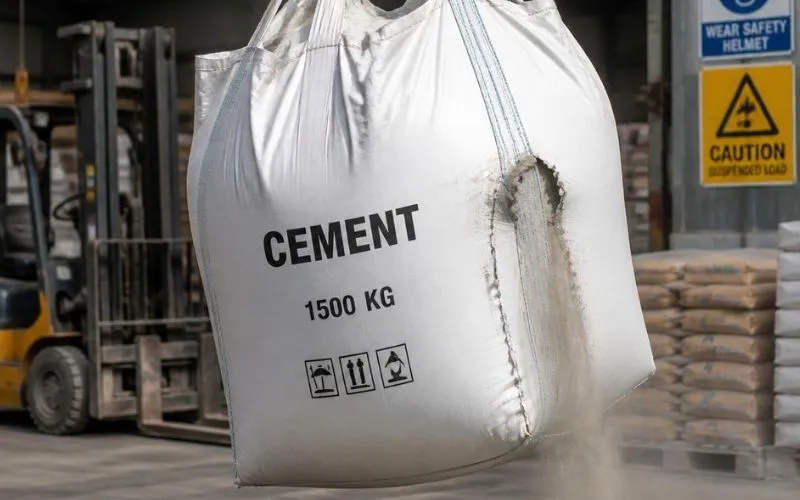

A cement bulk bag collapsing mid-lift is not just a product loss problem. It is a serious safety incident waiting to happen, and it occurs far more often than most construction sites expect.
Cement is dense, heavy and unforgiving when a bag folds inward during lifting. The contents shift, the load becomes unstable, and nearby workers are put at immediate risk. Most collapses do not happen because the bag itself fails. They happen because the lifting method was wrong from the very start.
This guide covers exactly why cement bulk bags collapse during lifting, what the most common causes are and how the right equipment eliminates the risk entirely.
Key Points
- Cement bulk bag collapse is caused by the lifting method not the bag itself
- Single point lifting is the most common cause of bag fold and collapse
- Four-point lifting distributes weight evenly keeping the bag fully upright
- The right lifting attachment works on both forklifts and overhead cranes
- Compliance documentation confirms the attachment meets Australian safety standards
What Is a Bulk Bag Lifter and How Does It Prevent Collapse?
A bulk bag lifter is a purpose-built lifting attachment designed to connect to all four strap points of a standard bulk bag simultaneously. It fits directly onto a forklift carriage or crane hook and distributes the weight of the load evenly across four lifting points.
The four safety swivel hooks at each corner secure the bag straps firmly before the lift begins. Once connected the bag is held fully open and upright throughout the entire lift. The bag cannot fold inward because the straps are secured at every corner holding the shape of the bag under load.
Swivel hooks allow operators to connect and disconnect straps with one hand making every lift faster and safer.
Why Is Cement Bulk Bag Collapse a Serious Risk?
Cement is one of the densest materials stored in bulk bags on any Australian construction site. A standard bulk bag of cement can weigh between 500kg and 1000kg. That weight, combined with the fine-powder consistency, creates a load that shifts rapidly when the bag loses its shape.
When a cement bulk bag collapses the consequences are immediate:
- Contents spill, creating slip and contamination hazards
- Unstable load swings putting workers below at serious risk
- Equipment underneath the lift gets damaged by falling material
- Product loss adds direct cost to the project
- A WorkSafe incident report may follow if workers are nearby
What Are the Most Common Reasons Cement Bulk Bags Collapse?
Single Point Lifting
- Bag folds inward immediately
- Weight pulls sides down while centre pulls up
- Load shifts and collapse follows fast
Uneven Strap Loading
- Straps not connected across all four points
- One side carries more weight than the other
- Bag tilts and folds during the lift
Exceeding the Load Rating
- Every bag and attachment has a rated capacity
- Overfilling creates structural stress
- Attachment failure follows under excess load
Using the Wrong Attachment
- General purpose attachments lack four-point connection
- Bag cannot stay upright without correct attachment
- Most common and most preventable collapse cause
Which Australian Industries Face the Highest Bulk Bag Collapse Risk?
1. Construction Sites
Cement, sand and gravel lifted multiple times daily
Time pressure increases incorrect attachment risk
2. Warehouses and Distribution
A bulk bag carrier without four-point lifting creates indoor collapse risk
Same risk indoors as on a construction site
3. Manufacturing Facilities
Collapse contaminates production area
Creates costly downtime across entire facility
4. Mining and Resources
Remote sites with heavy bulk bag loads
Collapse carries serious safety and regulatory consequences
How to Stop Cement Bulk Bags From Collapsing Every Single Time
Preventing bulk bag collapse comes down to three consistent practices:
- Always use a four-point lifting attachment connecting to all four bag straps
- Check all four straps are evenly loaded and secured before the lift begins
- Confirm combined bag weight does not exceed the rated capacity of the attachment
These three steps take less than a minute and eliminate the most common causes of collapse entirely.
What Should Australian Sites Look for When Choosing a Lifting Attachment?
When selecting a lifting attachment for cement bulk bag handling check for:
- Load capacity rated at or above your heaviest bulk bag
- Four safety swivel hooks for positive one-handed connection
- Compatible with both forklift and overhead crane operation
- Zinc plated finish for outdoor site durability
- Compliance certificate and operations manual available on request
The Right Bulk Bag Lifter Eliminates Collapse Risk Before It Becomes an Incident
Cement bulk bag collapse is a preventable problem. The cause is almost always the lifting method and the solution is straightforward. Four-point lifting with the right attachment keeps the bag upright, the load stable, and workers safe on every single lift.
Choosing the right lifting equipment once is far less costly than managing the consequences of a collapse that should never have happened.




















Sign in to leave a comment.