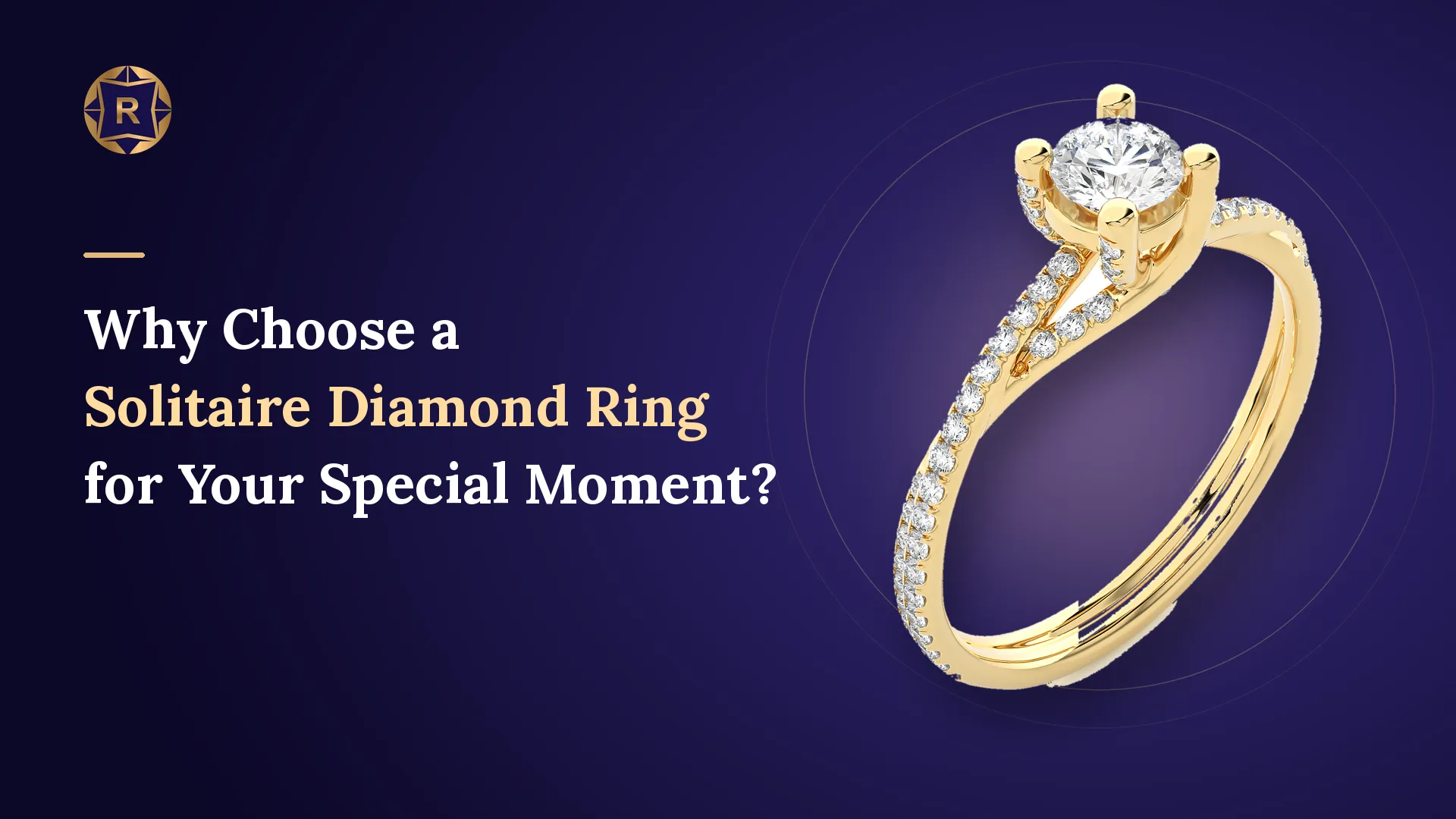

Quick Summary: A solitaire diamond ring puts one diamond at the center of attention, with no side stones competing for the eye, which is exactly why it has stayed the most requested style for proposals and solitaire engagement rings for generations. This article covers what actually sets a solitaire apart, how the 4Cs affect what you're paying for, which settings suit which diamond shapes, and the mistakes worth avoiding before you commit to the ring that marks this moment.
—----------------------------------------------------------------------------------------------------------------------------
Table of Contents
- Introduction
- What Makes a Solitaire Diamond Ring Different
- Why Couples Keep Choosing Solitaire Engagement Rings
- Understanding the 4Cs Before You Buy
- Choosing the Right Setting and Metal
- Common Mistakes to Avoid
- Making the Moment Even More Personal
- Conclusion
Introduction
Somewhere between choosing the right diamond shape and worrying about carat weight, most people forget to ask the simplest question: why does the solitaire style even exist, and why has it outlasted nearly every ring trend that came after it? A solitaire diamond ring isn't the safe, default option people sometimes assume it is. It's a deliberate choice to let one diamond carry the entire ring, with nothing else on it competing for attention. That decision changes how the diamond gets chosen, how it's set, and even how the whole ring ages over the years. This article looks at what makes a solitaire different, wat are these 4Cs, and the setting decisions that matter once you've picked the diamond itself.
What Makes a Solitaire Diamond Ring Different
The word solitaire refers to the setting, not the diamond itself, and that distinction matters more than most buyers realize. A solitaire setting holds a single diamond as the visual focus of the ring, usually secured with prongs that lift the stone and let light pass through it from nearly every angle. Compare that to a halo setting, which surrounds the center stone with smaller melee diamonds, or a pavé setting, which lines the band with tiny stones. Both add sparkle around the center diamond, but a solitaire lets the center diamond's own cut and clarity do all the work, unfiltered by anything else on the ring.
This is also why cut quality matters more on a solitaire diamond ring than on almost any other setting. There's nowhere for a mediocre cut to hide behind extra sparkle, so what you see is what the diamond delivers.
Why Couples Keep Choosing Solitaire Engagement Rings
Solitaire styles didn't become the default by accident. A handful of practical and emotional reasons keep pulling buyers back to this design generation after generation. Here are some of the reasons why couples choose this ring for their special occasion:
- The design of the ring. A solitaire looks as current in a photograph from decades ago as it does today, since the style isn't tied to a passing trend.
- It works with any diamond shape. Round brilliants are the classic choice, but oval, cushion, emerald, and pear shapes are all beautifully placed in a solitaire diamond ring setting, giving flexibility without changing the fundamental style.
- It puts the budget where it matters. Without melee diamonds and elaborate metalwork adding to the cost, more of what you spend goes directly into the quality of the center stone.
- It's easier to maintain and resize. A simple prong setting has fewer places for dirt to collect compared to a halo or pavé design, and resizing a plain band is typically more straightforward.
- The symbolism stays clear. One diamond, alone, has long represented a single, focused commitment, part of why solitaire engagement rings remain the go-to choice for this moment.
None of this means other styles are worse. It just explains why, when a couple wants a ring that feels timeless rather than trendy, the solitaire keeps winning that comparison.
Understanding the 4Cs Before You Buy
Every solitaire diamond ring gets priced around the same four factors, and understanding how they interact prevents overpaying for the wrong one. The 4Cs of this ring are as follows:
- Cut. This refers to a diamond's proportions and finish, not its shape, and it's the biggest factor in how much a diamond sparkles. A well-cut diamond in a solitaire setting outshines a larger, poorly cut one every time, since cut quality controls how light bounces back to your eye.
- Color. Diamonds are graded from D, completely colorless, down through the alphabet toward visible yellow tints. Since a solitaire has no side stones to distract from color, buyers often choose near-colorless grades, roughly G to H, to balance appearance against cost.
- Clarity. This measures internal inclusions and surface blemishes. In a solitaire diamond ring, where the stone is fully exposed, an eye-clean grade, typically VS2 to SI1, usually looks flawless without paying for a higher grade that only a jeweler's loupe would notice.
- Carat weight. This is simply the diamond's weight, and it's the number most buyers fixate on first, even though cut quality affects visible size and sparkle just as much as raw weight does.
A common mistake is maximizing carat weight while treating the other three Cs as an afterthought, which often results in a larger diamond that looks less impressive than a smaller, better-cut one.
Choosing the Right Setting and Metal
The center diamond gets most of the attention, but the setting and metal decide how it wears day to day. These are the things to consider before selecting the metal for the solitaire diamond ring:
- Prong settings are the classic solitaire choice, typically using four or six prongs to hold the diamond while exposing it to maximum light. Fewer prongs show more of the diamond but offer slightly less security.
- Bezel settings wrap a metal rim around the diamond's edge, trading a small amount of sparkle for better protection against chips, particularly useful for fancy shapes with pointed tips like pear or marquise cuts.
- Metal choice shapes the overall look as much as the diamond does. White gold and platinum make a diamond's color look crisper, while yellow and rose gold create warmer contrast that can flatter near-colorless grades.
Matching the setting to the solitaire diamond ring shape isn't optional. A pear or marquise cut needs a protective setting to prevent chipping at its pointed tip, while a round brilliant works safely in almost any prong configuration.
Common Mistakes to Avoid
A few recurring errors account for most of the regret buyers report after their solitaire purchase. These are some of the most common mistakes to avoid:
- Chasing carat weight without checking cut grade, ending up with a larger diamond that sparkles noticeably less than a smaller one.
- Skipping a certification of the solitaire diamond ring from a recognized grading lab, which makes it far harder to verify what you're paying for.
- Choosing a setting based only on photos rather than how it will hold up against the wearer's daily routine and hand size.
- Overlooking the return or upgrade policy, since a first ring often gets resized or the center stone eventually upgraded years down the line.
Making the Moment Even More Personal
A solitaire diamond ring's simplicity leaves space for personal touches that a busier design would crowd out. Engraving the inside of the band with a date or initials is a common choice, since the simple interior surface makes it easy to read. Choosing a diamond shape that reflects something personal, an oval for its elongated elegance or an emerald cut for understated glamour, adds meaning without complicating the design. Even the choice between a classic six-prong setting and a modern hidden-halo variation lets a couple make a timeless style feel distinctly their own.
Conclusion
A solitaire diamond ring doesn't need extra sparkle to make its point, and that's really the whole appeal. One good diamond, chosen well and set simply, says more than a ring crowded with side stones ever could. The part that actually matters is getting the cut right before worrying about carat size, since that's what decides how the diamond looks every single day it's worn. Rikhava Diamonds helps couples get that part right, so the ring feels just as special years from now as it does today.
FAQs
1. What is the difference between a solitaire and a halo engagement ring?
A solitaire features one diamond alone, while a halo surrounds the center stone with smaller diamonds that add extra sparkle and can make the center stone appear larger.
2. Which of the 4Cs matters most in a solitaire diamond ring?
Cut matters most, since a solitaire setting exposes the diamond fully, and cut quality is what controls how much it actually sparkles.
3. What carat size is typical for a solitaire diamond ring for engagement?
Popular sizes generally range from 1 to 2 carats, though the right size depends on budget, hand size, and personal preference rather than a fixed standard.
4. Is a solitaire setting less secure than a halo setting?
Prong solitaires hold the diamond firmly but expose more of it, while bezel solitaires trade a little sparkle for added protection, particularly useful for fancy-shaped diamonds.
5. Which metal looks best with a solitaire diamond?
White gold and platinum enhance a diamond's brightness, while yellow and rose gold add warmth and can flatter near-colorless diamond grades.
6. Do solitaire diamond rings hold their value well?
Larger, well-cut solitaire diamonds tend to hold demand better than smaller stones, though jewelry generally shouldn't be viewed primarily as a financial investment.
























Sign in to leave a comment.