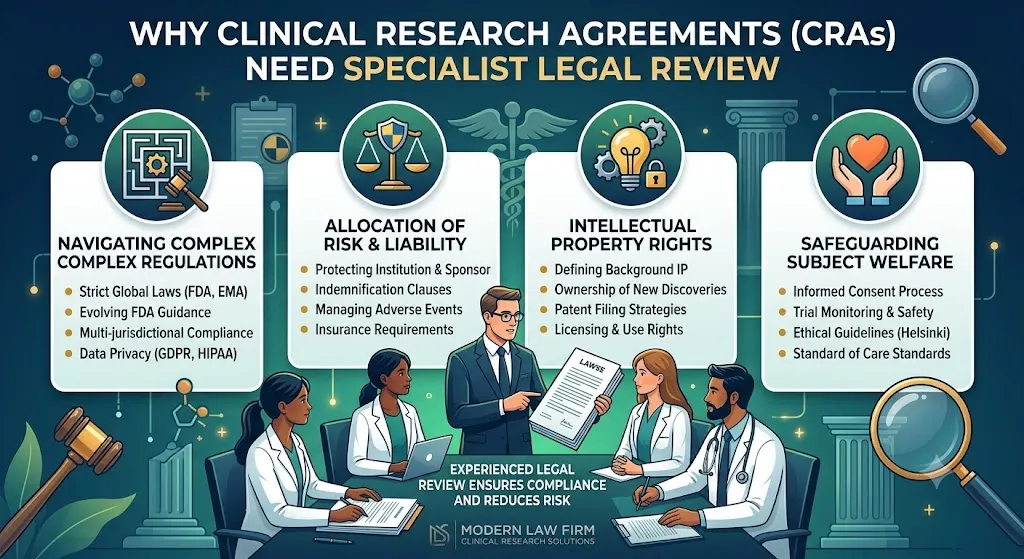

Clinical research involves researchers, sponsors, healthcare institutions, investigators and participants working together under a structured legal and scientific framework. A clinical research agreement helps define the responsibilities of these parties and establishes the terms under which research will be conducted. Since clinical research can involve patient safety, sensitive data, intellectual property and regulatory obligations, the agreement requires careful attention.
A standard commercial contract may not adequately address the issues arising from clinical research. The agreement needs to reflect the nature of the study, the responsibilities of each party and the legal requirements applicable to the research. Specialist legal review can help identify gaps before the agreement is signed and reduce uncertainty during the study.
What Is a Clinical Research Agreement?
A clinical research agreement is a legal document governing the relationship between parties involved in a clinical study. It may be entered into between a pharmaceutical or biotechnology company and a hospital, research institution, investigator or contract research organisation. The agreement generally establishes the commercial, operational and legal framework for the study.
The document may cover the research protocol, funding, responsibilities, intellectual property, confidentiality, publication rights, data management and regulatory compliance. Each study can involve different risks, so the agreement should be reviewed according to the specific research programme rather than treated as a standard template.
Regulatory Compliance Needs Careful Attention
Clinical research is subject to extensive regulatory requirements. The parties may need to comply with applicable legislation, regulatory guidance, ethical standards and institutional requirements. The agreement should clearly allocate responsibility for meeting these obligations.
Regulatory responsibilities can become complicated when several organisations participate in the same study. The sponsor may have certain obligations while the investigator or research institution has others. A carefully drafted agreement can help distinguish these responsibilities and establish appropriate reporting and oversight procedures.
Participant Safety Should Remain Central
Participant safety is a fundamental consideration in clinical research. Agreements should address responsibilities for monitoring adverse events, maintaining appropriate records and reporting relevant safety information. The parties should understand who is responsible for specific actions when a safety concern arises.
The contract should also consider procedures for responding to serious incidents and communicating relevant information. Clear allocation of responsibility can support a more coordinated response. It can also reduce the risk of disagreements during situations where timely action is important.
Informed Consent Requirements Matter
Clinical research involving human participants generally requires appropriate informed consent processes. The agreement should reflect the responsibilities of the relevant parties for obtaining, documenting and maintaining consent in accordance with applicable requirements.
Questions can arise over who provides information to participants, who maintains consent records and who manages changes to the research protocol. These responsibilities should be clearly understood before the study begins. Contractual clarity can support better coordination between sponsors, investigators and research institutions.
Data Protection and Confidentiality
Clinical studies can involve large amounts of sensitive information. Patient records, medical data, research findings and personal information may be accessed by several organisations. The agreement should therefore address how data will be collected, used, stored, transferred and protected.
Confidentiality provisions should also distinguish between personal data, commercially sensitive information and research results. The parties should understand who can access the information and under what circumstances. Data retention and deletion requirements may also need to be considered when the study ends.
Intellectual Property Can Become Complex
Clinical research may generate valuable intellectual property. This can include inventions, research findings, databases, processes and other developments arising during the study. The agreement should clearly establish ownership and rights to use such intellectual property.
The parties should also distinguish between intellectual property existing before the research and material created during the study. Ambiguity can lead to disputes over ownership or commercialisation rights. Clear provisions can provide greater certainty for both sponsors and research institutions.
Publication Rights Require Balance
Researchers may have legitimate interests in publishing study results, while sponsors may need to protect confidential information and intellectual property. Clinical research agreements should therefore address publication procedures carefully.
The contract may establish review periods, confidentiality requirements and processes for protecting patentable information before publication. It should also consider whether the sponsor has any legitimate grounds to request changes. A balanced approach can support academic integrity while protecting commercially sensitive information.
Funding and Payment Terms Should Be Clear
Financial arrangements form an important part of a clinical research agreement. The contract should establish the funding available for the study, payment schedules and circumstances in which additional costs may arise.
Research studies can experience delays, protocol amendments or changes in participant numbers. The agreement should consider how such changes affect costs. Clear financial terms can reduce disagreements between sponsors and research institutions during the study.
Protocol Changes Can Affect Responsibilities
Clinical research protocols may need to change during a study. New scientific information, regulatory requirements or safety considerations can lead to amendments. The agreement should establish how changes will be approved and implemented.
A significant protocol amendment may affect costs, timelines, participant arrangements and regulatory responsibilities. The contract should therefore provide a suitable mechanism for documenting approved changes. This can help ensure all parties understand their revised obligations.
Insurance and Indemnity Provisions Need Review
Clinical research can involve significant risks, so insurance and indemnity provisions require careful consideration. The agreement should address responsibility for relevant claims and identify the insurance coverage expected from the parties.
Indemnities should be reviewed alongside liability limitations and applicable insurance policies. The parties should understand what risks are covered and whether any exclusions could create gaps. A carefully considered risk allocation can help avoid uncertainty if a claim arises during or after the study.
Termination and Study Closure
Clinical research agreements should explain circumstances in which the relationship or study can be terminated. Termination may result from regulatory concerns, safety issues, contractual breaches or commercial decisions.
The agreement should also address what happens after termination. Patient safety, data retention, study records, confidentiality and outstanding payments may continue to require attention. Clear closure provisions can help ensure responsibilities remain understood even after active research has ended.
Why Specialist Legal Review Is Important
Clinical research agreements combine commercial, regulatory and scientific considerations. Specialist legal review can help identify issues involving research compliance, participant protection, intellectual property, data management and liability. It can also ensure contractual obligations are consistent with the structure of the study.
Businesses involved in pharmaceutical and clinical research may seek guidance from pharmaceutical attorneys when negotiating complex research agreements. Specialist knowledge can be particularly useful when several regulatory frameworks and contractual relationships apply. Early legal review can help resolve uncertainties before they affect the conduct of the research.
Dispute Resolution Should Be Considered Early
Disputes can arise over funding, intellectual property, publication rights, protocol compliance, data ownership or responsibility for losses. A clinical research agreement should establish how disagreements will be handled before the research begins.
The agreement should address governing law, jurisdiction and the preferred dispute resolution process. If a serious contractual dispute develops, best litigation law firms in india may assist with evaluating contractual rights and available remedies. Clear dispute provisions can provide a structured approach when negotiations fail.
Conclusion
Clinical research agreements require specialist legal review because they involve more than ordinary commercial arrangements. Participant safety, regulatory compliance, confidentiality, data protection, intellectual property, publication rights and financial responsibilities can all affect the relationship between the parties.
A carefully reviewed agreement can establish clearer responsibilities before research begins and provide a framework for managing changes during the study. Sponsors, investigators and research institutions should consider the specific risks and requirements of each project rather than relying solely on generic contractual terms. Specialist legal review can help create greater clarity while supporting the lawful and organised conduct of clinical research.































Sign in to leave a comment.