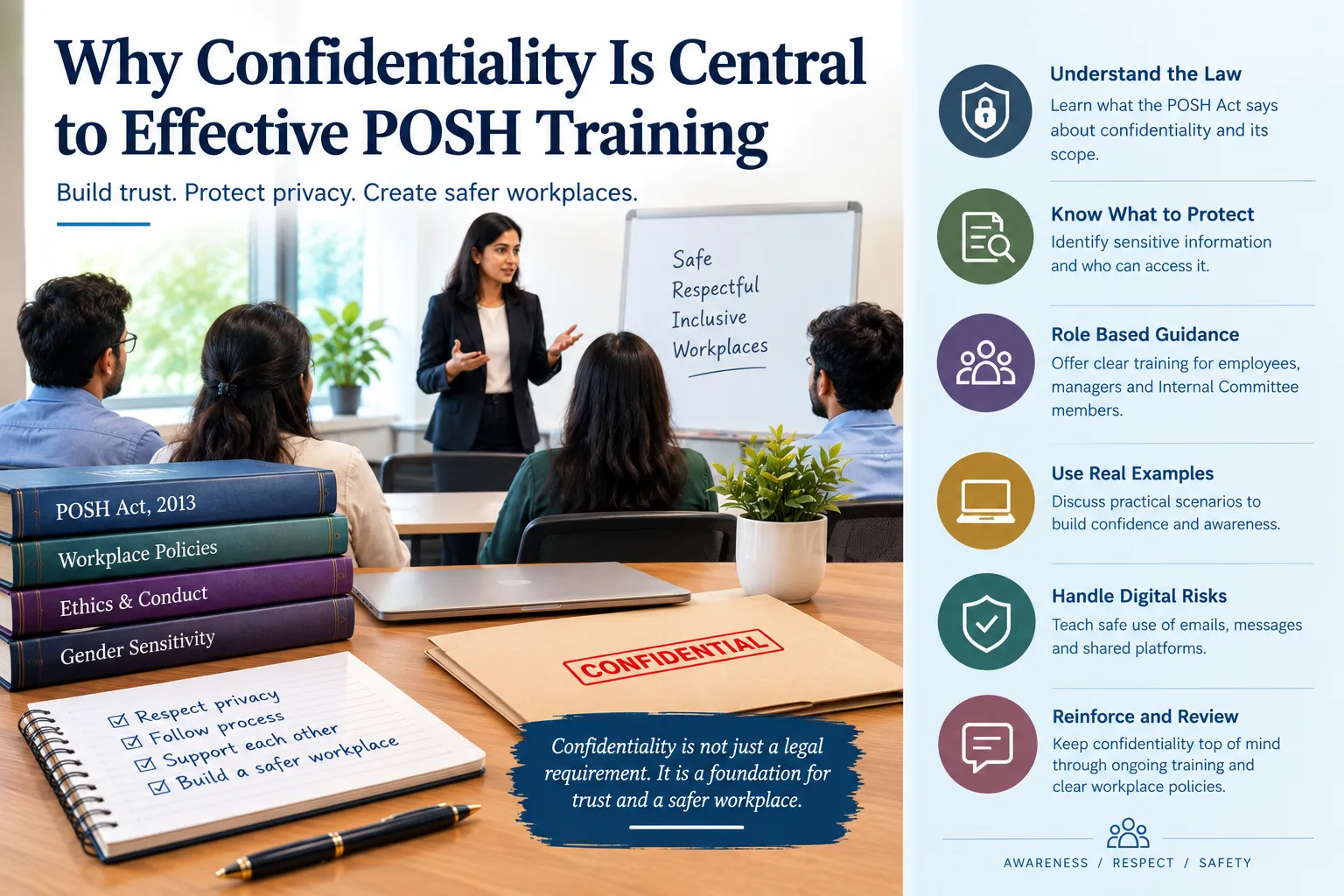

Workplace sexual harassment complaints often involve sensitive personal information, difficult conversations and serious professional consequences. For this reason, confidentiality is not simply a formal instruction under the POSH framework. It is an important part of building trust in the entire complaint and redressal process. Effective POSH training should therefore explain confidentiality in practical terms. Employees should understand what information must be protected, who can access it and why careless disclosure can harm the people involved. Internal Committee members, managers and employees may have different responsibilities, but each plays a role in maintaining a respectful and secure workplace.
Under the Sexual Harassment of Women at Workplace (Prevention, Prohibition and Redressal) Act, 2013, confidentiality has a specific legal basis. Section 16 restricts the publication or communication of the contents of a complaint, the identity and addresses of the aggrieved woman, respondent and witnesses, information concerning conciliation and inquiry proceedings, recommendations of the Internal Committee or Local Committee, and action taken under the Act.
What Does Confidentiality Mean Under POSH?
Confidentiality under POSH goes beyond telling employees not to discuss a complaint casually. A workplace complaint may contain personal experiences, allegations, witness statements, evidence, correspondence and other sensitive information. Sharing such details with people who have no role in the process can create unnecessary exposure and may affect the fairness of the proceedings.
Section 16 specifically protects information connected with complaints and inquiry proceedings from being published, communicated or made known to the public, press or media. Section 17 also provides for consequences where a person entrusted with handling a complaint, inquiry, recommendation or related action contravenes the confidentiality requirement. POSH training should make these legal requirements understandable rather than presenting them as technical provisions employees are expected to memorise.
Why Confidentiality Matters in POSH Training
A person considering whether to report workplace sexual harassment may already be concerned about professional relationships, reputation or workplace treatment. If employees believe a complaint will quickly become the subject of office discussion, they may hesitate to use the formal mechanism. Confidentiality helps create a more responsible environment for reporting concerns.
It also protects respondents and witnesses. A complaint involves an allegation and must be handled through the prescribed process. Unnecessary disclosure can lead to assumptions and workplace gossip before the matter has been properly examined. For the Internal Committee, confidentiality supports orderly handling of information and helps preserve the integrity of the inquiry. This is why confidentiality should be treated as a core learning objective rather than a short statement at the end of a training session.
Confidentiality Should Be Explained Through Real Workplace Situations
Employees often understand confidentiality better when they are given practical examples. For example, imagine an employee learns from a colleague that an Internal Committee has received a complaint. The employee may be tempted to ask others whether they know the person involved. Discussing names, incidents or alleged conduct with colleagues can unnecessarily spread sensitive information.
Another situation may involve a manager receiving information about a complaint. The manager may need to take appropriate organisational steps, but this does not mean the manager should discuss the details with the wider team. Training should explain the difference between taking responsible action and spreading information. The same principle applies to witnesses. A witness may need to participate in an inquiry, but this does not give them a general right to discuss the proceedings with colleagues.
Confidentiality Is Not the Same as Silence
One of the most important points in effective POSH training is understanding the difference between confidentiality and silence. Confidentiality does not mean an employee should ignore sexual harassment or avoid reporting a concern. It does not mean an organisation should discourage a person from using the available complaint mechanism.
Instead, confidentiality means sensitive information should be handled responsibly and only shared through appropriate channels. Employees should know where to raise concerns, whom they can approach and how the Internal Committee functions. At the same time, they should understand why they should not circulate allegations, screenshots, names or personal details among colleagues. The objective is responsible communication, not suppression of legitimate concerns.
The Internal Committee Needs Deeper Confidentiality Training
The Internal Committee has a particularly important role because its members may receive access to highly sensitive information. Committee members may handle complaints, statements, documents, evidence and inquiry related communications. Their training should therefore go beyond a general awareness session. They should understand the confidentiality requirements under Section 16 and the consequences associated with violations. They should also receive practical guidance on handling documents, meetings, emails, digital evidence and communications relating to an ongoing matter.
The Ministry of Women and Child Development lists the POSH Act, the POSH Rules and the official handbook among its resources concerning workplace sexual harassment. The Ministry also identifies awareness regarding women's rights and relevant legislation as an ongoing area of work. Training should help Committee members apply the legal framework carefully in actual workplace situations.
Managers Also Need Confidentiality Awareness
Managers are often among the first people employees approach when they experience or witness inappropriate conduct. A manager may therefore receive information about a sensitive situation without being responsible for conducting the inquiry. Managers need clear guidance on what to do next.
They should know how to respond respectfully, avoid making personal judgments and direct the matter towards the appropriate internal mechanism. They should also understand why discussing the complaint with other managers or team members may be inappropriate. A manager should not turn a sensitive disclosure into a workplace discussion. Effective training can use realistic scenarios to show managers how to respond when an employee approaches them privately. This helps prevent well intentioned but careless communication.
Digital Communication Creates New Confidentiality Risks
Modern workplaces create confidentiality risks beyond face to face conversations. Employees regularly use email, messaging applications, shared drives and workplace collaboration platforms. Sensitive information can be copied, forwarded, downloaded or accidentally shared with the wrong person within seconds. POSH training should therefore address digital conduct.
Employees should understand why complaint related documents should not be forwarded casually. Screenshots should not be circulated among colleagues. Case related discussions should not take place on informal group chats. Organisations should also consider access controls for electronic records. Information should be available to people who genuinely require it for their role in handling the matter.
Confidentiality and Workplace Gossip
Workplace gossip can be especially damaging in harassment related matters. Even without formally sharing documents, employees may discuss who complained, who was accused or what supposedly happened. Such conversations can affect workplace relationships and may place unnecessary pressure on the individuals involved.
Training should address gossip directly rather than assuming employees will automatically understand its risks. For example, a trainer can ask employees how they should respond when a colleague says, “I heard there is a POSH complaint against someone in our team.” The appropriate response should discourage speculation and redirect the conversation towards responsible channels. Simple scenarios like this can make confidentiality training more memorable.
Employee POSH training Should Include Confidentiality as a Core Topic
Confidentiality should not be treated as a separate legal concept understood only by the Internal Committee. Employees also need to understand why sensitive information must be handled carefully.
Good training can explain:
• What information may be confidential
• Why identities and complaint details require protection
• How to avoid workplace gossip
• Why screenshots and messages should not be circulated
• How to respond if someone shares confidential information
• When and where workplace concerns should be reported
The aim is not to make employees legal experts. It is to give them enough practical understanding to behave responsibly when sensitive situations arise.
Training Should Explain What Confidentiality Does Not Cover
Overly broad statements can sometimes create confusion. Employees may incorrectly assume they cannot seek help, report concerns or communicate with appropriate authorities simply because a POSH matter is confidential. Training should therefore explain the scope of confidentiality carefully.
The POSH Act itself contains a specific confidentiality framework under Section 16. It also provides an exception allowing information concerning justice secured to a victim to be disseminated where identifying details of the aggrieved woman and witnesses are not disclosed. A good training programme should explain the legal rule without creating unnecessary fear around legitimate reporting or support.
Confidentiality Should Continue Beyond the Training Session
A single annual training session may not be enough to build lasting awareness. Organisations can reinforce confidentiality through workplace policies, Internal Committee guidance, induction programmes and periodic awareness initiatives. Short reminders can also help. For example, organisations can remind employees not to circulate sensitive case information through informal channels.
Internal Committee members may benefit from periodic refresher sessions because their responsibilities can involve complex situations. Confidentiality should become part of the organisation's broader approach to workplace dignity and responsible conduct.
The Role of Trainers in Building Trust
The trainer's approach can influence how employees understand confidentiality. A trainer should avoid sensational examples or unnecessary details about real complaints. Instead, training should focus on principles and realistic workplace scenarios. Employees should feel comfortable asking questions without being encouraged to disclose personal experiences in a group setting.
A good trainer can also explain why confidentiality protects everyone involved. It protects the person who raises a concern, the respondent, witnesses and the integrity of the inquiry process. Organisations may also consider guidance from an anti-harassment training professional when designing practical sessions around reporting, confidentiality, respectful communication and workplace conduct.
Common Mistakes in Confidentiality Training
Several mistakes can reduce the effectiveness of confidentiality awareness. One common mistake is simply reading Section 16 from the Act without explaining its practical meaning. Another is focusing only on employees while giving limited guidance to managers and Internal Committee members.
Some training sessions also overlook digital communication. This can leave employees uncertain about handling emails, screenshots, shared documents and messaging platforms. A further problem is using vague language such as “do not discuss the case” without explaining why, what information is protected and how employees should respond to questions from colleagues. Practical examples make the message clearer.
Creating a Culture of Responsible Communication
Confidentiality works best when it forms part of a wider workplace culture. Employees should know how to raise concerns. Managers should know how to respond. Internal Committee members should understand their responsibilities. Leadership should support a process based on fairness and respect.
When these elements work together, confidentiality becomes more than a legal instruction. It becomes part of responsible workplace behaviour. The Ministry of Women and Child Development continues to provide official information and resources relating to the POSH framework, including the Act, Rules and handbook.
Conclusion
Confidentiality is central to effective POSH training because it affects trust, reporting, workplace relationships and the integrity of the redressal process. Employees should understand why complaint related information requires careful handling. Managers should know how to respond without spreading sensitive details. Internal Committee members require more detailed guidance because of their role in handling complaints and inquiries.
Most importantly, confidentiality should be taught through practical examples rather than presented only as a legal provision.
A well designed POSH training programme helps employees understand both their rights and their responsibilities. When confidentiality becomes part of everyday workplace conduct, organisations are better placed to handle sensitive concerns with care, dignity and procedural responsibility.

































Sign in to leave a comment.