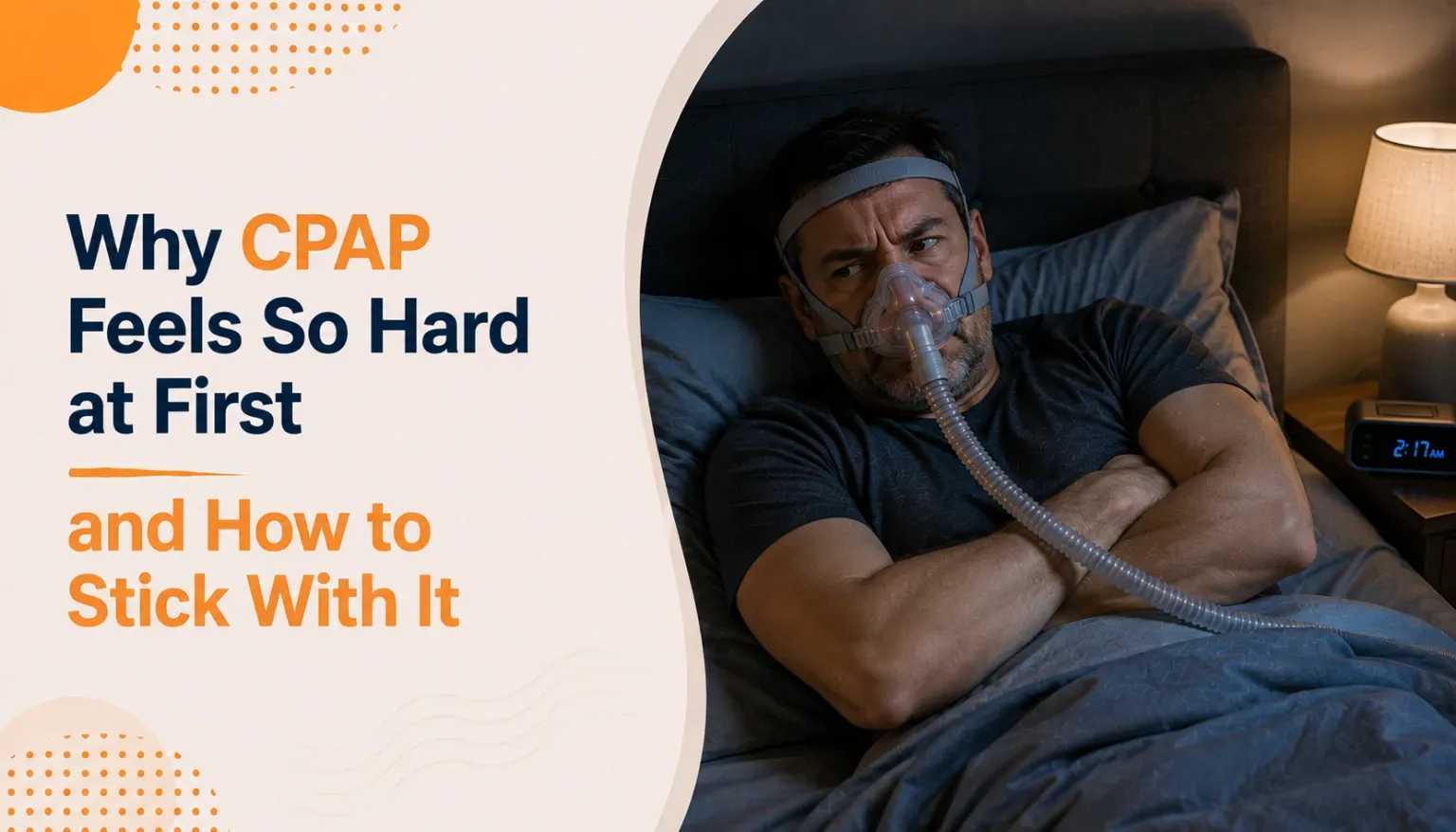

The first night usually goes something like this. You lie down with something strapped to your face, air starts moving before you are ready for it, and you stare at the ceiling doing math on how long until morning. Around two o’clock the mask comes off. Maybe you remember taking it off. Maybe you do not.
Nothing has gone wrong. It is common for sleep to be disrupted during the first few nights on CPAP therapy, and having a hard time getting used to CPAP says nothing about whether the treatment is right for you.
Here is why the adjustment period feels the way it does, and what makes it easier. Most of it is a few specific problems, each with a specific fix.
Why Is CPAP So Hard to Get Used To?
You are asking your body to accept three new things at once. Something touching your face all night. Air arriving with a push behind it instead of on demand. And the routine you have used to fall asleep for forty years, changed.
None of these sensations necessarily means something is wrong. All of it is unfamiliar, and unfamiliar keeps an alert brain awake. CPAP discomfort in the first weeks is a tolerance problem, not a treatment problem, and tolerance is built.
The Mask Feels Uncomfortable
Many CPAP complaints come down to the mask. It is the wrong shape for your face, or it slides when you turn over and blows air into your eye. So you tighten the straps, the one move that reliably makes it worse. Overtightening deforms the cushion, creates new leaks, and leaves marks along your nose by morning.
Masks come in several styles and several sizes within each. A mask that is uncomfortable on night three is not the mask you have to keep.
The Air Pressure Feels Strange
Breathing out against incoming air feels wrong at first. Your lungs are used to doing all the work in both directions, and the sensation fades for most people within a couple of weeks. What helps meanwhile is the ramp feature, which starts the pressure low and builds while you fall asleep, and the exhale relief setting that eases pressure as you breathe out. Ask whether both are on. Feeling the pressure does not mean the pressure is wrong.
You Feel Claustrophobic
For some people the mask is not uncomfortable. It is intolerable, and the reaction arrives before any reasoning does.
I treated a schoolteacher who could not get past it. She tried CPAP twice and threw the machine across the room both times. By the time she came to me she could not open the box without her chest tightening.
We did not start with sleeping. She held the mask against her face for a few minutes while watching television, machine off. Then with the machine running. Then headgear on, sitting up in bed, reading. Nights later, the mask went on for sleep. Six months after that she was sending her friends to my office.
CPAP anxiety responds to exposure in small doses. It rarely responds to willpower at three in the morning.
You Keep Taking the Mask Off
My patients ask me about this one constantly. You wake at four, the mask is on the floor, and you have no memory of taking it off. Your sleeping brain removed an irritation, the same way it pushes off a blanket that got too hot.
The useful question is not how to stop yourself. It is what irritated you. A leak blowing into your eye, a dry throat, a nose that congested when you lay down, a strap digging into your ear. Find the irritant and the removals usually stop.
You Can’t Fall Asleep With CPAP
Sleeping with a CPAP mask is a learned skill, and you cannot learn it lying in the dark willing yourself to sleep.
Wear it for an hour in the evening with the machine running, on the couch, before you bring it to bed. Several evenings of that teaches your nervous system the mask is boring.
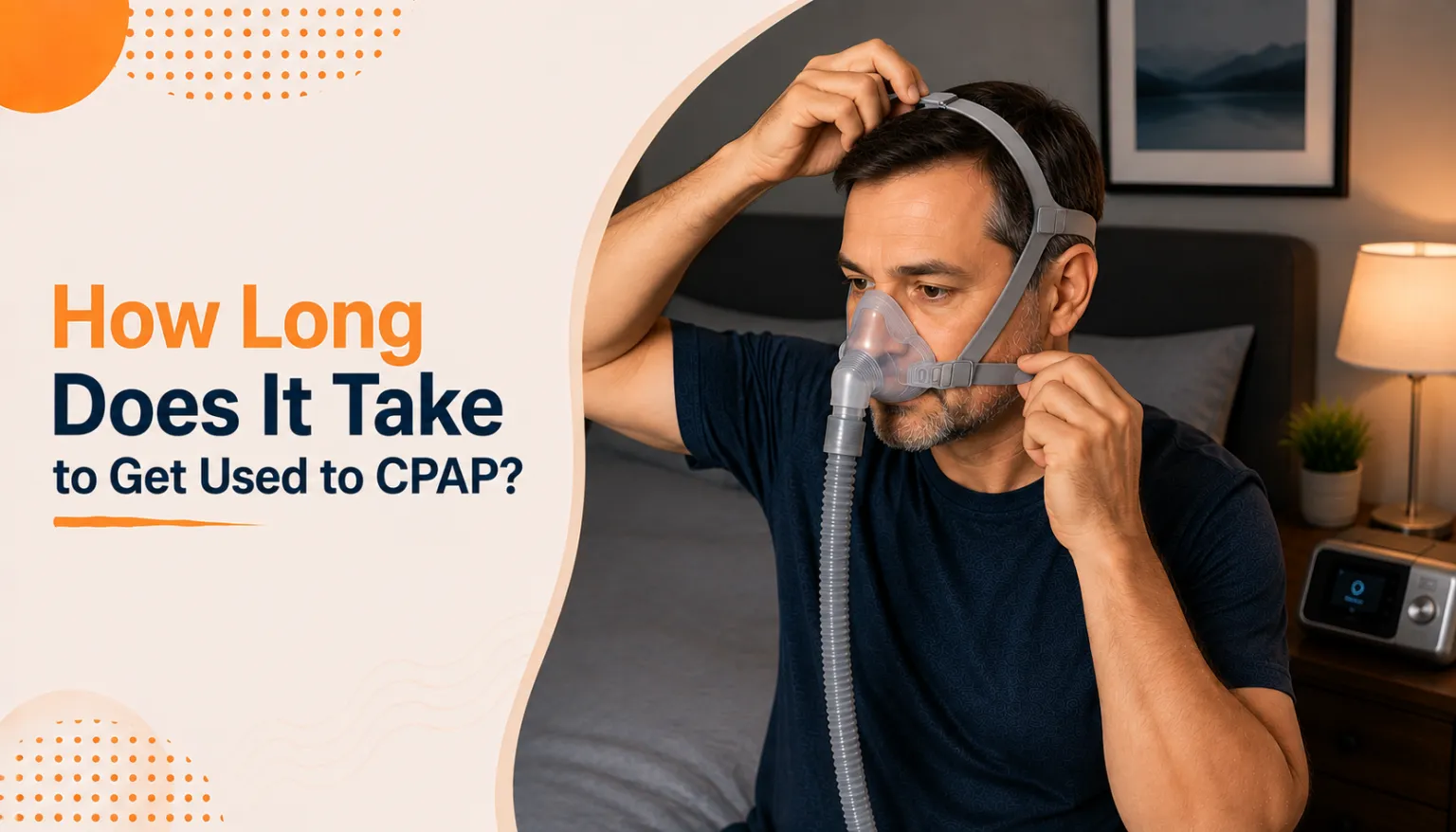
How Long Does It Take to Get Used to CPAP?
There is no universal adjustment timeline. Most people find their footing in the first two to four weeks. Some take a few months, and taking longer means only that something specific is still unsolved.
What moves the timeline: mask fit, whether your nose is clear, whether the pressure suits you, how much anxiety the mask sets off, and how many nights a week you wear it. The last matters most, because consistency matters, because using CPAP regularly gives your body more opportunities to get used to it.
For more on what treatment gives back, download the first chapter of CPAP Is Sexy free at dryatinjpatel.com/chapter1.
How Can You Make CPAP More Comfortable?
Work through these in order. Nearly every case of CPAP discomfort I see is on this list.
Get the mask refitted rather than resized by guesswork, and fit it lying down in the position you sleep in. A seal that is perfect while you sit upright often fails the moment your cheek meets the pillow.
Deal with your nose. Nasal congestion can make CPAP therapy much harder to tolerate. Turn the humidifier up, add a heated hose if the tubing collects water, and ask your sleep physician whether a saline or nasal spray may be appropriate.
Practice awake every evening until the mask is unremarkable, and check your leak numbers rather than going by feel. A leak you sleep through still costs you treatment.
If you use a nasal mask, ask your sleep team about mouth leak specifically. Different approaches may help, and the safest option depends on why you are opening your mouth during sleep. In one randomized trial, adding hypoallergenic mouth tape to a nasal mask increased nightly use by about fifty minutes [1]. In a separate trial, closing the mouth made airflow worse in roughly one in five patients [2]. Both findings are real, which is why mouth taping is something to discuss with your sleep team rather than something to try on your own.
Read More About Why CPAP Feels So Hard at First and How to Stick With It





















Sign in to leave a comment.