

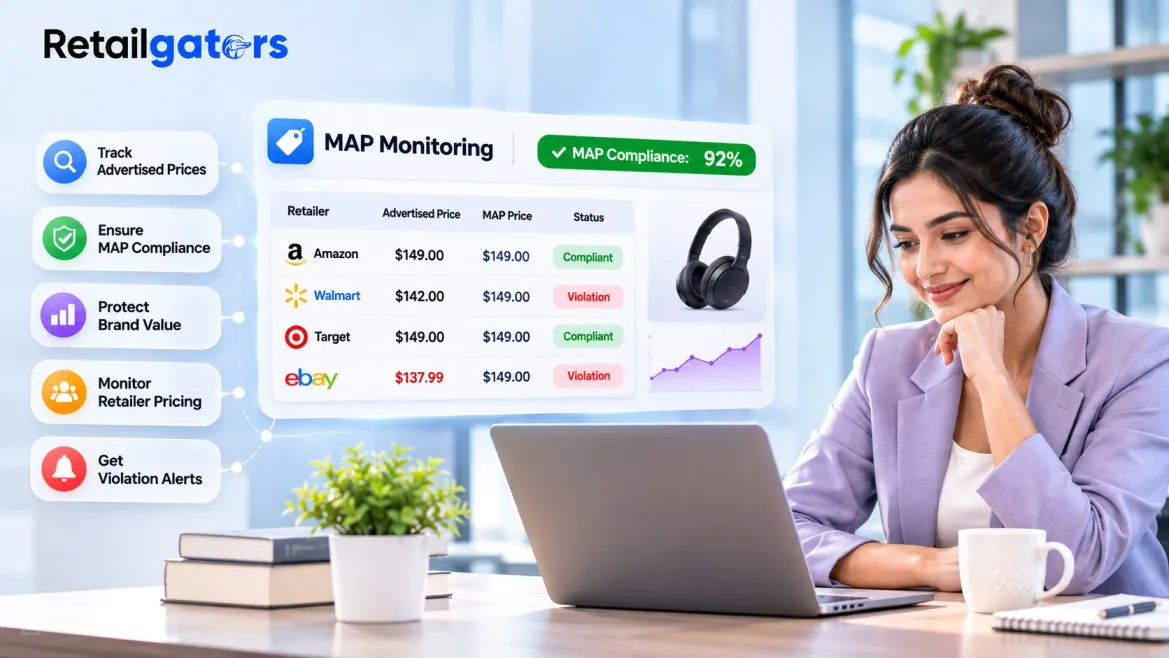
A brand can spend years building a premium position and a consistent retail strategy, only to see that positioning weakened when products repeatedly appear below their intended advertised price. A retailer may run an unauthorized discount, a marketplace seller may advertise an item below the brand's pricing policy, or a temporary promotion may create a pricing gap that other sellers quickly follow. When a brand manages hundreds or thousands of products across retailers, marketplaces, distributors, and regional stores, identifying these changes manually becomes almost impossible.
This is why a MAP Monitoring Service has become an important part of modern channel management. MAP, or Minimum Advertised Price, refers to the minimum price a brand allows retailers or authorized sellers to advertise a product for under its MAP policy. It is different from controlling the final selling price, and the exact rules depend on the brand's policy and applicable commercial and legal considerations. The practical challenge for brands is visibility: they need to know where advertised prices fall below their established thresholds, which products are affected, which sellers are responsible, and whether the issue is isolated or part of a wider pattern.
Effective monitoring is therefore not simply about finding low prices. It is about creating a reliable view of advertised pricing across retail channels so brands can identify patterns, investigate potential policy violations, and protect the consistency of their channel strategy.
What Is MAP Monitoring and Why Does It Matter?
MAP monitoring is the process of regularly checking advertised product prices across retailers, ecommerce websites, marketplaces, and other sales channels against a brand's defined MAP requirements. A useful monitoring program considers more than the headline price. It may also need to account for product variants, pack sizes, promotional messages, coupons, bundles, seller identity, availability, and other conditions that determine whether two listings are genuinely comparable.
The distinction between MAP and ordinary competitor price tracking is important. A retailer can advertise a product at the same price as the brand's MAP while another seller advertises it below MAP. The brand may want to investigate the second listing even if its own direct store has not changed pricing. Similarly, a retailer may display a temporary promotion or coupon that changes the effective advertised price without changing the standard product price. Without detailed monitoring, these situations can be difficult to identify consistently.
For brands with a broad retail network, MAP Monitoring Service can provide a structured way to monitor these pricing signals across multiple channels rather than relying on periodic manual checks.
Why Brands Need MAP Price Monitoring Across Retail Channels
The biggest problem is scale. A brand might have a few strategic products that can be checked manually, but the situation changes quickly when hundreds of SKUs are sold through dozens or hundreds of retail partners. Product listings can change throughout the day, sellers can appear or disappear, and promotions can be active for only a short period. A spreadsheet created last week cannot reliably explain what is happening today.
MAP price monitoring gives pricing and channel teams a historical view of these changes. Instead of asking only, "Which retailer is below MAP right now?", teams can investigate more useful questions: How often does this retailer advertise below MAP? Which products are repeatedly affected? Are violations concentrated in one category? Does the issue occur during promotional periods? Is the same seller appearing across several retailers? These patterns can be much more useful than an isolated price alert.
For example, suppose a consumer electronics brand notices that three retailers are advertising one of its headphones below the approved MAP. If the same product repeatedly appears below MAP across different channels, the brand has a stronger reason to investigate the underlying distribution or seller relationship. On the other hand, if a single listing briefly falls below the threshold and then returns to normal, the appropriate response may be different. Historical monitoring provides the context needed to distinguish between these situations.
MAP Compliance Is More Than Finding a Low Price
MAP compliance requires accurate comparison between a brand's pricing policy and the advertised product information found in the market. That sounds straightforward until real-world ecommerce data is involved.
Retailers may use different product titles, descriptions, SKUs, pack sizes, or product identifiers. One store might list a product by its manufacturer part number while another uses its own internal item number. A multipack can also create confusion: a two-unit bundle should not automatically be compared with a single-unit product simply because the product names look similar.
Promotions introduce another layer of complexity. A listing may show a reduced price, a coupon, a percentage discount, a member-only offer, or a bundle incentive. Depending on the brand's MAP policy, some promotional mechanics may need separate treatment. This is why reliable monitoring requires product matching and pricing rules rather than simply collecting numbers from product pages.
A strong monitoring workflow should therefore establish what counts as a comparable product, which price fields matter, how promotional conditions are treated, and what threshold should trigger an alert. Those rules should reflect the brand's own MAP policy rather than assumptions made by the monitoring system.
What Data Should Brands Track for MAP Monitoring?
Price is the central signal, but it is rarely enough by itself. Brands generally benefit from capturing the surrounding information that explains where the price came from and what was happening on the listing at the same time.
Important data can include the product name, brand, SKU or UPC where available, retailer, seller, advertised price, list price, discount information, promotion details, product availability, product URL, and the date and time the information was observed. Depending on the business requirement, brands may also need seller information, ratings, reviews, fulfillment details, or marketplace-specific identifiers.
Product identification is particularly important. UPC product scraping services can be relevant when brands need product-level data organized around UPCs or other identifiers for more consistent comparison. When the same product appears under different titles across retailers, a stable identifier can make matching and reporting considerably more reliable.
The objective should not be to collect every possible field. It should be to collect the fields that help the brand answer a business question: Which products are below MAP? Where are they appearing? How long has the issue existed? Which sellers are involved? Is the problem isolated or recurring?
How MAP Monitoring Supports Brand Protection
Pricing is closely connected to brand perception. If a premium product is repeatedly advertised at heavily reduced prices, customers may begin to question its normal value or wait for discounts instead of purchasing at the intended price. At the same time, retailers that follow a brand's pricing policy may feel disadvantaged if other sellers consistently advertise below the agreed threshold.
This is where brand protection extends beyond counterfeit detection or unauthorized listings. Maintaining pricing consistency can also be part of protecting channel relationships and the commercial position of a product. Monitoring gives brands evidence they can use when reviewing channel behavior, investigating potential policy issues, or discussing pricing practices with retail partners.
The data can also help identify distribution problems. If the same seller appears with unusually low advertised prices across several retailers, the brand may want to investigate how the inventory is entering the channel. Monitoring cannot by itself determine the cause, but it can reveal patterns that deserve attention.
MAP Monitoring vs. Retailer Price Monitoring
MAP monitoring and broader retailer price monitoring are related, but they serve different purposes. Retailer price monitoring may focus on understanding competitor pricing, promotional activity, assortment changes, and market positioning. MAP monitoring is more specifically concerned with comparing advertised prices against a brand's defined pricing policy.
The two approaches can work together. A brand may use retailer monitoring to understand the overall market while using MAP monitoring to identify potential pricing-policy issues. For example, if several retailers lower prices during a seasonal event, broader market monitoring can show how widespread the change is, while MAP monitoring can identify which listings may require further review.
This broader view is especially useful for brands operating across multiple channels. A pricing team can see not only whether a product is below MAP, but also how its advertised price compares with other retailers, whether competitors are promoting similar products, and whether availability is changing at the same time.
How Automated MAP Price Monitoring Works
A scalable MAP workflow normally begins with defining the products, retailers, marketplaces, and pricing rules that need to be monitored. Relevant product data is then collected on a scheduled basis, standardized, matched against the correct products, and evaluated against the brand's MAP requirements.
The next stage is historical storage. Instead of replacing yesterday's price with today's price, a useful system keeps a record of changes so teams can understand when an issue started and how long it continued. Alerts or reports can then be generated when a monitored product crosses a defined threshold.
For businesses that need frequent updates, live price crawling services can support workflows where current retail pricing needs to be monitored at a higher frequency. The appropriate monitoring interval depends on the product category, number of retailers, price volatility, and the brand's operational requirements.
The same principle applies to the underlying infrastructure. When monitoring expands across large product catalogs and many retail domains, cloud-based web scraping can provide an approach for managing data collection at scale without treating every monitoring task as a separate manual process.
Turning MAP Monitoring Data Into Business Decisions
The real value of MAP monitoring comes after a potential violation is identified. A pricing alert should not automatically be treated as proof of intentional non-compliance. The team may first need to confirm the product match, verify the advertised price, check promotional conditions, identify the seller, and review the relevant MAP policy.
Once verified, historical data can help prioritize the response. A one-time issue involving a single product may require a different conversation from a recurring pattern involving dozens of products and multiple sellers.
Brands can also use aggregated monitoring data to identify broader channel trends. If MAP issues repeatedly occur within one category, the business may need to examine distributor relationships, promotional practices, product launches, or channel-specific policies. Monitoring therefore becomes more valuable when it supports both individual investigation and strategic channel analysis.
Why Product and Retail Data Infrastructure Matters
MAP monitoring depends on reliable product data. If a monitoring system cannot distinguish between different pack sizes, variants, or product identifiers, price comparisons may produce false alerts or miss genuine issues.
For brands monitoring broad retail networks, retail data scraping service can support wider retail intelligence workflows where pricing is analyzed alongside product and market information. This can be particularly useful when MAP monitoring is one component of a larger competitive intelligence program.
Wholesale relationships can also influence retail pricing visibility. When brands work with distributors or wholesale channels, wholesale data scraping can be relevant for gathering structured information from wholesale sources as part of a broader channel-data strategy. The exact data requirements depend on how the brand manages its distribution network.
What Should Brands Look for in a MAP Monitoring Service?
Choosing a MAP Monitoring Service should start with business requirements rather than simply asking how many websites can be monitored. Brands should evaluate whether the solution can cover their priority retailers, identify products accurately, capture the pricing fields they need, and maintain historical records.
Monitoring frequency is another important consideration. A brand with relatively stable product pricing may not need the same monitoring schedule as a consumer electronics company operating in a highly competitive category. Product matching, seller identification, promotion handling, alert configuration, data delivery, scalability, and reporting should also be considered.
Brands should also ask how potential violations are presented. A useful system should make it easier for a team member to understand the product, retailer, seller, advertised price, expected MAP, observation time, and supporting listing information. Good reporting reduces the time between identifying an issue and deciding what to do about it.
How RetailGators Can Support MAP Monitoring
RetailGators provides ecommerce data solutions that can support brands looking to monitor retail pricing and product information across online channels. For a MAP monitoring workflow, the focus should be on building a structured process around the brand's products, target retailers, pricing rules, monitoring frequency, and reporting requirements.
A practical setup can combine product identification, retail data collection, price tracking, historical records, and reporting so that pricing teams have a consistent source of information for channel review. The exact workflow should be designed around the brand's catalog and retail environment rather than using the same monitoring model for every business.
For brands that are already tracking prices manually or receiving occasional reports, the next step is often to determine which products and retailers require continuous visibility and which data points are actually needed to support channel decisions.
Final Takeaway
A MAP Monitoring Service is valuable because pricing problems rarely exist in isolation. A below-MAP listing may be the visible symptom of a broader issue involving a seller, distributor, promotion, product match, or retail channel. Without historical and product-level context, brands may see the price but miss the reason behind it.
Effective MAP price monitoring gives brands a structured way to identify pricing changes, investigate potential MAP compliance issues, and understand how advertised prices behave across retail channels. Combined with broader retailer price monitoring, product intelligence, and brand protection efforts, it can give pricing and channel teams a clearer view of what is happening in the market.
For brands managing large catalogs and multiple retail partners, the goal is not to monitor every possible data point. It is to build a dependable process that identifies meaningful pricing changes early, preserves the evidence needed for review, and turns marketplace data into practical channel decisions.
FAQs
What is a MAP Monitoring Service?
A MAP Monitoring Service tracks advertised product prices across retailers, marketplaces, and ecommerce websites and compares those prices with a brand's Minimum Advertised Price policy. It can help teams identify potential pricing-policy issues and maintain historical records for review.
Why is MAP price monitoring important for brands?
MAP price monitoring gives brands visibility into advertised pricing across multiple retail channels. It helps identify recurring pricing patterns, potential violations, and channel issues that may be difficult to discover through occasional manual checks.
What is the difference between MAP and selling price?
MAP generally refers to the minimum price a retailer is permitted to advertise under a brand's MAP policy. It does not necessarily mean the retailer is prohibited from selling the product below that price. The exact terms depend on the brand's policy and applicable legal and commercial considerations.
How does MAP monitoring improve brand protection?
MAP monitoring can support brand protection by helping brands identify unusual advertised pricing, recurring below-MAP listings, and seller patterns that may require investigation. It provides visibility and historical evidence but does not by itself establish why a pricing issue occurred.
What data is needed for MAP compliance monitoring?
Useful data can include product identifiers, product names, retailer and seller information, advertised price, list price, discounts, promotions, availability, product URLs, and observation timestamps. The required fields depend on the brand's MAP policy and monitoring objectives.
Can MAP monitoring be automated across multiple retailers?
Yes. Automated data collection can monitor products across multiple ecommerce websites and marketplaces on a scheduled basis. The workflow can standardize product information, compare prices against MAP rules, store historical observations, and generate alerts or reports for potential issues.























Sign in to leave a comment.