

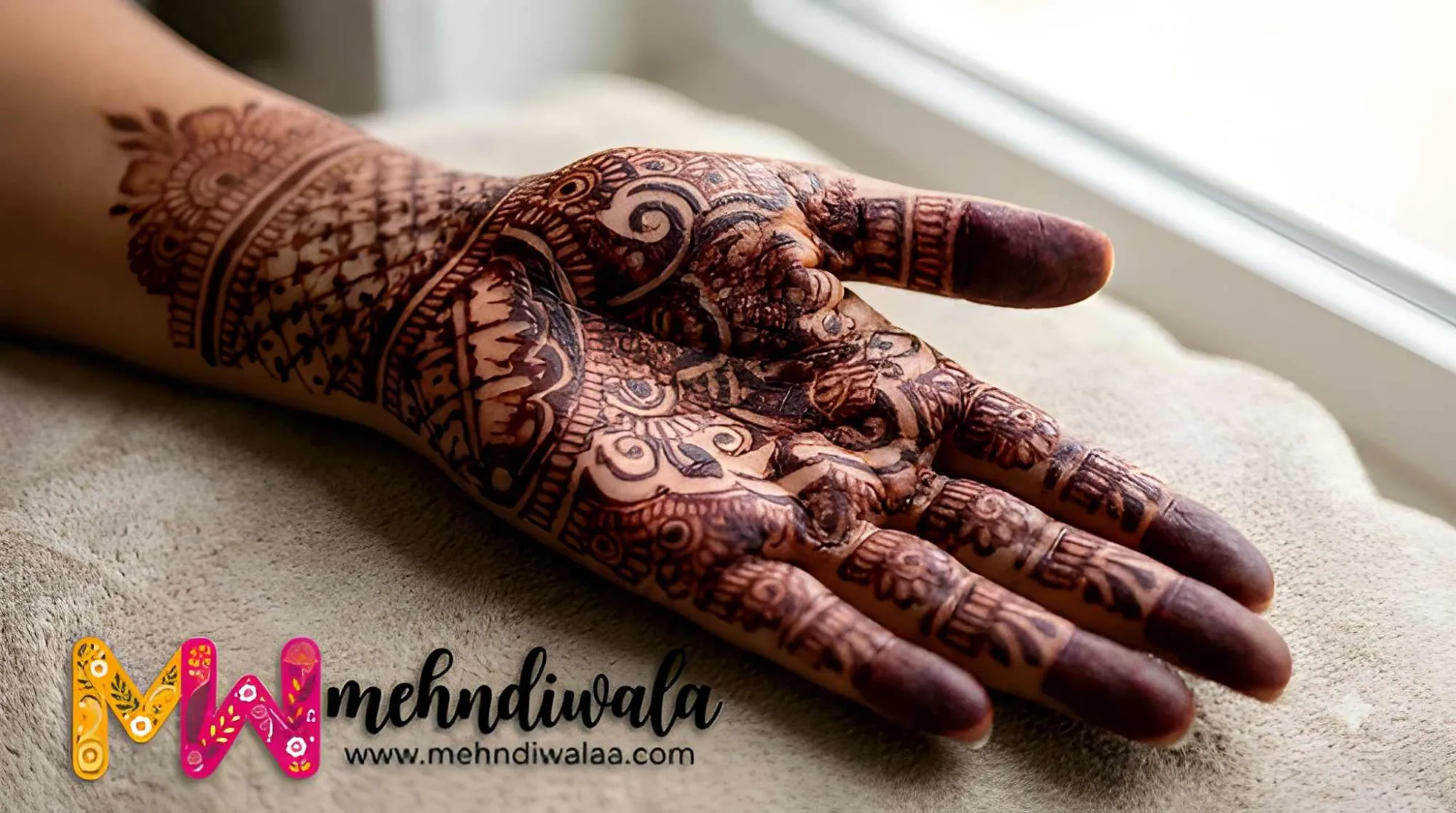
When I see a mehndi design I often see details that seem to pop out at me when I see a design in real life. Those same details may not have been there as they appear in the two-dimensional view of a photo. For example, in one photo the lines of the mehndi design could look sharper. Then in another photo the color of the mehndi design could look darker. Also a mehndi design that looks light and delicate in real life could appear too thick in the photo.
This does not mean that the mehndi design looks too different in real life, however. What that means is that the contrast, detail, skin texture, and balance captured by photography can make it look different.
This especially leads to confusion for brides when they look at photos on an Instagram feed, a Pinterest board, or even the portfolio of the mehndi artist before an appointment. I always explain that the camera, lighting, editing and timing all play a part in how the mehndi design is portrayed.
So why does a mehndi design sometimes seem to look different than in real life?
Why Mehndi Looks Different In Pictures
When viewing the mehndi design, there are 4 main aspects to consider: lighting, camera, timing, and angle of the hand/hands. A mehndi design is basically sitting on the surface of the skin. While taking a picture, the camera system captures mehndi by interpreting light and contrast. For this reason alone, the same design can look darker, softer, sharper, and more intricate at the same time.
This is especially true with mehndi design as most mehndi designs consist of lines and intricate details.
How Lighting Alters The Appearance Of Mehndi
In my experience, lighting is just one of the reasons I notice the differences between a mehndi design I am looking at and the same looking up mehndi in the photograph. While looking at a mehndi design in person in daylight, I seem to be looking at the right skin tone and have perfect mehndi stain when the mehndi is applied.
When it comes to indoor lighting, the mehndi can look cool or warm based on the type of bulb used.
Yellow lighting can give an orangish hue to the mehndi design, while cooler lights can give warmth to the stain.
Direct lighting can also cast highlights and shadows throughout the hand. While this can create a very dramatic or even beautiful photo, it definitely has an impact on my perception of the depth and contrast of the mehndi art.
This is one of the main reasons I prefer to look at the mehndi art, with a photo that has been taken under lighting. I will not judge the mehndi art based on photos taken while in the absence of lighting.
Does Camera Exposure Affect Mehndi Color?
Yes. Camera exposure has a very prominent and profound impact on how the mehndi art comes across on photographs.
Moreover, when the photograph is bright, the skin appears to be lighter. Additionally, the contrast between the mehndi art and skin shall appear softer. Similarly, when the photograph is darker, the mehndi art may appear denser and bolder.
Most modern smartphones will auto expose based on the scenario. When having a close-up image of a decorated hand, the image quality can be very different to a shot taken on the wedding day.
This is why two images of the same mehndi design can look so different.
Why Fresh Henna is Different Than in a Picture Taken Later
The timing is another thing to consider. Fresh henna looks different from the created stain of the henna design. When I look at it after putting it on, I can see a raised henna design that is on the top of the skin. In contrast, after the henna gets removed, the color of the henna design is built up slowly over time.
You cannot compare a picture of henna while it's on the hand with a picture after it is developed and had a stain.
I always think about when the picture was taken whenever I think about the picture I am going to use as a reference for the henna design.
A portfolio picture that showcases the stain tells me something different compared to the picture that has the henna paste.
Can Hand Position Change Perspective of Mehndi?
Depending on the hand placement, the same henna design can look very different compared to the following options. A mehndi design can look different when the hand is:
flat
bent
Fingers apart
Fingers together
Rotated towards the camera
Photographed from above
In my experience taking pictures of mehndi design holding the hands in positions can make parts of the design stand out or disappear. Curving the palm for example can make the lines blend together and separating the fingers can give the mehndi design room to be seen.
This is especially important for the mehndi design because the mehndi design goes through the fingers, palm, wrist and sometimes forearm.
Why Does Close-Up Photography Capture More Details?
Zooming in. When I am able to touch a mehndi design I usually see the hand as one piece. However in up images the camera is focused on one part of the mehndi design.
Close-up photographs can also show details such, as dots, lines, floral patterns, paisleys and tiny shapes in more detail.
If there are any mistakes or flaws mehndi can also reveal them that are not visible when looking at the mehndi.
Does Flash Change How Mehndi Looks?
Flash can change both the skin and mehndi. A stronger flash can make spotting occur on the skin. It can increase the contrast between the mehndi and the skin, and possibly, some details in the picture can look finer, depending on the type of camera and the light. The mehndi’s richness and brownish-red color, might also look different.
Flash photography creates an ambiance so different from natural light. In fact, whenever I see two mehndi pictures I always check whether one of them was shot in flash or other was not.
What Makes Mehndi Pictures on Instagram or Pinterest Look Different?
I see brides saving pictures to show me what they liked about a particular style or design. It gives me a hint to know what kind of style they wish to replicate with that design. I don’t consider all the photos on the internet, that I see brides saved, as medically accurate to what mehndi may look like.
Photos online may look different due to:
Lightings
Camera quality
Exposure
balance
Editing
Cropping
Contrast
Image compression
The original mehndi design may be lovely but the photograph reflects its processing. Because of this, I'm more inclined to view images of a design or artist than a single photo that has undergone extensive editing.
Can Editing Change the Look of Mehndi?
Yes, photo editing can change the appearance of a mehndi design. Brightness, contrast, saturation, warmth and sharpness adjustments can transform the way the picture looks. I don't expect that every photo altered is not representational. Many photo editors alter wedding photography based on some style, of their choosing, captured or altered.
When I'm looking at mehndi references, I remember that the image represents both the mehndi and the production of the image.
Keeping that in mind makes sense of what I am looking at.
Why Do Mehndi Drawings Look Darker in Photographs Sometimes?
Darkness in an image does not mean the stain is dark, in real life. The contrast with the photograph can make the mehndi really contrast with the skin.
Thus, I will first analyze the images to see what commonalities are shown before I establish what the actual stain color may look like.
One of the photographs captures a one-time moment whereas several photographs tell me about the mehndi's appearance under various conditions.
How do I asses a mehndi design based on a photograph?
I will see:
| What I See | Why it Matters |
|------------|--------------------|
| whole composition | Shows how the design flows across the hand |
| line quality | Gives me an understanding of the stylist drawing style |
| motifs | Identifies whether the artist included each of the desired motifs |
| space | Assists distinct how dense or open the design appears to be |
| details on fingers | Important for bridal works |
| coverage on palm | Shows the design structure |
| transition on wrist | Assists understand how the design is attached |
| various photographs | Gives global perspective more than any one edited image |
| cross-lighting | Diminishes dependence of one condition |
The previous method gives clearer idea of the initial design language.
Why Should I Look At Than One Mehndi Photo?
I might think a single Mehndi Photo looks good. I prefer to look at Mehndi Photos so I can see the context.
When I look at Mehndi Photos I enjoy seeing angles variations in hand position and where possible Mehndi Photos taken under different lighting. For work I think about whether the artist keeps lines and balances the overall composition of the design.
This helps me separate the design from one Mehndi Photos interpretation.
How Can I Use Mehndi Pictures as Reference Pics without Copying the Exact Look?
I often treat a reference Mehndi Picture as a suggestion than an expectation. For example I may appreciate the density of one Mehndi Design then the finger positioning from another Mehndi Photo and the directionality of a Mehndi Photo.
Of focusing on someone color choices I simply identify the components of the Mehndi Design that I enjoy:
- Dense or open composition
- Floral motifs
- Paisley patterns
- Flow
- Fine line detailing
- Other traditional motifs
- Symmetrical or asymmetrical layout
This results in a clearer discussion, about the way I want the Mehndi Design to look.
What Should I Talk About With a Mehndi Artist, About Reference Photos?
When I make reference photos I do not want to state that I desire this picture, this is why I want to focus on the pattern and not the photo itself.
But I will refer to the elements that I find most appealing:
I am drawn to the arrangement.
I am attracted to the detail.
I like the spacing.
I want it to flow across the hand.
Mehndi Artist gets a feeling about the direction. Is given freedom to adapt the design to the shape, function and appearance of the hand.
How Can Mehndi Wala Help me Find a Mehndi Artist, For My Preferred Style?
When I use Mehndi Wala I can search through all Mehndi Artist profiles. I can see the type of work that Mehndi Artist has done before I speak about what I want.
Of basing my decision on one picture I can see Mehndi Artist portfolio.
This will help me see the styles and approaches that Mehndi Artist uses.
From there I can find a Mehndi Artist that I feel matches the look and general feel.
I can always communicate with the artist the elements that I prefer, but I can also review all of the other details that are associated with the design before securing my booking. In this way the reference-image process feels far more relevant as I am looking at the artist's own work and understanding that photographs can alter the look of the mehndi.
Frequently Asked Questions (FAQs)
1. Why does mehndi appear darker photos?
Due to lighting, set up, contrast and editing the mehndi may appear darker than what is present in real life.
2. Does lighting come into play with mehndi photography?
Yes. Different types of light, in particular in doors can alter the way the color of the mehndi and contrast looks.
3. Why does fresh mehndi look different from the stain?
Fresh paste will be present on the skin therefore any pictures taken with the paste on will not look the same as the stain once the paste has been removed.
4. Do camera perceptions change the look of henna?
Yes. Even just the adjustments of the hand and angles of the camera can transform the design in terms of distant, coverage and flow.
5. How much one should trust the henna reference photo?
I like to look at photos since either picture can be taken in a certain light, or edited, or could be affected by a camera setting.
6. Are edited photos altering henna color as well?
Yes. The brightness, contrast, warmth and color can alter how the henna looks in the image.
Summary
When I analyze the henna in life or photographs, I understand that I am observing experiences. The way rose gold reflects, or the camera’s setting, position of hand, angle, moment in the time of exposure, and post-processing may impact how the image reflects. I still think of a photo as an idea of the artist and their style. I don’t look at the color or special dramatic ability to see beauty. I instead look at how the design is assembled, how it looks, quality of lines, patterns, the contrast between line thickness and detailed work, and how the quality of work remains comparable, across the multiple pictures.





















Sign in to leave a comment.