Why Enterprises Are Investing in SQL ETL Automation for Scalable Growth

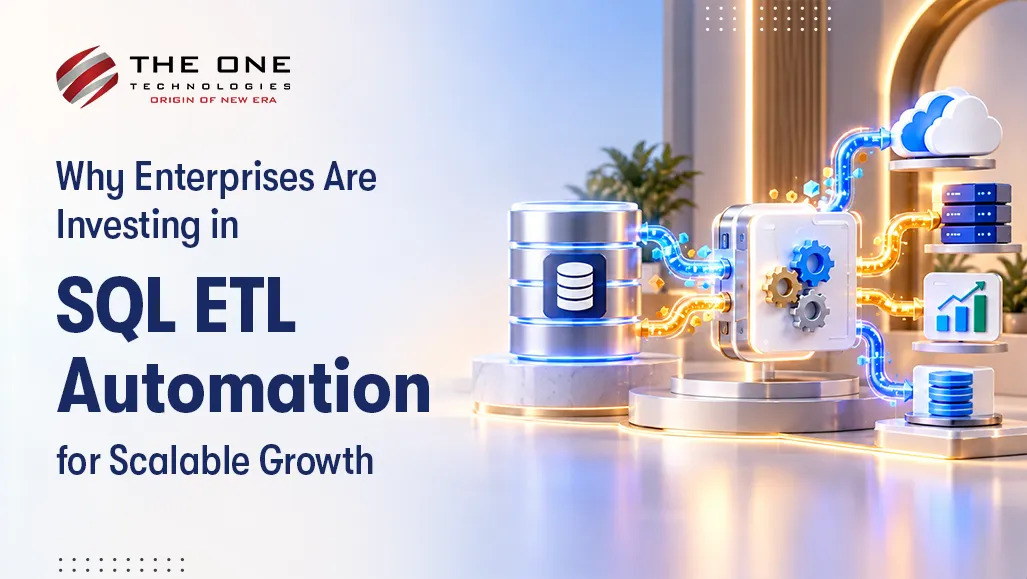
Enterprise data rarely sits in one place. Customer records live in a CRM. Financial data lives in a database. Operational data moves through business applications. Reporting data lands in a cloud warehouse. Each system is doing its job, and none of them are talking to each other without someone in the middle making it happen.
That middle work - extracting data from source systems, transforming it into a consistent and usable format, and loading it somewhere analytics can reach - is the work that SQL ETL automation is designed to handle without constant human intervention. The larger an organization grows, the more that middle work accumulates, and the less sustainable it becomes to keep doing it by hand.
For enterprises that are serious about building a data environment that scales with the business rather than lagging behind it, automated ETL pipelines are no longer a technical upgrade. They are an operational requirement.
What Manual ETL Actually Costs
The cost of manual data preparation is easy to underestimate because it distributes across a lot of different people and a lot of different hours.
An analyst exports a file from the CRM on Monday morning. A data engineer runs a series of SQL queries to clean and join it with financial records. Someone else checks the output against the previous week’s numbers. The report lands on Tuesday afternoon - almost two days after the underlying data was available.
Multiply that sequence across multiple reporting needs, multiple departments, and multiple data sources, and the hours add up quickly. The real cost is not just the time spent preparing data. It is the decisions being made on information that is always slightly out of date, always slightly inconsistent, and always dependent on someone remembering to run the right query at the right time.
Data pipeline automation removes the dependency. Once a pipeline is built and validated, it runs on a defined schedule - or in response to a business event - without anyone having to initiate it manually. The data is where it needs to be before anyone has to ask for it.
Why SQL Remains Central to Enterprise ETL
SQL’s role in enterprise data work has not diminished as the tooling around it has grown more sophisticated. If anything, the shift toward cloud-based data warehouses has made SQL more central to how transformation work gets done.
Traditional ETL transformed data before loading it into the target system. The modern ELT pattern inverts that sequence - raw data is loaded into the cloud warehouse first, and SQL transformations run inside the warehouse using its own compute resources. Platforms like Snowflake, BigQuery, and Redshift are built to handle large-scale SQL transformation efficiently, which means the processing power scales with the data volume rather than being constrained by a fixed transformation layer sitting outside the warehouse.
For enterprise data integration, this matters in a practical way. When reporting requirements change - a new metric is needed, a business rule needs updating, a new data source needs to be incorporated - the SQL transformation layer can be adjusted without redesigning the pipeline from the ground up. The architecture is flexible by design, rather than rigid by necessity.
What Automated Pipelines Actually Handle
SQL queries are the transformation logic. They are not the entire pipeline. A production ETL process involves considerably more than a set of queries, and the additional components are where most of the operational value of automation sits.
Scheduling and dependency management ensure that transformations run in the right order and at the right time. If a downstream transformation depends on an upstream one completing successfully, the orchestration layer enforces that dependency automatically rather than relying on someone monitoring the sequence manually.
Error handling and retries manage the inevitable failures that occur in any production data system. A source API goes down. A schema changes unexpectedly. A batch job times out. Automated pipelines catch these events, log them, trigger alerts, and in many cases retry the failed step without human intervention. The team finds out something went wrong and is already looking at a resolved state rather than discovering a gap in the data after the fact.
Monitoring and validation catch quality issues before they reach downstream consumers. Automated checks for missing records, unexpected nulls, value ranges outside normal bounds, and schema changes flag problems at the point of ingestion rather than after a report has already gone out with bad numbers.
These components together are what make SQL ETL automation a production-grade operation rather than a scheduled script. The query handles the transformation. The pipeline handles everything around it.
Scalability Is the Compounding Benefit
The case for data pipeline automation is most obvious at the point where manual processes visibly break down - when the data volume exceeds what a team can process manually in the available time, or when the number of reporting requirements outpaces the number of people available to meet them.
But the compounding benefit shows up before that breaking point, and it is worth accounting for in the investment calculation.
Incremental processing is one example. Instead of reprocessing a full dataset every time the pipeline runs, an incremental approach extracts only new or changed records. As the total dataset grows, the processing time and compute cost of each run stay roughly constant rather than scaling proportionally with the data volume. A pipeline that takes five minutes to run on day one takes five minutes to run two years later, even if the underlying dataset has grown by an order of magnitude.
Reusability is another. A well-structured pipeline built for one reporting use case can be extended to serve additional use cases without starting from scratch. The extraction layer, the connection management, the error handling, and the scheduling infrastructure are already in place. Adding a new transformation and output target is a fraction of the work that building the first pipeline required.
For enterprises planning data infrastructure against a multi-year growth curve, these compounding advantages change the return-on-investment calculation significantly compared with maintaining and expanding a manual data preparation process.
The Foundation That Analytics Depends On
Reliable analytics requires reliable data. That is not a controversial statement, but it is one that is frequently underweighted when organizations invest in analytics tooling while leaving the data preparation layer manual and inconsistent.
A dashboard built on top of data that arrives late, arrives inconsistently, or arrives with quality issues that vary from week to week is a dashboard that erodes trust. Stakeholders start double-checking the numbers against their own exports. Analysts spend time defending the data rather than analyzing it. The investment in the analytics layer produces a fraction of the return it should because the foundation underneath it is not dependable.
Enterprise data integration done properly - with automated pipelines, validated transformations, and monitored execution - changes that dynamic. The data is consistent. It arrives on schedule. When something is wrong, the team knows before anyone else does. The analytics layer can be trusted because the layer beneath it has been built to be trustworthy.
Getting the Implementation Right
The technical components of an automated ETL pipeline - the SQL transformations, the orchestration layer, the error handling, the monitoring - are well-understood. The harder part is designing a pipeline architecture that fits the specific combination of source systems, data volumes, transformation requirements, and reporting cadences that an organization actually has.
Getting that design right at the start avoids the rework that comes from a pipeline built for current requirements that cannot accommodate the next 18 months of growth. Custom software development for data pipeline implementation means the architecture is designed for the specific environment rather than adapted from a generic template that fits imperfectly.
The One Technologies builds automated SQL ETL and data pipeline automation solutions for enterprises working across multiple data sources and cloud platforms. If your organization is dealing with growing data volumes, inconsistent reporting, or a manual data preparation process that is consuming more time than it should, the starting point is a conversation about what the pipeline architecture needs to support.







Sign in to leave a comment.