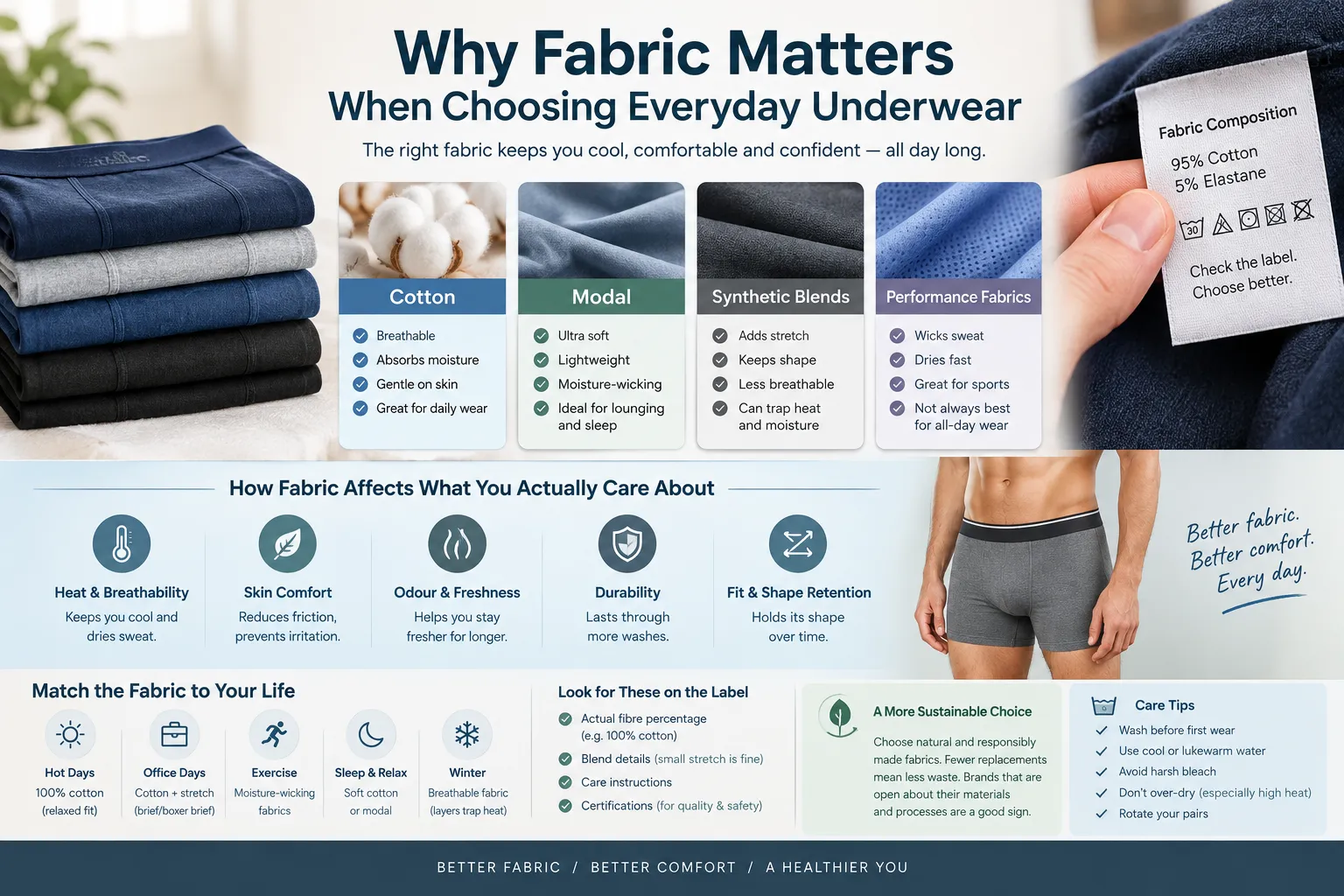

Ask ten men what they look for when buying underwear and most will say size, then price, then maybe colour. Fabric rarely comes up. Yet if you ask those same men what they hate about their underwear, the complaints are almost all fabric complaints: it's itchy, it's sticky, it's too warm, it's gone rough after a few washes.
I learned this the slow way. For years I bought whatever came in a bright pack at a decent price. The prints were fine, the sizes were fine, and by three in the afternoon I was uncomfortable and couldn't work out why. It was only when a friend handed me a pair of plain cotton boxers that the penny dropped. Same size, same style, completely different day.
So let's talk about fabric properly, because it's the part of men's underwear that does the most work.
Why Underwear Is a Different Kind of Clothing
Most of what you wear has a job in public. Your shirt has to look good, your trousers have to fit well, and your shoes have to survive the pavement. Underwear has no audience. Its only job is to feel good against your skin for as many hours as you're awake, and sometimes while you sleep as well.
That skin is also some of the most sensitive on your body. It deals with heat, sweat, friction, and very little airflow. Any fabric that traps moisture, rubs, or irritates will make itself known quickly. That's why the same style can feel great in one material and miserable in another.
The Main Fabrics, and What Each One Does
Cotton
There's a reason cotton has been the standard for so long. It's a natural fibre that lets air pass through, absorbs moisture rather than trapping it against the skin, and is generally gentle on sensitive areas. It's also easy to wash, and it doesn't need any special treatment.
For daily wear in a warm country, men cotton underwear is the safest starting point. One thing to watch: the word "cotton" on a pack doesn't always mean 100% cotton. Some products are blends, and the extra fibres change how the fabric feels and performs. Read the fabric composition on the label, not just the front of the box.
Modal
Modal is made from beech tree pulp and processed into a very fine, smooth fibre. Its main appeal is softness. It has a slightly silky feel, drapes nicely against the body, and tends to feel lighter than standard cotton. It also handles moisture well. People often choose modal boxershorts for evenings, lounging, and sleep, when the priority is a soft feel rather than heavy-duty daily wear.
Synthetic blends
Polyester, nylon, and similar fibres aren't villains. In small amounts, a stretch fibre like elastane helps a waistband or fitted cut keep its shape, and that's genuinely useful. The trouble starts when a pair is mostly synthetic. Those fabrics tend to hold heat and moisture close to the skin, which is not what you want on a humid day or during a long commute.
Specialty and performance fabrics
Some fabrics are engineered for sport, designed to pull sweat away quickly or dry fast. They can be great for the gym or running, though not always the most comfortable choice for a full day at a desk. It's worth matching the fabric to the situation rather than assuming the technical option is always better.
How Fabric Affects the Things You Actually Care About
Heat and breathability
In Pakistan, this is the big one. Summers are long, humid in the south and brutally hot in the plains. A breathable fabric lets air circulate and keeps things from feeling damp. A fabric that traps heat will leave you sweaty and irritable by midday. If you only change one thing about your underwear, changing the fabric to a breathable one will likely make the biggest difference.
Skin comfort
Rough fabric rubs. Damp fabric irritates. Both can lead to chafing, redness, and general discomfort, especially on the inner thighs and around the waistband. Soft, smooth fabrics in a good fit reduce friction, which is why fabric and fit work together. If you struggle with chafing, a longer-cut style like a long leg boxer brief in breathable cotton is often the fix.
Odour and freshness
Fabrics that trap moisture also tend to hold onto smells. Absorbent, breathable fabrics don't remove the need to change daily, but they do help you stay fresher through the day.
Durability
Better fabric survives more washes. A well-made cotton or modal pair keeps its softness and shape far longer than a thin, cheap blend that pills and stretches out. That matters for your wallet, too. A pair that lasts eighteen months costs less per wear than one you replace every four.
Fit and shape retention
Fabric decides how a pair behaves after being washed a few times. Some fabrics shrink, some stretch out, and some go stiff. Good fabric with decent stitching holds its shape, and the waistband stays put.
How to Read a Fabric Label
This takes about ten seconds and saves a lot of regret. Check for:
- The fibre percentage. Look for the actual cotton or modal percentage rather than the word "cotton" alone.
- The blend. A small amount of stretch fibre is fine. A large synthetic portion is a warning sign for hot weather.
- Care instructions. Simple wash instructions usually mean a straightforward fabric.
- Any mention of testing or certification. Brands that publish certified fabric details usually take the material side of their products more seriously.
Matching Fabric to Your Life
Different situations call for different choices, so here's a simple way to think about it.
Long, hot days: breathable cotton, ideally in a relaxed cut like standard men boxers.
Office days with fitted trousers: cotton with a small amount of stretch, in a brief or boxer brief, so it stays put.
Exercise: a fabric that handles sweat well, with a cut that stays in place.
Sleep and relaxing: soft cotton or modal, since softness matters more than support.
Winter: breathable fabrics still make sense. Layered clothing traps heat, so underwear that doesn't hold moisture keeps you more comfortable than something thick and synthetic.
The Sustainability Side
More shoppers now care how their clothing is made, and fabric is a big part of that story. Natural and plant-based fibres are a common starting point, but how a fabric is produced, finished, and tested matters just as much as where it comes from.
The most practical form of sustainability is also the simplest: buy something that lasts. Fewer replacements mean less waste and fewer orders shipped to your door. It's worth choosing brands that are open about their materials and approach, like Savys, which shares its environmental commitments publicly. That kind of openness is a good sign to look for anywhere you shop.
Looking After Good Fabric
Even the best material won't last if it's treated badly. A few habits help:
- Wash new pairs before the first wear.
- Use cool or lukewarm water.
- Avoid harsh bleach, which weakens fibres and elastic.
- Don't over-dry, especially in high heat.
- Rotate your pairs so no single one wears out first.
If you're building a full set, ten to fourteen pairs is a sensible number, and multi-packs are usually cheaper per piece than singles.
FAQs
1. What is the best fabric for men's underwear in hot weather?
Breathable natural fabric like 100% cotton is the most reliable choice. It absorbs moisture and lets air circulate, which helps you stay cooler and drier.
2. Is modal better than cotton for underwear?
Neither is better in every situation. Modal feels softer and smoother, which many people like for lounging and sleep, while cotton is a dependable everyday fabric that breathes well. Many men keep both.
3. Can synthetic underwear cause irritation?
It can, especially if the fabric is mostly synthetic. Those materials tend to trap heat and moisture, which can lead to chafing or discomfort. If you notice irritation, try breathable natural fabric and check the fit. If it continues, speak to a doctor.
4. How can I tell if underwear is really 100% cotton?
Check the fabric composition on the label or product description. The percentage should be stated clearly. A vague description like "cotton feel" or "cotton blend" usually means the pair isn't fully cotton.
Final Thoughts
It's easy to treat underwear as an afterthought, but it's one of the few things you wear every day without exception. Style and size matter, but fabric quietly decides how the whole day feels.
So the next time you shop, flip the pack over before you look at the coolers. Check what it's made of, and choose something that suits your climate and your routine. Whether you go for classic cotton, soft modal, or a mix of both, the right fabric turns underwear from something you notice into something you barely think about, and that's exactly what good underwear should do. You can browse the full men underwear collection to compare fabrics and cuts side by side.





















Sign in to leave a comment.